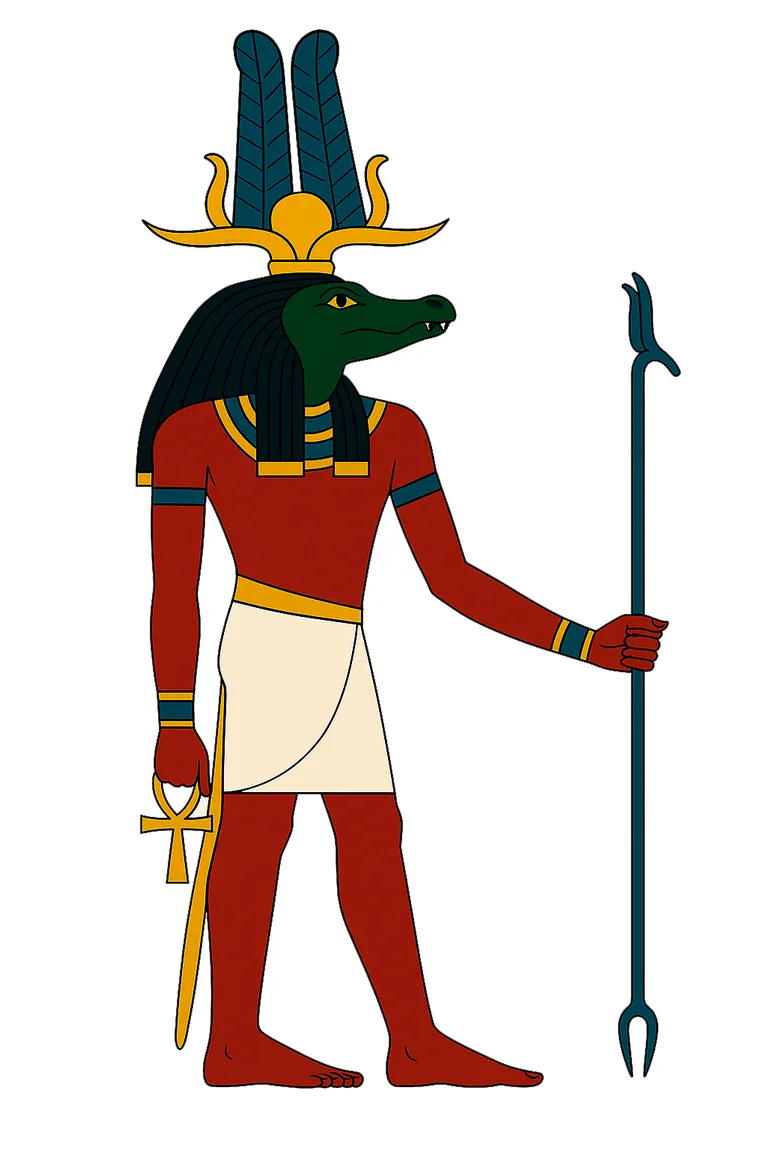
Sobek is the crocodile-headed god of ancient Egypt. He embodies the power of the waters of the Nile and the marshes, the fertility they bring and the fearsome strength of the animal that lives in them. Honoured from the first dynasties, he reached his peak in the Middle Kingdom, in the Faiyum, before sharing with Haroeris the double temple of Kom Ombo. The Greeks called him Souchos.
The lord of the waters
The Nile crocodile is a familiar and dangerous neighbour of those who live by the river. The Egyptians saw in it the image of a force that had to be appeased and won over. Sobek brings these two sides together: he threatens, but he protects; he rises from the water, and water is the condition of every harvest. His presence is thus linked to the flood and to the fertility of the banks.
His cult is very old. A seal impression from the time of King Narmer already shows crocodiles in front of a shrine whose shape would become the sign of Shedet, in the Faiyum. In the Old Kingdom, Sobek appears in the Pyramid Texts, where the goddess Neith is presented as his mother.
Shedet and the Faiyum
Shedet, the Crocodilopolis of the Greeks, is the great centre of the cult of Sobek. In the Middle Kingdom, the kings of the 12th Dynasty settled near the Faiyum and made its god a power of the state. Amenemhat III was buried at Hawara and built at Medinet Madi a temple dedicated to Sobek and to the harvest goddess Renenutet. The very name of Queen Sobekneferu, then those of the Sobekhotep kings of the 13th Dynasty, speak of the god’s favour.
In this period Sobek of Shedet was united with Horus, the god of kingship. The king, Horus on earth, thus associated himself with the crocodile god. Much later, the Greek geographer Strabo still described at Crocodilopolis a sacred crocodile fed by the priests in a pool of the temple.
Sobek-Ra, the creator
From the beginning of the Middle Kingdom, Sobek was also associated with the sun under the name Sobek-Ra. The Coffin Texts describe him as ‘he who rises in the east and sets in the west’. United with Ra, the god of the waters becomes a creator risen from Nun, the primordial ocean. He is then recognised by the sun disc and the uraeus on his head.
Kom Ombo and the local Sobeks
In the south, the Ptolemaic temple of Kom Ombo brings two cults together under one roof: the right half belongs to Sobek, accompanied by Hathor and Khonsu, the left half to Haroeris, Horus the Elder. Mummified crocodiles from the neighbouring necropolises are displayed there today in a small museum.
Sobek was never a single, uniform god. Each sanctuary honoured its own form: Sobek of Shedet, Sobek of Sumenu and Sobek of Gebelein south of Thebes, Soknebtunis at Tebtynis, Soknopaios in the north of the Faiyum. Recent research published by the IFAO shows that these regional cults formed a complex religious geography that Egyptologists are still reconstructing.
Recognising Sobek
Sobek most often appears as a man with a crocodile’s head and a tripartite wig. He frequently wears a crown of two tall plumes, with horns and sun disc, and holds the was sceptre and the ankh. He can also be shown as a crocodile lying on a base, sometimes crowned. As with other gods, the animal is not enough to identify him: the inscriptions and the place of worship remain decisive.
A god both feared and beneficent, Sobek is a reminder that the Nile feeds as much as it threatens. His long history, from the first kings to the Roman period, also shows how a local god could become, over the centuries, protector of the king, solar creator or lord of a single sanctuary.
Sources and references
- Maryan Ragheb (UCLA), The Rise of Sobek in the Middle Kingdom, American Research Center in Egypt
- Edwin Dalino, Amenouahsou et les deux Sobek de Gebelein, BIFAO 122, 2022, pp. 155–178 (in French)
- Gérard Godron, Deux objets du Moyen Empire mentionnant Sobek, BIFAO 63, 1965, pp. 197–200 (in French)
Reference works
- Richard H. Wilkinson, The Complete Gods and Goddesses of Ancient Egypt, London, Thames & Hudson, 2003, entry Sobek
- Christian Leitz (ed.), Lexikon der ägyptischen Götter und Götterbezeichnungen, 8 vols, Leuven, Peeters, 2002–2003 (Orientalia Lovaniensia Analecta 110–116 and 129)