In brief
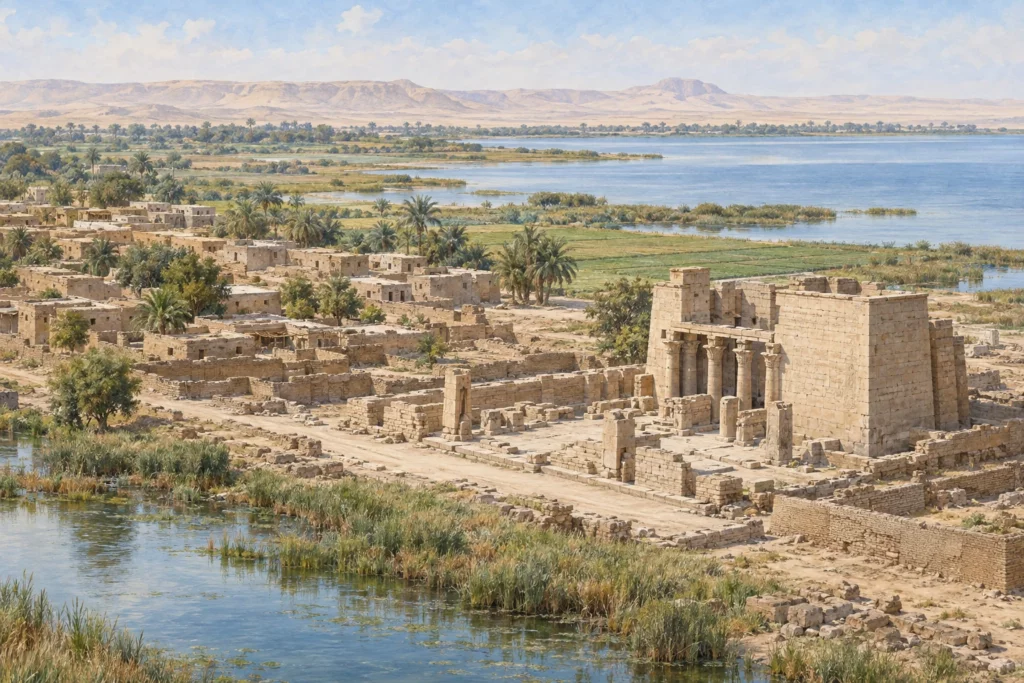
Tebtynis, Egyptian Tp-dbn, is now a vast mound of ruins called Kom Umm el-Breigat, on the southern edge of the Faiyum, about 170 kilometres south-west of Cairo. The village, whose foundation the Institut français d’archéologie orientale (IFAO, French Institute of Oriental Archaeology) places around 1800 BC, when the kings of the 12th Dynasty were developing the depression, remained for centuries the main centre of the south of the oasis. Its great sanctuary was that of Soknebtynis, a local form of the crocodile god Sobek. Driven out by the advancing desert, the last inhabitants left in the 12th century AD and founded, 6 kilometres to the north, a new village that still bears the old name: Tutun.
What you discover
The site does not appear as a temple standing on the edge of the desert, but as a town of mudbrick, levelled and dug over. At the beginning of the 20th century, papyrus hunters and then sebakh diggers, looking for the nitrogen-rich earth used as fertiliser, turned over very large areas. The French-Italian mission of the IFAO and the University of Milan, working on the mound since October 1988, has nevertheless found intact areas: previously unknown Ptolemaic quarters, a large grain store of the 2nd century BC, public baths, two large bakeries of the 4th and 5th centuries AD, a chapel of Thermouthis and a desert police post. Nearly 10,000 texts on papyrus and potsherds, in Egyptian, Greek, Aramaic, Coptic and Arabic, have been recovered there.
What to look at
The axis of the place is the sacred way, the dromos, leading to the temple of Soknebtynis cleared by Carlo Anti’s Italian mission between 1931 and 1934. Vincent Rondot’s study has shown that this way was designed for the procession of the mummy of the sacred crocodile. The temple itself holds a surprise: the sanctuary excavated in the 1930s, long thought to date from the early Ptolemaic period, actually dates from the 1st century BC; beneath its remains, the present mission has found the first temple, built under Ptolemy I. Two states of the same place of worship are thus superimposed on the same spot.
The second detail concerns the crocodiles. On 16 January 1900, the workmen of Bernard Grenfell and Arthur Hunt reached, on the edge of the human necropolis, a cemetery of mummified crocodiles. One of them, broken by a workman, turned out to be wrapped in sheets of papyrus. Of more than a thousand animals exhumed, 31 contained reused papyri in this way.
Its history
Grenfell and Hunt excavated in 1899–1900 for the University of California, thanks to funding from Phoebe Apperson Hearst; their papyri are kept in the Bancroft Library at Berkeley. Evaristo Breccia worked on the site for four weeks in 1929 for the University of Florence. Carlo Anti and Gilberto Bagnani, at the head of the Royal Italian Archaeological Mission, then excavated it from 1930 to 1936. Besides the temple, they discovered in 1931 two cellars full of papyri, then located in 1933 a convent and a church covered with frescoes. After their departure, the site was left for fifty years without archaeologists, at the mercy of the fertiliser diggers.
Many questions remain. The earliest phases of the village are still poorly known, and the organisation of the different sanctuaries, including the crocodiles dedicated to the god, continues to be clarified with each season.
Sources
Consulted on 30 September 2026: Tebtynis, une ville gréco-romaine au sud du Fayoum, Institut français d’archéologie orientale (in French); History of the Tebtunis Papyri Collection, Bancroft Library, University of California, Berkeley; Vincent Rondot, Tebtynis II. Le temple de Soknebtynis et son dromos, Institut français d’archéologie orientale, 2004.