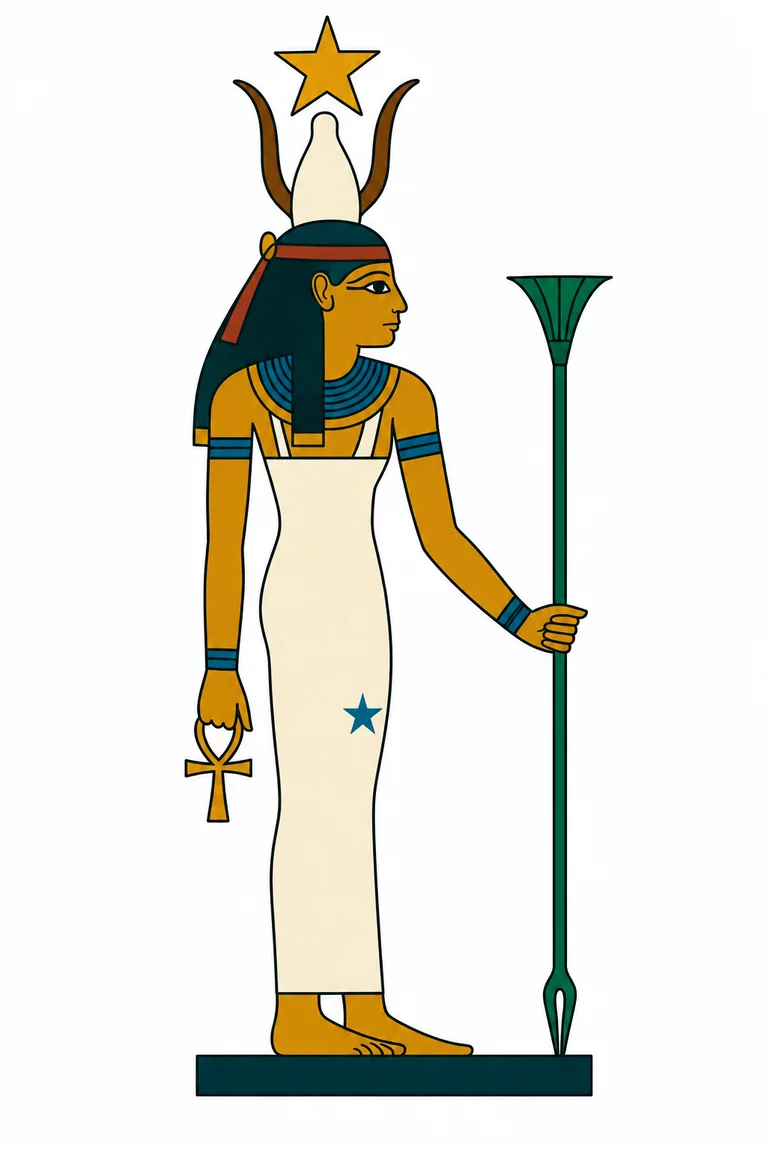
A star named by the Egyptians
Sopdet is the Egyptian name of a goddess associated with Sirius, the bright star that Greek authors called Sothis. Her identity thus joins a divine presence to a phenomenon visible in the sky. This star cannot be seen all year round in the same conditions: after a period of invisibility, it can reappear near the horizon just before dawn. The Egyptians observed this so-called heliacal rising and linked it to the ordering of time. The Metropolitan Museum explains its place among the landmarks of the year and in thinking about renewal.
The return of Sirius was linked to the seasonal rise of the Nile. This link does not mean that the star physically caused the flood; it is an observed coincidence charged with religious meaning. The date of the heliacal rising varies with latitude and period. The Egyptian civil calendar, of 365 days with no leap day, also drifted against the solar year. It would therefore be wrong to give a single modern date valid for the whole of Egyptian history. Sopdet helps us understand how an astronomical landmark could enter a calendar that was lived and celebrated.
Calendar, flood and renewal
The inundation brought the water and silt the cultivated land needed. The return of Sopdet may have symbolised the expectation of this renewal. The Metropolitan Museum links the rising of Sirius to the beginning of the year in some Egyptian traditions, while explaining the difficulties raised by the different calendars. Watching the sky was not detached from human work. It offered a sign for thinking about the regularity of the seasons, the festivals and the hopes that went with the river. Hapy, for his part, personified the power of the inundation itself.
The goddess is not, however, reduced to a dating tool. A relief in the Carlos Museum names her as a divine figure and shows her in the language of religious images. The inscriptions give the figure an identity that could not be deduced from a star drawn on its own. Depending on the texts, Sopdet can be brought close to other great goddesses, notably Isis, without necessarily losing her own name. These associations are ways of linking several powers and functions, not proof that their cults were always identical.
Seeing Sopdet in images
The standing figure offered here gives Sopdet a human silhouette and a starry headdress. It lets the reader recognise her within a series designed for the gods and goddesses of the site. This star is a contemporary reading; ancient works vary and must be explained from their inscriptions. An attractive image of the sky would not on its own document an astronomical practice. The ancient relief cited in the sources offers a concrete point of comparison and keeps our illustration from becoming a false archaeological witness.
Sopdet finally shows that Egyptian religion also looked to the sky to order the experience of time. Each return of Sirius could evoke the possibility of a new year, but modern calculations must remain attentive to the period, the place and the type of calendar concerned. The Greek name Sothis often appears in books; it designates the same deified star. Reading museum entries, objects and observations of the sky together allows us to keep the richness of this goddess without giving her a fixed date or a single interpretation.
Sources and references
- Metropolitan Museum, telling time in ancient Egypt
- Carlos Museum, relief of Sopdet
- Global Egyptian Museum, Sopdet
Reference works
- Richard H. Wilkinson, The Complete Gods and Goddesses of Ancient Egypt, London, Thames & Hudson, 2003, entry Sopdet
- Christian Leitz (ed.), Lexikon der ägyptischen Götter und Götterbezeichnungen, 8 vols, Leuven, Peeters, 2002–2003 (Orientalia Lovaniensia Analecta 110–116 and 129)