In brief
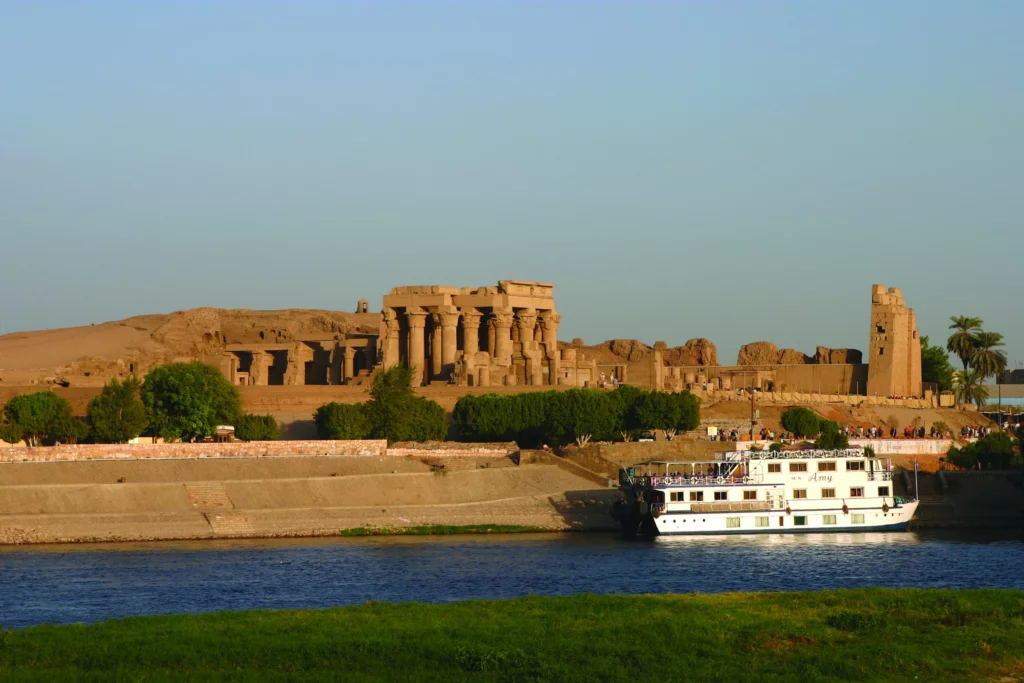
The temple of Kom Ombo rises on the bank of the Nile, in the Aswan region. Its name combines the Arabic kom, ‘mound’, with Ombo, derived from the Egyptian Nubt, ‘the golden one’. It is dedicated to two gods: Sobek, the crocodile god, and Haroeris, Horus the Elder, falcon god of kingship. The visible monument dates from the Graeco-Roman period: Ptolemy VI Philometor is the first sovereign whose name is attested there, Ptolemy XII had most of the decoration carried out, and additions continued under the Romans. The town then controlled the trade routes towards Nubia.
What you discover
You arrive at a monument that has lost its entrance. Of the pylon, erected in the 1st century AD, and of the court that followed it, only foundations and column shafts of the reign of Tiberius remain; these fragments of the peristyle have kept reliefs in their original colours. In front of the site of the pylon, towards the river, the mammisi of the 2nd century BC is reduced to the base of its walls.
Beyond, the plan recalls that of Edfu, with one distinctive feature: two parallel axes cross the columned halls and lead to two sanctuaries, that of Sobek to the south and that of Haroeris to the north. This does not, however, make them two temples set side by side. The rooms preceding the sanctuaries, the hall of appearances, the middle hall, the offering hall and the hall of the Ennead, are shared by the two gods, as are certain annexes, the wabet and the treasury. In the offering hall, Sobek and Haroeris receive the king’s homage side by side, and in each sanctuary the occupant welcomes his partner, who is well present in the decoration.
What to look at
Behind the sanctuaries, several rooms fitted out under Ptolemy VIII remained unfinished. Their decoration makes it possible to follow, from one wall to the next, the successive stages of the sculptors’ work, which the finished rooms no longer reveal.
On the walls, other scenes catch the eye: festival calendars listing the rites of the year, and a Roman-period relief, dated to the 2nd century AD, showing a series of instruments often interpreted as surgical. This attractive reading remains debated and does not allow us to conclude that there was a hospital in the temple.
Its history
The place of worship is much older than the temple. The oldest inscription mentioning the site goes back to the First Intermediate Period, and architectural fragments bear the cartouches of Amenhotep I and Thutmose III: a sanctuary already existed in the New Kingdom.
The temple was cleared in 1895. Jacques de Morgan, with Urbain Bouriant, Georges Legrain, Gustave Jéquier and Alexandre Barsanti, published its documentation between 1894 and 1909, an edition containing errors and gaps. From 1953 to 1961, the Egyptologist A. Gutbub led five seasons there to gather the inscriptions, before undertaking their systematic recording; the first volume of the new publication, Kom Ombo I, appeared in 1995 at the Institut français d’archéologie orientale (IFAO, French Institute for Oriental Archaeology). Since 2010, a team assembled by the Supreme Council of Antiquities around Shafia Bedier and Françoise Labrique has continued this work, in collaboration with the IFAO since 2012. A large part of the decoration therefore remains to be published and translated.
Sources
Consulted on 30 September 2026: Kom Ombo, Institut français d’archéologie orientale (in French); Pharaonic temples in Upper Egypt from the Ptolemaic and Roman periods, Tentative List, UNESCO; Kom Ombo Temple, Egyptian Ministry of Tourism and Antiquities.