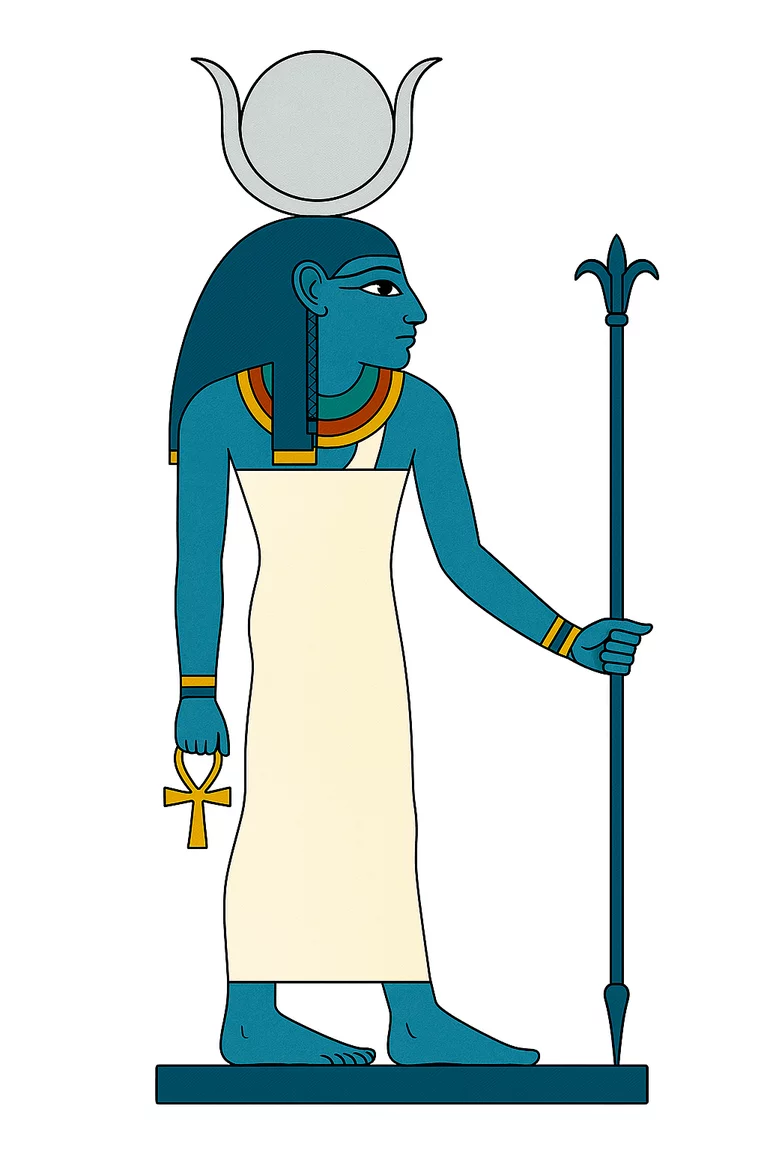
Khonsu is a lunar god of particular importance at Thebes. With Amun and Mut he forms the Theban triad, in which he often appears as their son. The lunar crescent and disc of his headdress make his function instantly recognisable. His name is linked to a verb meaning ‘to traverse’ or ‘to travel’, an image that suits the movement of the moon across the sky. The rhythms of the moon played a part in measuring time and in ritual life.
A member of the triad of Thebes
The main cult place of Khonsu lay within the vast complex of Karnak. A triad is not just a portrait of a divine family: it organises festivals, sanctuaries and the relationships between several powers. Amun, Mut and Khonsu could receive separate statues, offerings and processions while forming a whole. This place as son does not exhaust the god’s identity, whose lunar and protective functions go beyond the family story alone.
The Global Egyptian Museum mentions Khonsu under the title Neferhotep at Thebes. Titles and local forms matter: the same divine name can take on a different nuance depending on its sanctuary. The reliefs and inscriptions of Karnak allow his cult to be placed within a real architecture. They also show that Theban religion changed over the dynasties instead of keeping a fixed organisation throughout Egyptian history.
The moon and time
The movement and phases of the moon brought Khonsu close to the measuring of time. The Global Egyptian Museum entry indicates that he can determine years of life or of reign. This function does not mean that he was the only god of time. Thoth also has strong links with the moon, writing and calculation. The two deities can be brought together, but their images and cults keep distinct characteristics.
The moon is also a light of the night. In some contexts Khonsu is linked to the sun or to other celestial figures. Egyptian traditions like to express a single phenomenon through several gods and several moments. It would be misleading to place Khonsu in an astronomical system entirely separate from the solar cult. The light of day and the light of night can enter into dialogue in the texts.
The young protective god
Khonsu is sometimes shown as a child with a sidelock of youth and a wrapped body, or as a falcon-headed man. Our illustration takes up the human form with the lunar headdress. Late scenes bring him close to the young Horus, especially in contexts of protection and healing. This closeness does not make every portrait of a divine child an image of Khonsu.
His protective power concerns threats and illnesses. The healing stories associated with him show how a celestial power could also intervene in human life. We should nevertheless avoid turning all the traditions into a single spectacular story. Cult objects, inscribed titles and temple scenes give surer evidence of his functions than isolated anecdotes handed down late.
The travelling god thus links sky, city and body. His lunar course provides an image of time; his temple places him in Theban life; his protective roles bring him close to the concerns of worshippers. Recognising Khonsu means observing together his headdress, his sometimes childlike form, his name and the place of the object.
Sources and references
Reference works
- Richard H. Wilkinson, The Complete Gods and Goddesses of Ancient Egypt, London, Thames & Hudson, 2003, entry Khonsu
- Christian Leitz (ed.), Lexikon der ägyptischen Götter und Götterbezeichnungen, 8 vols, Leuven, Peeters, 2002–2003 (Orientalia Lovaniensia Analecta 110–116 and 129)