A woman exercising kingship
Sobekneferu, also called Neferusobek, reigned at the end of the 12th Dynasty. She bore a full royal titulary and is among the women whose exercise of pharaonic power is attested by contemporary monuments. The length and exact form of her rule remain debated; it is not known for certain whether she always reigned alone or whether an association with Amenemhat III or Amenemhat IV should be considered. Her tomb has not been identified. The surviving remains are fewer than those of Hatshepsut, but they are enough to rule out the idea of a merely legendary figure. Her history calls for particular attention to titles, find-spots and the limits of dynastic reconstructions. In the chronology of Ian Shaw (Oxford, 2000), her reign falls c. 1777–1773 BC.
A titulary that asserts authority
Sobekneferu used the royal names that defined Egyptian sovereignty. Her throne name, Sobekkare, associates the gods Sobek (in French) and Ra; a relief fragment from Hawara shows her name accompanied by the title ‘daughter of Ra’. This formula is important because it adapts to the feminine an essential element of the royal titulary. It should not be isolated from the rest of the names and epithets: authority was expressed through a whole set of signs, rites and monuments. The inscriptions show how a woman could hold the office of king while marking her identity in certain forms of official language. They do not, however, reveal her daily decisions or a complete theory of the succession.
Hawara and the memory of the Faiyum
The relief bearing the name of Sobekneferu found at Hawara links her record to the Faiyum region, strongly marked by the programme of Amenemhat III. This geographical proximity does not allow all the works of her predecessor’s complex to be attributed automatically to the queen. It shows that she took her place in a royal landscape already charged with memory. The stone fragments must be dated and placed according to their find context, since a block may have been moved or reused. The Hawara attestation remains valuable: it provides material proof of the titulary and of the ruler’s symbolic presence in a region central to the end of the 12th Dynasty.
The statues from Qantir
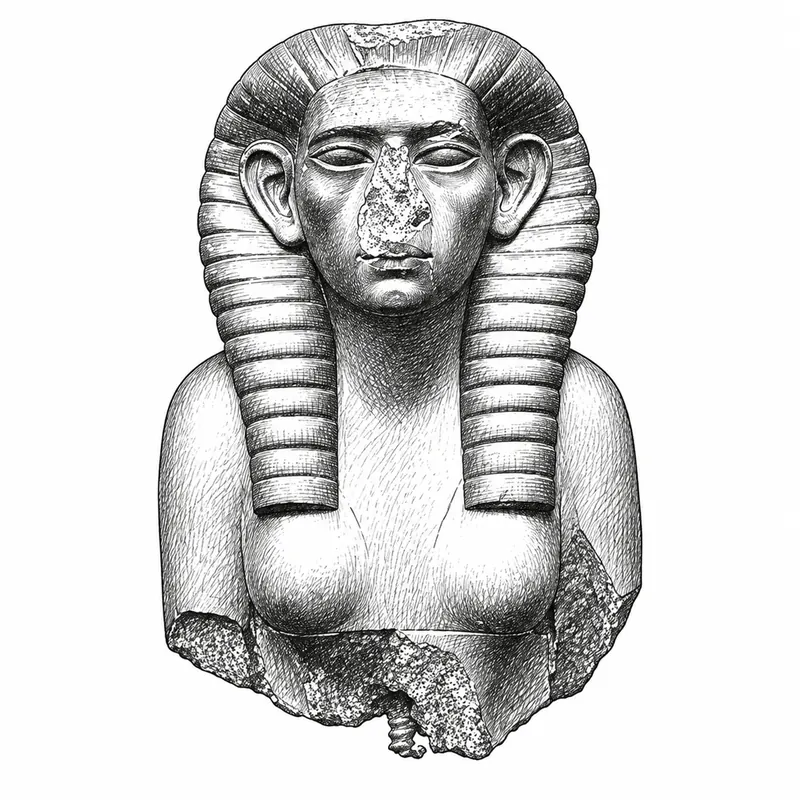
Statues attributed to Sobekneferu were found at Qantir, in the eastern Delta. Their existence widens the map of attestations beyond the Faiyum. Royal sculptures did not merely reproduce a person’s features; they made the ruler present in political and religious settings. Their fragmentary state and history of displacement call for caution in reconstructing their original location. They nevertheless confirm that the reign cannot be reduced to an entry in a king list. The queen had official images able to carry her titulary and to take part in the representation of the state. Their study complements that of the reliefs and seals, even where the associated architecture has disappeared.
A tomb still unknown
The burial of Sobekneferu has not been identified with certainty. Several attributions of monuments have been discussed, but the absence of a decisive inscription rules out presenting any of them as established. This gap contrasts with the well-known pyramids of some rulers of the 12th Dynasty. It may be due to the loss of buildings, to their location in less well-preserved regions or to the history of excavation. It does not prove that the queen was deprived of royal funerary rites. The distinction between an unknown tomb and a non-existent tomb is essential. It avoids turning a lack of archaeological documentation into a political narrative about the end of the dynasty.
The transition to the 13th Dynasty
Sobekneferu is often presented as the last ruler of the 12th Dynasty. The king lists and modern chronologies make this position visible, but the concrete circumstances of the transition to the 13th Dynasty remain poorly known. For lack of evidence, all the political transformations that followed cannot be attributed to her reign. Comparing her monuments with those of neighbouring rulers rather allows us to measure the continuities of titulary and administration. The question of her family ties with Amenemhat III and Amenemhat IV has given rise to various hypotheses. Only contemporary documents can set their limits; genealogical reconstructions should not become certainties repeated without a source.
A singular place in history
Sobekneferu is important on two counts. She shows that a woman could exercise pharaonic kingship with the official names and images of that office. She also allows us to study the end of a dynasty whose sources are less abundant than the great monuments of the preceding reigns. Her record brings together a titulary, reliefs, statues and open questions about the succession and the burial. Comparing it with that of Hatshepsut can be useful, provided that the reality of her power is not measured solely by the number of surviving monuments. The history of Sobekneferu rests on modest but decisive evidence, and on a clear acknowledgement of what that evidence does not yet allow us to conclude.
Main sources
- UCL Digital Egypt, Sobekneferu
- UCL Digital Egypt, the royal personal name
- UCL Digital Egypt, kings of the Middle Kingdom
- Model for the line portrait: 1914 photograph of the female royal bust Berlin ÄM 14475, lost during the Second World War.
Reference works
- Ian Shaw (ed.), The Oxford History of Ancient Egypt, Oxford, Oxford University Press, 2000, chronology pp. 479–483
- Aidan Dodson and Dyan Hilton, The Complete Royal Families of Ancient Egypt, London, Thames & Hudson, 2004