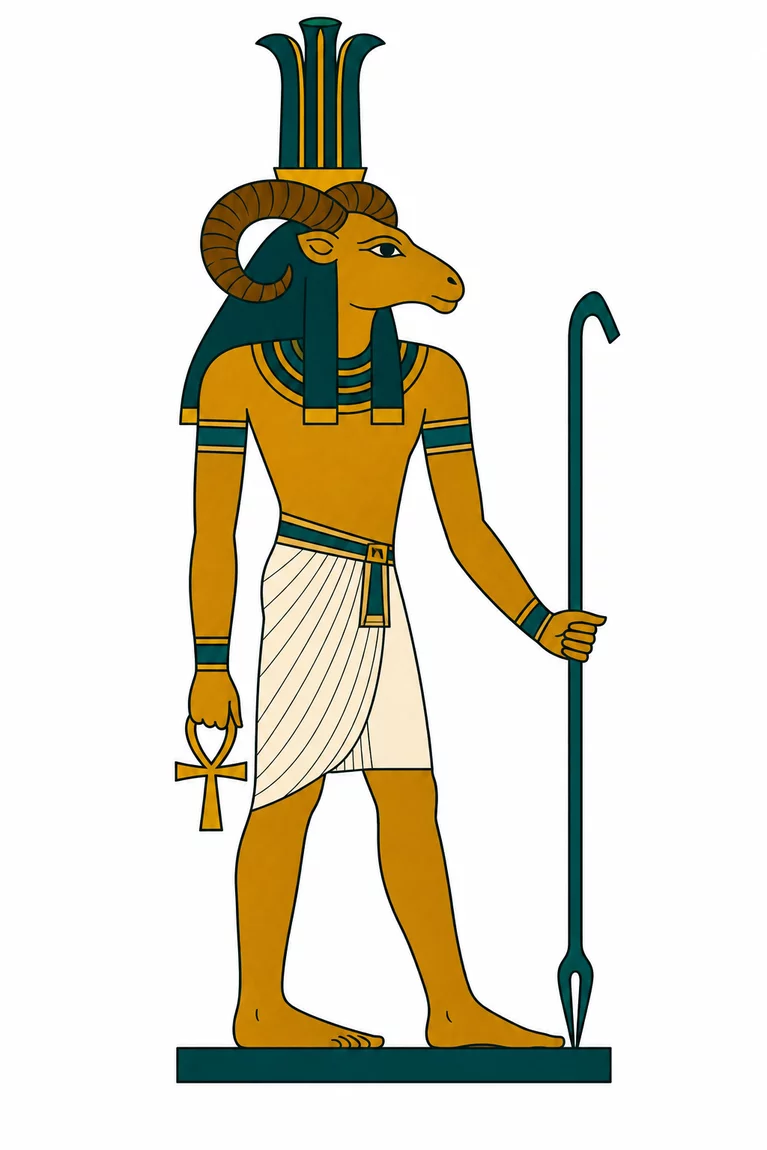
Banebdjedet is the ram god of Mendes, in the Nile Delta. His name refers to the ‘ba of the lord of Djedet’, a formula often translated as the soul of the master of the city. This translation helps us into his world, but the Egyptian word ba is not an exact equivalent of our idea of an individual soul. Banebdjedet shows how a divine power, a sacred animal and the identity of a city could answer one another within one religious tradition.
Mendes, a centre of the Delta
Mendes is the Greek name of a Delta city called Djedet in the Egyptian sources. This landscape of Nile branches and cultivated land gives a concrete setting to the cult of Banebdjedet. Local traditions have their own history, sometimes different from that of the great sanctuaries of Thebes or Heliopolis. The ram god held a pre-eminent place there. Animals associated with the sacred and their images have left material traces that allow this cult to be studied beyond the mythical stories alone.
An object entry in the Global Egyptian Museum describes a model ram mummy and recalls that Mendes was the centre of the cult of Banebdjedet. The document distinguishes this god from Khnum, another great ram-formed deity linked in particular to Elephantine and Esna. The presence of horns in an image is therefore not enough to identify a god. The place, the written name and the associated objects are essential.
An animal and a divine presence
The ram can evoke vigour and fertility. That does not mean that Banebdjedet was merely an allegory of reproduction. For the Egyptians, a sacred animal could manifest a divine power in a particular cult context. Figurines, temple images and animal burials are not all interchangeable: they answer acts and expectations specific to each period.
Banebdjedet is an important god of Mendes, linked to vital power. The contemporary illustration on this page gives him a human body and a ram’s head so as to make this association instantly legible. It does not reproduce an ancient statue. Ancient images may take other forms; a single modern silhouette never sums up the whole repertoire of a cult.
Beside Hatmehit
Another Mendesian deity is Hatmehit, ‘the foremost of the fish’. The Global Egyptian Museum indicates that her local cult was partly eclipsed by that of Banebdjedet and that she was later presented as his consort. This relationship shows that a local pantheon could reorganise itself. A god gains in importance, a goddess changes her place in the stories, but the two names can go on coexisting.
Hatmehit is sometimes linked to the cycle of Osiris and brought close to Isis. These associations do not justify automatically attributing all the Osirian stories to Banebdjedet. They rather bear witness to the circulation of religious themes between the Delta and other cult centres. The links between deities were built up over texts and rites.
A god to be read in his sources
Short summaries sometimes link Banebdjedet to several episodes and practices without giving precise evidence. To tell his story accurately, it is better to start from attestations that can be checked: Mendes as a cult centre, the ram form, the relationship with Hatmehit and the surviving objects. The more detailed traditions need to be placed in their document, their date and their context before being presented as general.
Banebdjedet is also a reminder that animals do not play a uniform role in Egyptian religion. The ram of Mendes is not simply a variant of the ram of Khnum; each is tied to a city and to its own network of relationships. The animal image provides a way in, while enquiry into the place and the objects reveals the historical depth of the god.
Sources and references
Reference works
- Richard H. Wilkinson, The Complete Gods and Goddesses of Ancient Egypt, London, Thames & Hudson, 2003, entry Banebdjedet
- Christian Leitz (ed.), Lexikon der ägyptischen Götter und Götterbezeichnungen, 8 vols, Leuven, Peeters, 2002–2003 (Orientalia Lovaniensia Analecta 110–116 and 129)