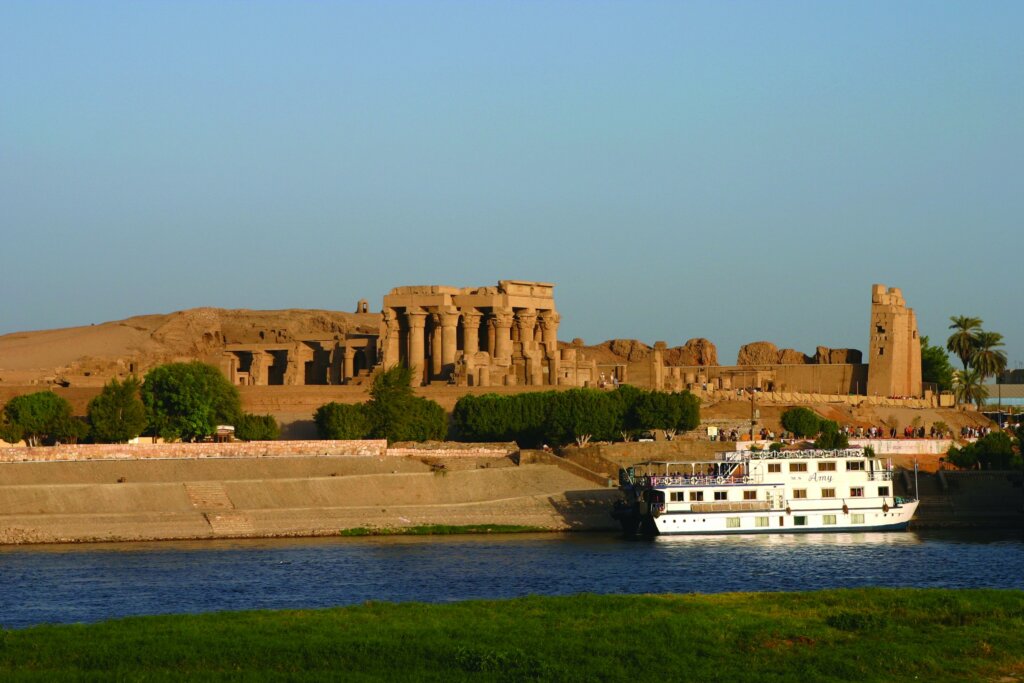
Kom Ombo appears at sunset; we shall visit it during the night. At Edfu, the next day, the horse-drawn carriages are waiting for us. From one stop to the next, the journey changes its rhythm.
A temple beneath the moon
In the last rays of the sun, Kom Ombo appears on its mound, some fifty kilometres north of Aswan. The boats moor at the foot of the temple. After a day spent watching the banks, I am at last going to walk in what I saw coming from afar. It will be dark during the visit.
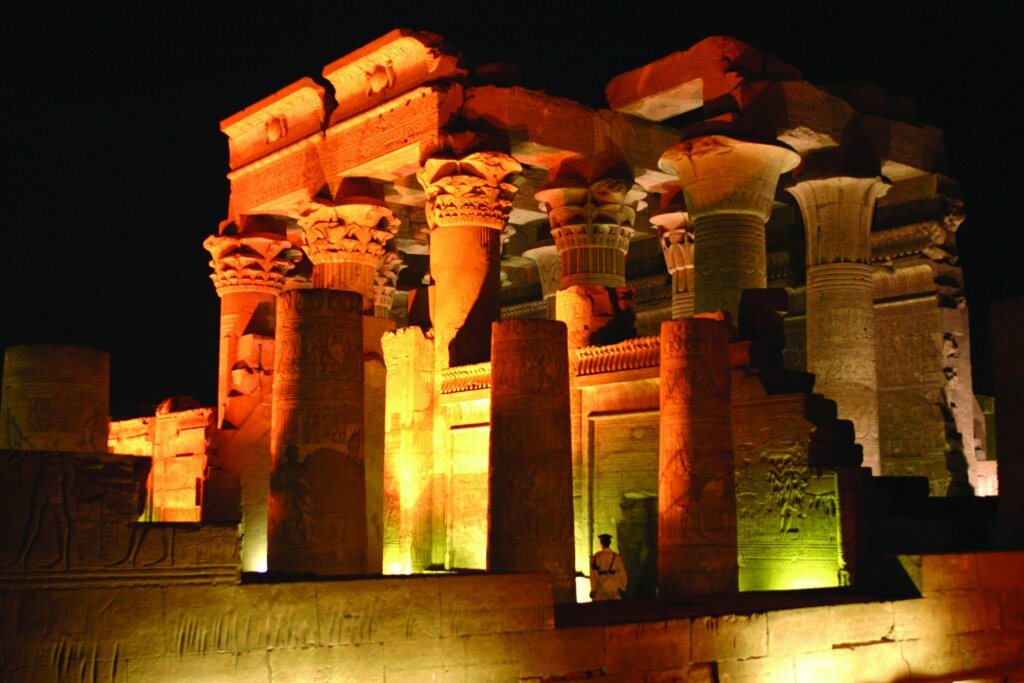
The floodlights sharpen the angles and deepen the shadows. I look up and, for a moment, the ceiling seems whole to me: the carved stars join those of the sky. I think of Nut, mistress of the firmament. Then the full moon rises on the horizon and breaks the illusion. The roof is open, the walls have collapsed in places. I find the ruins again, without entirely losing what I have just seen in them.
The falcon and the crocodile
Next I need to understand where I am going. Here, the temple is doubled: Horus the Elder, the falcon god, on one side; Sobek, the crocodile god, on the other. Two doorways in the pylon, two axes, two sanctuaries. As I pick out this layout, the night walk becomes easier to read.
A guard comes over to chat and suggests another way of visiting. For a modest sum, he will take me into the ‘secret passage’ between the sanctuaries. Dozens of mummified crocodiles are said to sleep there, visible by the light of his storm lantern. The offer inspires only limited confidence in me. The mummies in the chapel of Hathor are enough for me; I leave the secret to its guardian.
There are no longer any crocodiles to be expected in the river at this point: they have been pushed back beyond the dam, towards Lake Nasser. Falcons, for their part, are still sought after for falconry. As I leave Kom Ombo, I think again of these two gods and of the very earthly fate of their animals.
Today: the mummified crocodiles of Kom Ombo are displayed in a small museum at the foot of the temple.
Edfu, the perfect temple
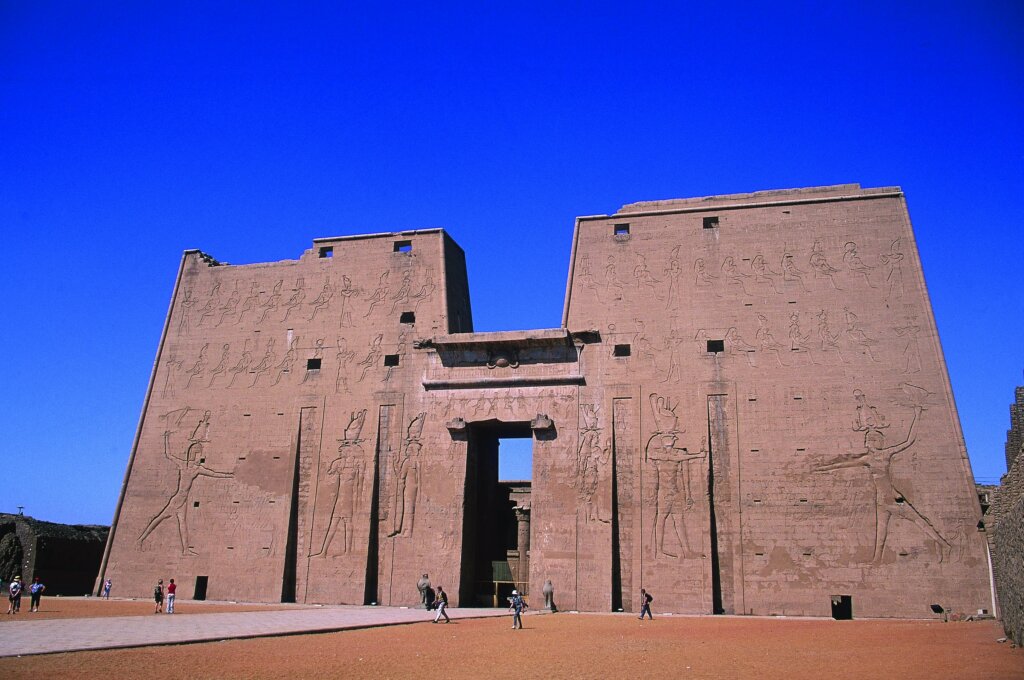
In the morning, Edfu abruptly brings us back to the bustle of a town. A swarm of carriages lies in wait for the passengers; the drivers fight over the arrivals. Then comes the temple of Horus. After this disorderly ballet, its facade calls for a halt. The pylon rises to thirty-six metres, and granite falcons guard the entrance. I feel small even before passing through the gateway.
This temple, cleared by Auguste Mariette in the 1860s, had been invaded by sand and houses. Today it is the best preserved in Egypt. Nearly two centuries, from 237 to 57 BC, were needed to build it under the Ptolemaic kings. These dates take on meaning when I look at the regularity of the whole: at Kom Ombo, the night helped me to restore what was missing; here, almost everything is still before me.
Towards the darkness
I cross the court, then move from hall to hall. The spaces shrink, the ceilings come lower, the light withdraws. All the way to the naos, the temple makes me follow a path whose effect I feel before I understand its detail. On the walls, the festivals still await their colours and processions: Hathor coming from Dendera to join Horus, her husband, the falcon god triumphing over Seth. I came in amid the uproar of the carriage drivers; here I am in the darkness, imagining the return of a procession.
To go further: Kom Ombo, the temple of two paths (in French) · Kom Ombo (archaeological site) · Edfu, in the footsteps of Horus (in French) · Edfu (archaeological site) · Horus (in French) · Nut (in French) · Hathor (in French) · Auguste Mariette (in French) · Sobek (in French)