In brief
Medinet Madi, in the Faiyum, preserves one of the rare Middle Kingdom temples to have come down to us with their texts and reliefs. Amenemhat III, a king of the 12th Dynasty, founded the town of Dja and its sanctuary together, as part of a project to increase the agricultural resources of the region; his successor Amenemhat IV continued the work. The temple was dedicated to Renenutet, the cobra goddess, mistress of the harvest and protector of the king, to Sobek, the crocodile god and lord of the region, and to Horus ‘who resides in Shedet’. In the Graeco-Roman period, Dja took the name Narmouthis, ‘the town of Renenutet’; the Arabic name Medinet Madi means ‘the town of the past’.
What you discover
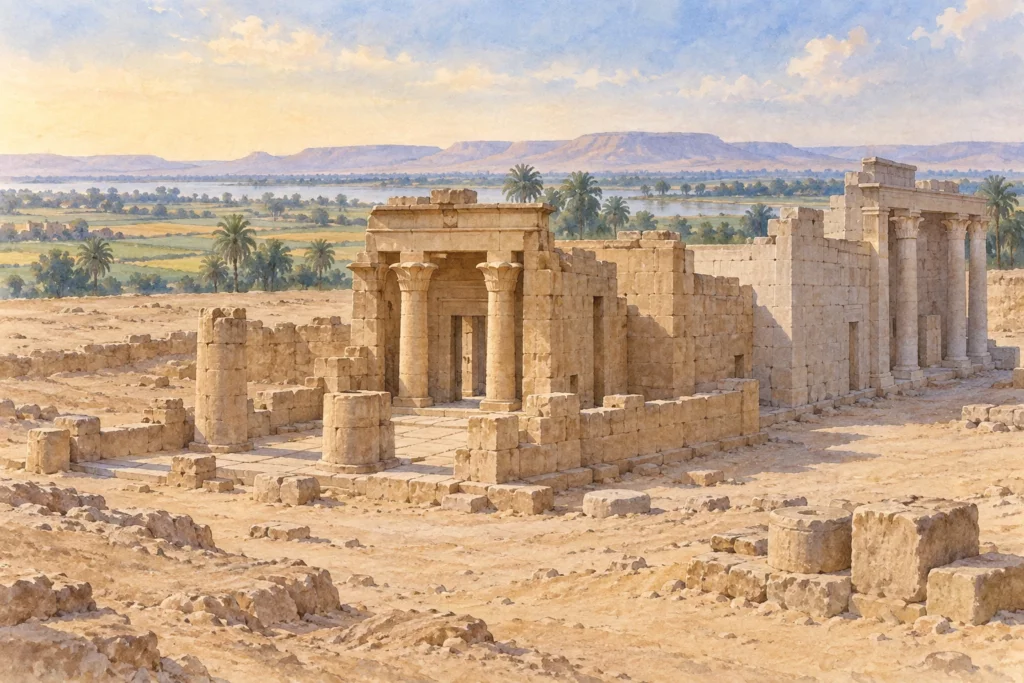
Today the sanctuary is approached along a long processional way, cleared of sand over 230 metres and lined with sphinxes; the University of Pisa mission uncovered there four statues of lions and a statue of a lioness, with no known parallel. This avenue and the buildings in front of the temple are Ptolemaic: three courts, a vestibule, a second temple attached to the north and a thick, high mudbrick enclosure wall were added, probably under Ptolemy IX Soter II. The Middle Kingdom core lies at the back of this complex. Its plan, rectangular and very simple, comprises a hall with two columns, then a transverse hall opening onto three chapels.
What to look at
The contrast between the walls deserves attention. According to Sergio Donadoni, reliefs of great delicacy cover the inner walls, while the outer faces were left bare. The scenes show the two founding kings, Amenemhat III and Amenemhat IV, which makes it possible to follow the continuity of the work from one reign to the next.
The memory of the founder can also be read in the later additions. Achille Vogliano found on the site four hymns in Greek composed by Isidorus, a Hellenised Egyptian, in honour of Isis-Thermouthis and of Amenemhat III, the founder of the temple. A statue of the king from the sanctuary, now in Milan, shows him seated on a block throne, wearing the nemes headdress. He probably held on his knees a small naos sheltering the image of the temple’s goddess. His cartouches are carved on the throne, on either side of the legs.
Its history
The temple was cleared between 1935 and 1939 by Achille Vogliano, a papyrologist at the University of Milan, until the Second World War halted the work. The University of Pisa mission, directed by Edda Bresciani, worked systematically on the site from 1978, and more intensively from 1995. It revealed the scale of the late occupation: a Ptolemaic temple dedicated to two crocodiles, with a ‘nursery’ where dozens of eggs were found, ten early Christian churches of basilican plan dated to the 5th and 6th centuries, and a Roman military camp of the late 3rd century AD. Between 2005 and 2008, a conservation programme funded by Italy removed about 35,000 m³ of sand.
Several questions remain open, in particular the exact chronology of the Ptolemaic enlargements and the link between the temple, the town of Dja and the agricultural development of the Faiyum.
Sources
Consulted on 30 September 2026: Medinet Madi, Egittologia, Università di Pisa (in Italian); Statua di Amenemhat III, Civico Museo Archeologico di Milano; Sergio Donadoni, ‘Medinet Madi’, Enciclopedia dell’Arte Antica, Treccani, 1961 (in Italian).