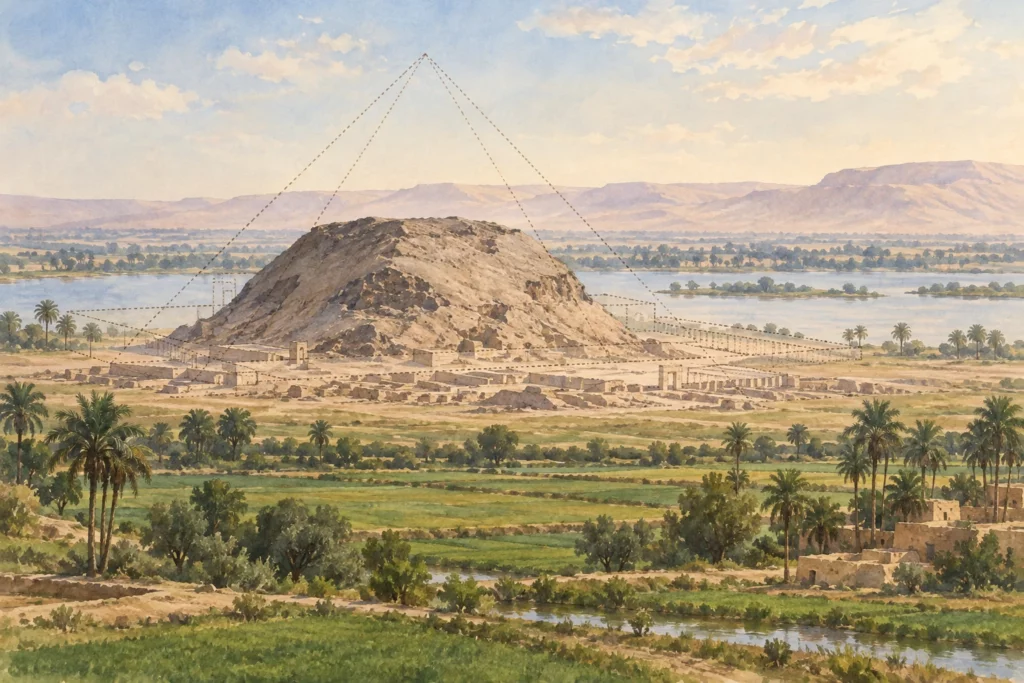
In brief
The pyramid of Hawara occupies a spur of the desert plateau bordering the entrance to the Faiyum depression. Amenemhat III, a king of the 12th Dynasty, had it built towards the end of his reign, after abandoning a first pyramid at Dahshur because of construction problems; it was at Hawara that he was buried. South of the monument stretched a vast mortuary temple, most often identified with the ‘Labyrinth’ that ancient authors judged even more impressive than the Great Pyramid. Around it, a necropolis remained in use until the Roman period.
What you discover
The pyramid is now no more than a hill of mudbrick. Petrie showed that its bricks, made of Nile silt deposited a few hundred metres away, were laid in beds of yellow sand, and that the whole was covered with a casing of fine limestone. This casing has entirely disappeared, as has almost all the paving; according to his surveys, the brick base measured nearly 94 metres a side.
Of the neighbouring temple, all that remains is a vast expanse of stone chips. As early as 1888, Petrie noted that the site had served as a quarry throughout the Roman period and that the plan of the building was probably lost for ever. A modern canal, first recorded in 1837, now crosses the site of the Labyrinth.
What to look at
The entrance to the pyramid is not on the north, as in the pyramids Petrie knew, but on the south face, between the middle and the south-west corner. Unable to find it, in 1888 he drove a tunnel through the brick to the centre, then reached the burial chamber the following year through a passage forced by ancient robbers. He discovered a route of corridors interrupted by stone trapdoors, then a chamber cut from a single block of sandstone brought from Upper Egypt, whose weight he estimated at more than a hundred tonnes, lowered into a pit before the pyramid was built. It held a large sarcophagus and a second one, added at the side, attributed to a daughter of the king. The chamber was flooded; a fragment of an alabaster vessel bearing the cartouche of Amenemhat III confirmed the identity of the owner.
A more discreet detail concerns the history of the building work: in his tunnel, Petrie recorded on two bricks marks painted in red, measuring marks drawn during construction to check the axis of the building.
Its history
Amenemhat III was worshipped as a god in the Faiyum, notably in the Ptolemaic and Roman periods. The necropolis received burials in the New Kingdom and the Late Period, and Herodotus visited the site in the 5th century BC. The dismantling of the Labyrinth may have begun under Ptolemy II, when ancient Shedet, renamed Arsinoe, was the subject of a vast building programme. In the Roman period, Hawara served as the necropolis of the Faiyum elite: Petrie discovered there in 1888–1889, then in 1910–1911, the encaustic portraits placed over the faces of mummies, a group that became famous as the ‘Faiyum portraits’.
The appearance of the Labyrinth remains a riddle. Petrie proposed a plan of it, while Dieter Arnold, in 1979, compared it with Djoser’s enclosure at Saqqara; neither of these reconstructions can be verified on the ground.
Sources
Consulted on 30 September 2026: W. M. Flinders Petrie, Kahun, Gurob, and Hawara, London, Kegan Paul, Trench, Trübner, 1890 (Internet Archive digitisation); The nineteenth and early twentieth century work at Hawara, Petrie Museum of Egyptian Archaeology and Centre for Advanced Spatial Analysis, University College London; Amenemhat III, Digital Egypt for Universities, University College London.