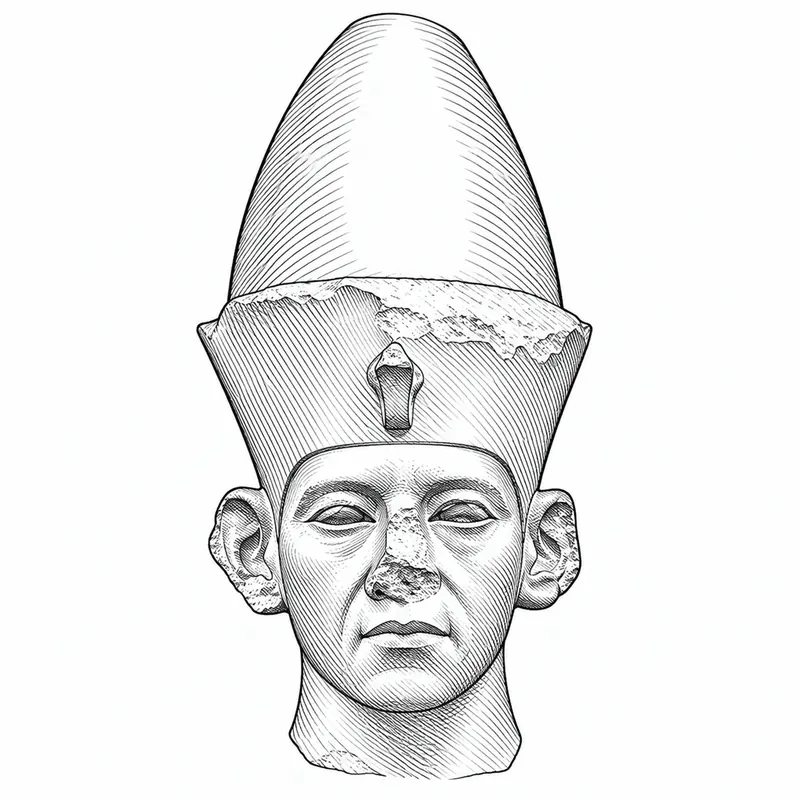
A long reign of the 12th Dynasty
Amenemhat III succeeded Senusret III and reigned for several decades within the 12th Dynasty. His record is particularly rich in the Faiyum region, where he had a pyramid built at Hawara as well as several monuments. A first pyramid had been begun at Dahshur, but it did not become his final burial place. The dates proposed for his reign vary between chronologies, while a length of about forty-five years is often accepted. The king’s statues, the temples and traces of mining activity allow him to be studied from several angles. The documentation nevertheless requires distinguishing the works carried out under his authority from his much later veneration in the Faiyum. In the chronology of Ian Shaw (Oxford, 2000), his reign falls c. 1831–1786 BC.
The first pyramid at Dahshur
Amenemhat III had a pyramid built at Dahshur, sometimes called the Black Pyramid because of its present appearance. Problems linked to the ground and the structure have been invoked to explain why the king then chose another burial place. The technical details of this decision are still being studied; it would be excessive to reduce the story to a sudden, fully documented collapse. The Dahshur complex is nonetheless not a worthless building site: it tells us about the court’s initial ambitions, building methods and the associated tombs. Its state of preservation is also the result of later destruction. Comparison with Hawara makes it possible to follow an adaptation of funerary choices within a single reign.
Hawara and the ‘Labyrinth’
The second pyramid lies at Hawara, at the entrance to the Faiyum. It was associated with a vast mortuary temple that Greek and Roman authors later described under the name of the ‘Labyrinth’. Their accounts bear witness to the lasting fame of the place, but they were written long after Amenemhat III and must be compared with the remains. The walls and courts no longer survive in the state that impressed ancient visitors. The site remains central to understanding the ruler’s religious and funerary programme. The later presence of Roman burials at Hawara also shows that the place continued to be occupied and interpreted long after the end of the 12th Dynasty.
Temples and works in the Faiyum
Amenemhat III is also associated with the temple of Medinet Madi and the colossi of Biahmu. Their presence shows the court’s interest in the Faiyum, a region where water, cultivated land and human settlements were closely linked. We should avoid attributing all the great hydraulic works of the region to the king without examining dates and evidence: several generations took part in its transformation. The monuments of his reign are nevertheless enough to show a strong royal presence. They link the burial at Hawara to a wider landscape of sanctuaries and resources. The Faiyum thus emerges as a region of political and religious prestige, and not merely as the site of a pyramid.
Unusual royal images
The sculpture of Amenemhat III includes several types of statue that have often drawn the attention of researchers. Some show the king with very pronounced features, others associate him with particular symbolic forms. It would be tempting to infer from them his physical appearance or his mood directly; the royal image, however, responded to conventions, cult functions and workshop choices. Comparing the statues with their find contexts gives a better understanding of their role. They show a monarchy concerned to multiply the ways of making itself present in the temples and settlements of the kingdom. Their variety helps to explain the ruler’s renown in the history of Egyptian art.
Resources and the power of the court
The long reign of Amenemhat III is associated with sustained activity in the regions of resources, notably the mines and quarries exploited for monuments and workshops. Expedition inscriptions must be studied according to their place and date; they do not form a complete account of the kingdom’s economy. The coexistence of two pyramid projects and a major programme in the Faiyum nevertheless implies a lasting capacity to mobilise materials, craftsmen and supplies. The history of the reign is also that of the officials who organised these tasks. The royal names on the monuments celebrate the ruler, but archaeology reveals the collective labour and infrastructure needed to build them.
An afterlife in the Faiyum
Amenemhat III was venerated in the Faiyum region long after his death, particularly in the Ptolemaic and Roman periods. This late memory cannot be projected without caution onto his own intentions. It does show, however, that his monuments and his name had acquired an exceptional place in local identity. The king remains important for the history of the Middle Kingdom because of the length of his reign, the variety of his statues and the scale of his building. Dahshur and Hawara allow the development of his funerary programme to be followed, while Medinet Madi and Biahmu widen the geography of his activity. The sources outline a powerful rule, even though all the ruler’s personal decisions remain out of reach.
Main sources
- UCL Digital Egypt, Amenemhat III
- Metropolitan Museum of Art, Hawara and the ‘Labyrinth’
- UCL Digital Egypt, kings of the Middle Kingdom
- Model for the line portrait: royal head attributed to Amenemhat III, Metropolitan Museum of Art.
Reference works
- Ian Shaw (ed.), The Oxford History of Ancient Egypt, Oxford, Oxford University Press, 2000, chronology pp. 479–483
- Aidan Dodson and Dyan Hilton, The Complete Royal Families of Ancient Egypt, London, Thames & Hudson, 2004