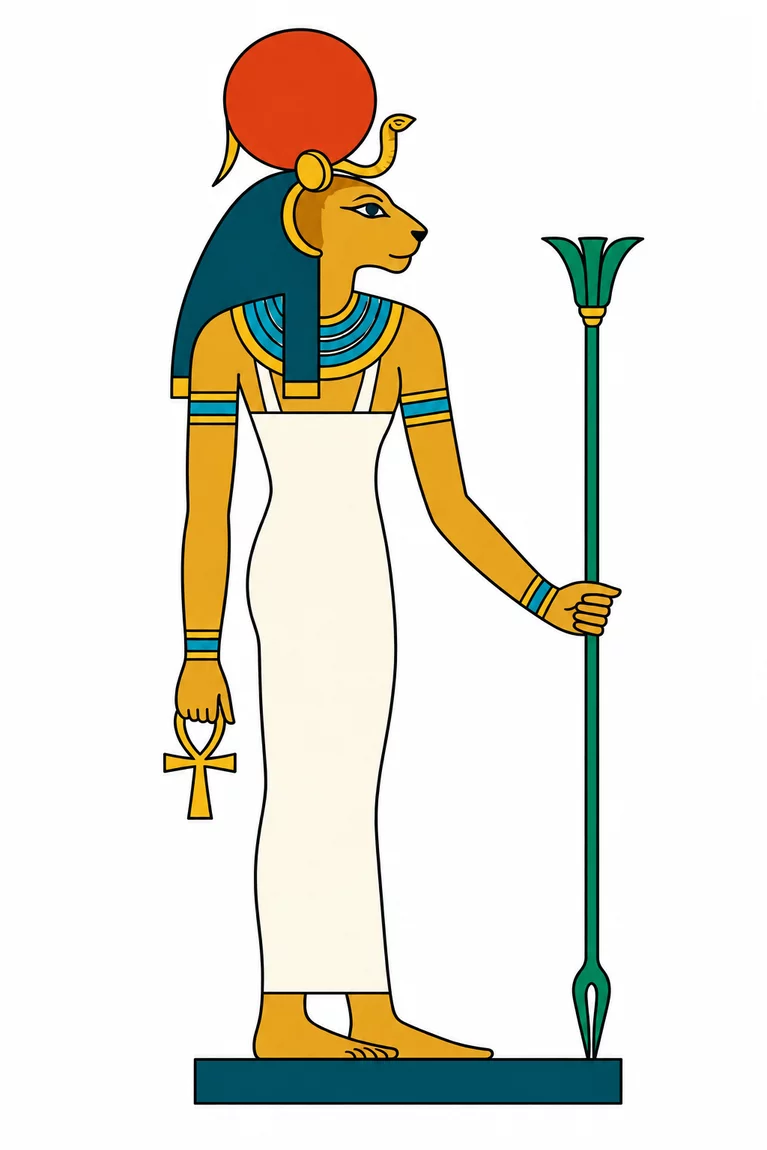
Menhit, written Menhyt in French, is a lioness goddess associated in particular with the temple of Esna. The strength of the wild beast expresses her protective and fearsome power. In the local theology she appears beside Khnum. Her name appears less often in general presentations of Egyptian religion than that of Sekhmet. This modern obscurity should not erase the place that inscriptions and images give her in her sanctuary.
A presence in the temple of Esna
Esna, in Upper Egypt, is famous for its temple of Khnum and its late decoration. The texts of this place present several gods and goddesses in relationships that can change from scene to scene. A research report from the University of Tübingen mentions Menhit as the consort of Khnum in an offering scene. The source anchors this link in a precise relief, instead of speaking of a uniform ‘wife’ throughout Egypt and in every period.
Temples were not dictionaries in which each god receives an unchanging function. Their walls stage actions: a king offers a crown, a deity receives it, names and titles specify the roles. Menhit takes part in this ritual language of Esna. Research on the colours recovered in the temple is also a reminder that these reliefs were painted. A present-day photograph of pale stone does not fully restore the original effect.
The power of the lioness
A lioness’s head evokes vigour, protection and the capacity to drive back hostile forces. Several Egyptian goddesses share this appearance. The Metropolitan Museum of Art stresses that an uninscribed lioness statuette may evoke various deities, among them Sekhmet, Bastet and others. Menhit must therefore be identified by her name, her provenance or her relationship with the neighbouring gods, not by the muzzle of the beast alone.
An amulet in the British Museum is recorded as a representation of Menhit. This small object shows that a temple goddess could also appear on a portable support. Its size does not indicate lesser importance: amulets answered personal needs for protection. But a single piece is not enough to reconstruct all the uses of the cult. The museum gives the material, the dimensions and the identification; the lost context of the object limits any further conclusions.
Relationships and differences
At Esna, Menhit belongs to the world of Khnum. Other sources bring the young Heka into the divine circle of this temple. The family relationships of temples are sometimes ways of organising powers and generations rather than human biographies. It is wise to name the local source of each kinship. Likewise, the iconographic closeness to Sekhmet does not automatically make Menhit identical to her.
Menhit can be shown as a lioness-headed woman crowned with the sun disc. This appearance visually links the goddess with other leonine powers, Sekhmet among them, without being enough to confuse them. In the monuments of Esna, the inscriptions and the relationships with other deities make it possible to recognise her place. The colour of a garment or a piece of jewellery is not by itself a criterion of identification.
Menhit invites us to look at deities on the scale of their sanctuaries. Egypt did not have only a few great names known everywhere in the same way. Each cult centre gave its gods a voice and associated them with particular rites. At Esna, the lioness Menhit shares the sacred space with Khnum and reveals this local richness.
Sources and references
- ENiM, Khnum and Menhit at Esna
- University of Tübingen, the colours of the temple of Esna
- British Museum, amulet of Menhit
- Metropolitan Museum of Art, lioness-headed goddesses
Reference works
- Richard H. Wilkinson, The Complete Gods and Goddesses of Ancient Egypt, London, Thames & Hudson, 2003, entry Menhit
- Christian Leitz (ed.), Lexikon der ägyptischen Götter und Götterbezeichnungen, 8 vols, Leuven, Peeters, 2002–2003 (Orientalia Lovaniensia Analecta 110–116 and 129)