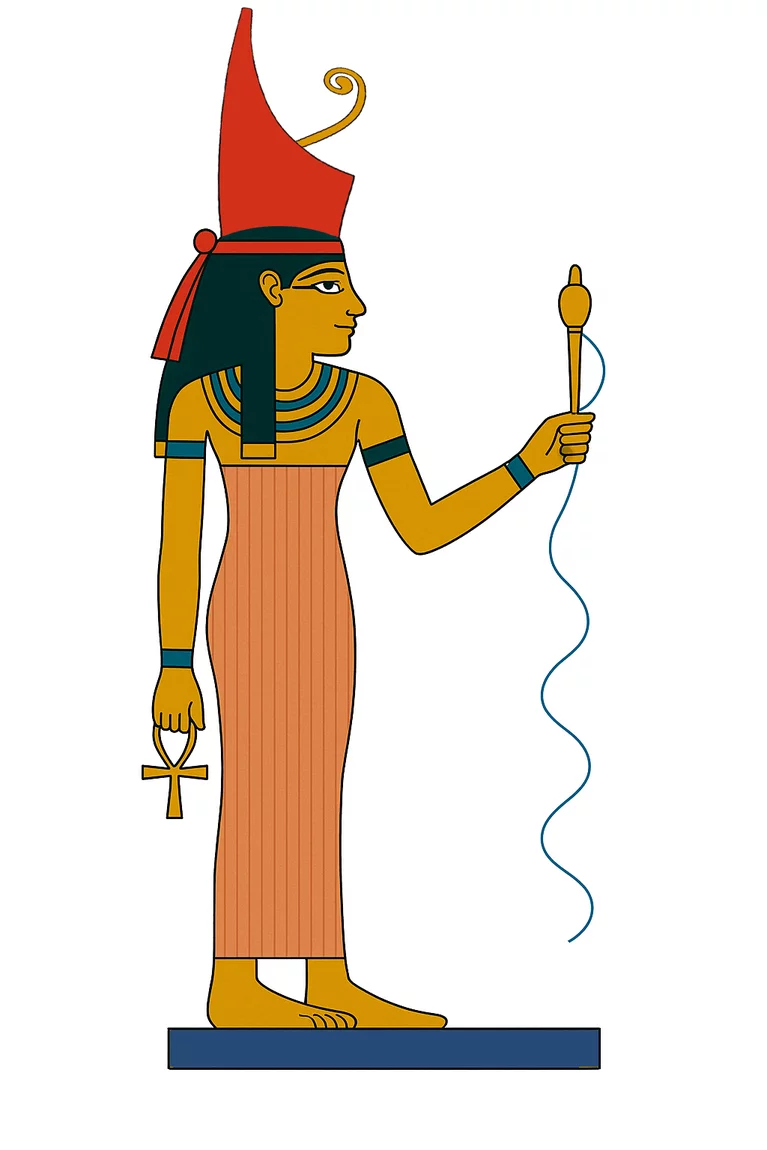
A goddess of Sais
Neith is one of the great goddesses of ancient Egypt. Her cult is particularly linked to Sais, in the Delta. Modern summaries tend to file her under a single label, such as war or weaving. The documents present a broader figure: she can protect, create and act in the funerary world. This diversity is not a contradiction. Deities received titles and functions according to place, period and the needs of the faithful.
The long history of Neith brings together functions that developed and combined over time. Her link with Sais, her weapons, protective fabrics and her role beside the dead show different ways of preserving life and the order of the world. These aspects must be placed in the texts and monuments that attest them: they do not form an unchanging personality, fixed from the beginning.
Weapons, crown and cloth
The British Museum presents Neith as a goddess linked to hunting, war and weaving. It mentions the Red Crown of Lower Egypt and an emblem evoking weapons. A small object in its collection shows her standing with precisely this crown. The bow and arrows express a capacity for defence. They do not sum up her whole role, for protection can also come through wrapping and through fabrics intended for the living or the dead.
The metaphor of weaving offers another way of approaching Neith. Knotting threads, stretching a weft and making a lasting wrapping are concrete operations that can serve to think about how the world is organised. When some stories give her a creative role, they develop this power to order and to bring into being. These local traditions must be distinguished from the simplified formula that would make her the sole creator in the whole of Egyptian religion. Other sanctuaries have their own stories of origin.
A funerary protector
Neith belongs to the group of goddesses who watch over the organs placed in the keeping of the sons of Horus. In a common tradition she is associated with Duamutef. The four protectors are not mere interchangeable ornaments: each holds a place in the funerary whole. Preserving the body and allowing the deceased to go on existing are essential religious aims. The goddess known for her weapons thus takes part in a work of care and preservation.
Our portrait shows Neith with the Red Crown and a bow. It keeps her most legible signs, but an ancient work may make other choices. The colour of the dress in our drawing is not a universal criterion of identification. What makes Neith interesting is her capacity to cross several domains: Sais, defence, cloth, creation and the tomb. Each reveals part of her personality; none should erase the others.
The funerary role of Neith shows that an armed power could also be an attentive guardian. The modern categories of ‘warrior’ and ‘mother’ risk dividing her artificially. On an ancient object, the attributes, the place in the scene and the written name answer one another. It is their combination that allows us to approach the goddess accurately.
Sources and references
Reference works
- Richard H. Wilkinson, The Complete Gods and Goddesses of Ancient Egypt, London, Thames & Hudson, 2003, entry Neith
- Christian Leitz (ed.), Lexikon der ägyptischen Götter und Götterbezeichnungen, 8 vols, Leuven, Peeters, 2002–2003 (Orientalia Lovaniensia Analecta 110–116 and 129)