A god of the eastern Delta
Sopdu, also written Sopedu, is linked to the east of the Egyptian Delta. The back pillar of a statue in the Metropolitan Museum bears an address to the priesthood of the temple of Sopdu at Per-Sopdu, today Saft el-Hinna. This provenance gives the divine name a place on the map: he is not just a figure added to a general list. A sanctuary, officiants and people are attached to him. The region of the Wadi Tumilat opened routes to the east, which explains why studies often link Sopdu with the eastern borderlands of Egypt.
We must nevertheless distinguish what an object proves from what is reconstructed from several sources. The statue documents a cult centre and its priesthood; it does not on its own tell us all the god’s rites. The notions of frontier, movement and defence provide a useful framework, but their forms changed over the centuries. Speaking of a protector of the east does not mean imagining a soldier who was the same in every period. Local cults could take in regional concerns while taking part in the wider religion of the country.
The falcon and protection
On another object the Metropolitan Museum identifies a mummiform falcon as Sopdu. This protective image appears on the lid of a funerary figure. It shows that the god’s presence was not confined to a territory in the Delta; his name could accompany the dead and strengthen their defence. The falcon form visually links Sopdu with Horus and other celestial powers. Only the precise context can decide. A beak or wings are not a sufficient label to identify a deity on a work without text.
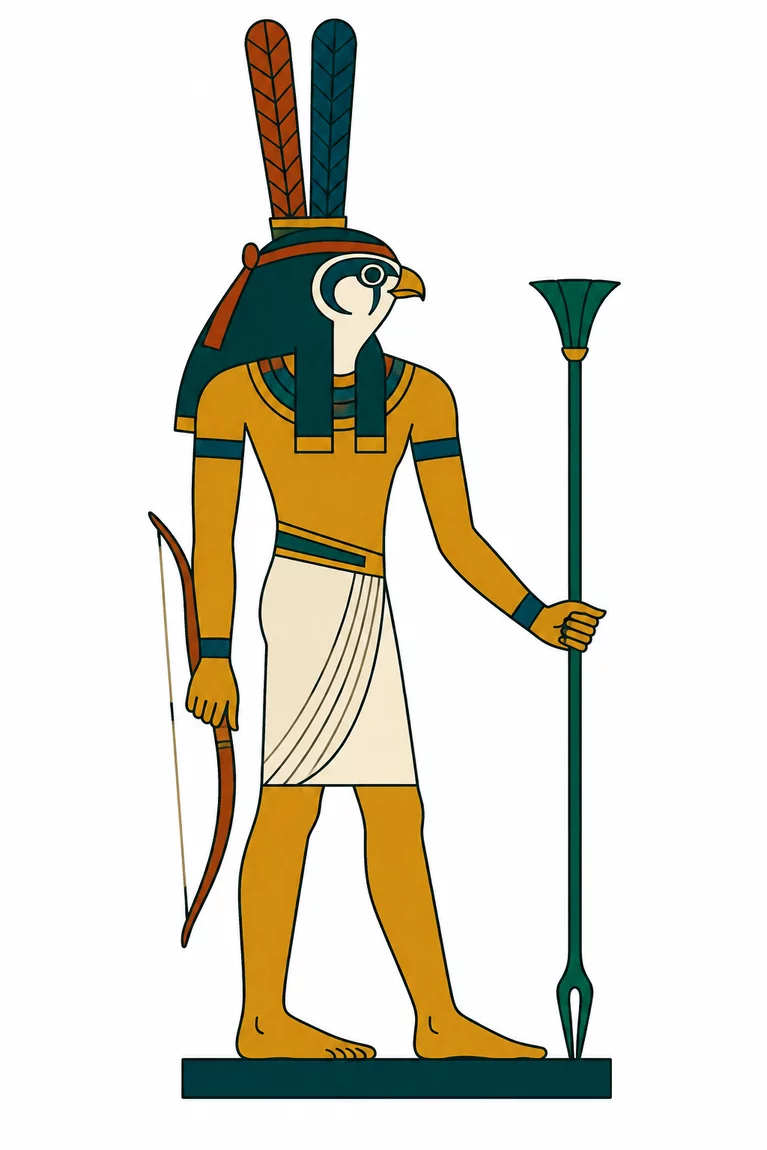
Our drawing shows Sopdu as a falcon-headed man crowned with two tall plumes and holding a bow. It renders legibly the idea of a watchful power of the east, but the details of this evocation should not be taken as the description of a particular ancient object. The surviving representations are not uniform. Some show a falcon figure rather than a human body. The material evidence thus invites us to look at the objects before fixing a single appearance for a god with many uses.
A local name in a connected world
The domain of Sopdu points to practices rooted in a place: priests, officiants and images are attached to it. This local scale matters for understanding Egyptian religion. The great narratives of Memphis or Heliopolis did not automatically absorb every deity. A power of the east could have its own history and roots, then appear on objects circulating elsewhere. The funerary lid in the Metropolitan Museum shows precisely this possibility of leaving the sanctuary without losing its protective role.
Sopdu also reminds us of the limits of our sources. Two well-described objects are not enough to write a continuous biography of the god from the Old Kingdom to the last temples. They do, however, allow us to present secure facts: a name, an eastern centre, a falcon form and a protective use. The reader can then compare this evidence with that of Sokar, another god sometimes shown as a falcon in a funerary setting. The inscribed names and the places prevent their histories from being confused despite a visual resemblance.
Sources and references
- Metropolitan Museum, overseer of the domain of Sopdu
- Metropolitan Museum, Sopdu as protective falcon
Reference works
- Richard H. Wilkinson, The Complete Gods and Goddesses of Ancient Egypt, London, Thames & Hudson, 2003, entry Sopdu
- Christian Leitz (ed.), Lexikon der ägyptischen Götter und Götterbezeichnungen, 8 vols, Leuven, Peeters, 2002–2003 (Orientalia Lovaniensia Analecta 110–116 and 129)