After Giza, I go back towards the first pyramids. At Saqqara, I have to imagine what is missing; at Dahshur, Ali waits for me while I venture alone into a dark corridor.
Memphis beneath the palms
At Memphis, I look for a capital and find a palm grove. A colossus of Ramses II (Ramesses II) lying in a museum, an alabaster sphinx: the remains offer little to hold on to when trying to imagine the first capital of unified Egypt. All around, farming life is very much present. The dates are known for their sweetness; the ruins are even used to knock down the fruit. I leave Memphis with the feeling that the ancient city is harder to find than a pyramid.
The ancestor of the pyramids
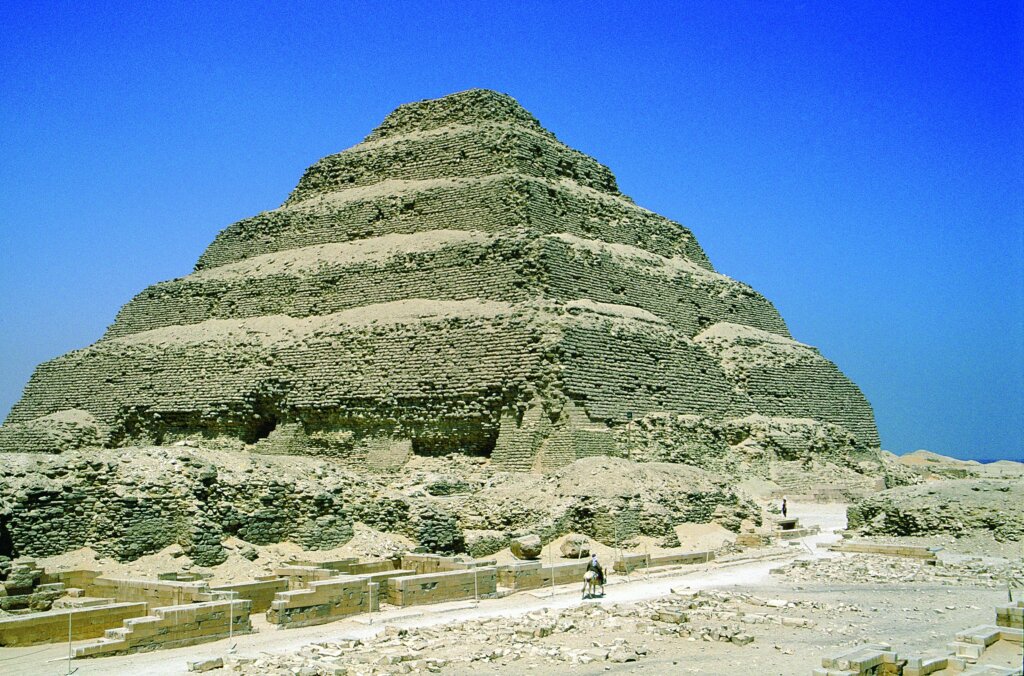
At Saqqara, on the arid plateau overlooking the valley, the six steps of Djoser give me back a readable shape. Imhotep designed them around 2650 BC. After Giza, I look at this pyramid as a stage on the way to the silhouettes I have already seen. But the invention is already immense: building on this scale in cut stone, when mud brick, wood and reed were the usual materials. The six steps no longer seem so simple.
Around them, once again, a whole has to be pieced together from what the sand and people have left. Jean-Philippe Lauer devoted his life to it, raising the columns and walls of the complex of Djoser. I also think of Auguste Mariette discovering the Serapeum in 1851, of the colossal sarcophagi of the Apis bulls, of the statue of the king found in its serdab, that small closed chamber. Later, Alain Zivie reopened tombs of dignitaries in the cliff of the Bubasteion, with a necropolis of mummified cats. The names pile up like the centuries: Unas, Teti, Pepi I, Pepi II. The pyramid of Unas contains the oldest Pyramid Texts. I could stay a long time trying to link all this together; Ali is waiting, and Dahshur draws me on.
Ali is smiling
I tell him where we are going next. Ali wears his good-day smile: twenty or so more kilometres for his taxi, whose meter already shows plenty. Long a military zone, Dahshur has only been open to the public since 1996. At the time of my journey, the place is still little enough known for us to find a welcome peace there.
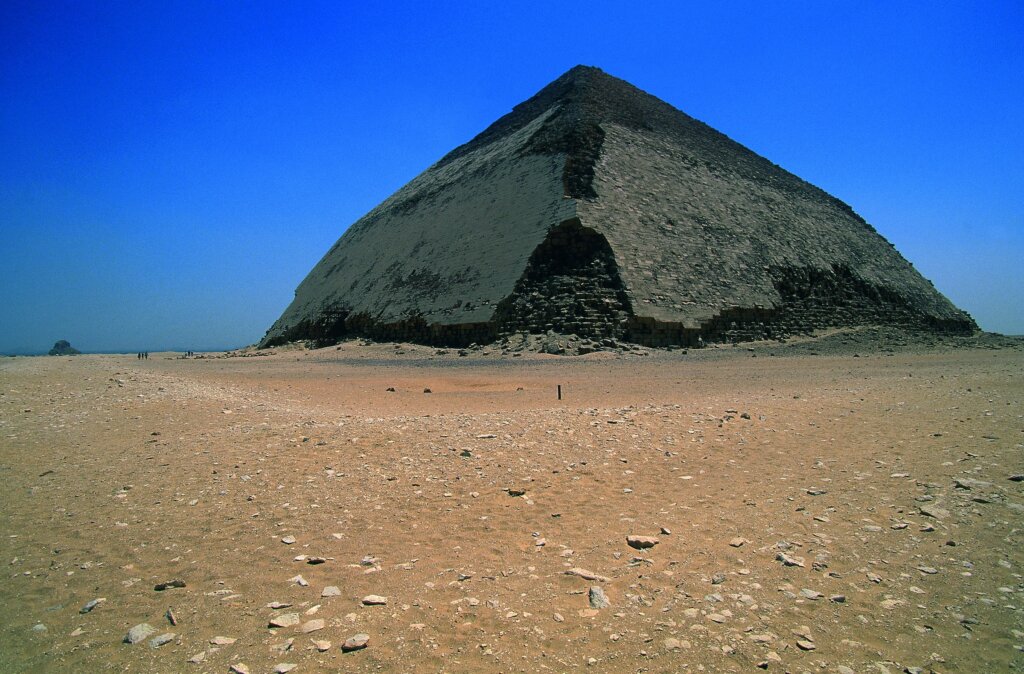
In front of the Bent Pyramid, I step back to see the break better. Halfway up, the slope changes from about fifty-four to forty-three degrees. A problem of stability, a change of plan? Egyptologists are still debating it. The polished limestone casing has largely survived, and the change of angle is clearly visible. Further on, the Red Pyramid offers a more regular silhouette. Sneferu, first king of the 4th Dynasty and father of Cheops (Khufu), wanted both. Between Saqqara and Giza, the path towards the smooth-sided pyramid begins to take shape before my eyes.
Alone before the black hole
I take advantage of the quiet to go into the Red Pyramid. First I have to climb a good hundred steps in full sun. At the entrance, the guard shows me the way on: more steps, but downwards. Then he calmly returns to the light. Here I am, alone before the black hole. The first light bulb is far away; I move towards its glow, then towards voices. A second guard welcomes me and tells me what he knows of the high corbelled chambers. Did they hold the king? Nothing is certain. The place seems all the more enigmatic to me. To finish, he recommends the Egyptian Museum: ‘There, you will have all the riches of Egypt, and much more besides.’ After this corridor, the promise of display cases has something reassuring about it.
Exhausted but happy
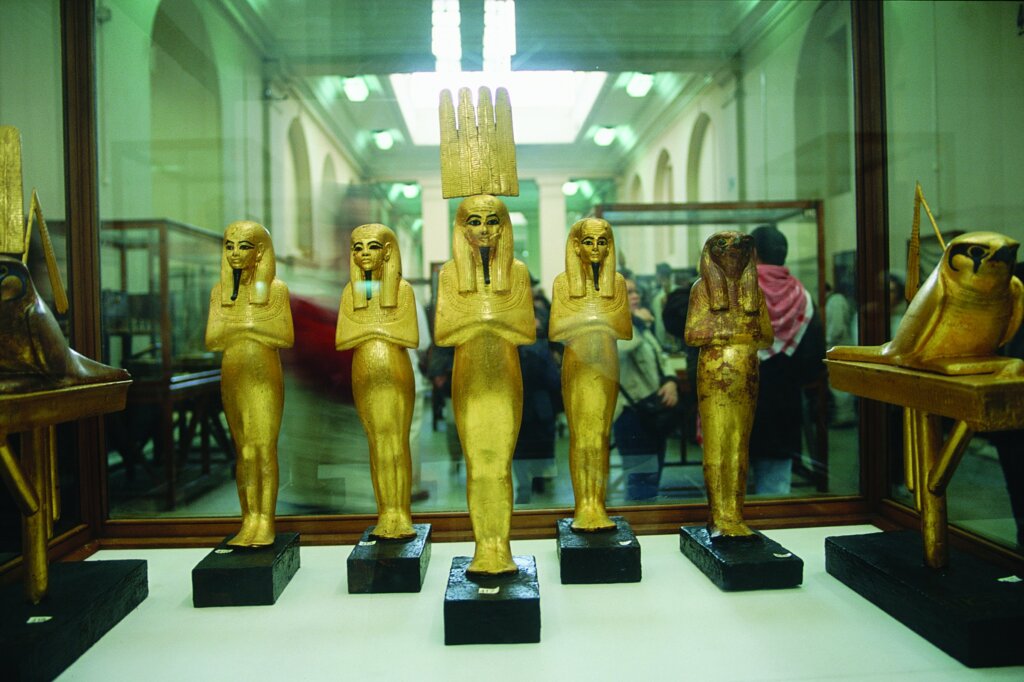
At the museum, the promise is more than kept. Mummies, statues, sarcophagi: the riches crowd the galleries, and my head begins to spin again. The collection, begun by Mariette in 1858 and enriched by Maspero and his successors, numbers tens of thousands of objects on display, and even more in storage. I soon give up following a scholarly route. As on the sites, I go where love at first sight takes me, stopping in front of one work, letting another pass by. I come out exhausted, but happy. After so many kilometres, temples and staircases, perhaps I should allow myself a break. I am going back tomorrow.
Today: the inside of the Bent Pyramid has been open to visitors since 2019. The Egyptian Museum on Tahrir Square remains open, but the treasure of Tutankhamun has moved to the Grand Egyptian Museum at Giza. The journey can now end there, or begin there.
To go further: Saqqara, centuries in the sand (in French) · Complex of Djoser · Serapeum · Bubasteion · Pyramid of Unas · Bent Pyramid · Red Pyramid · Djoser · Sneferu · Imhotep (in French) · Auguste Mariette (in French) · Gaston Maspero (in French)