In the footsteps of Giovanni Battista Belzoni · 1818. A story adapted from the traveller’s account.
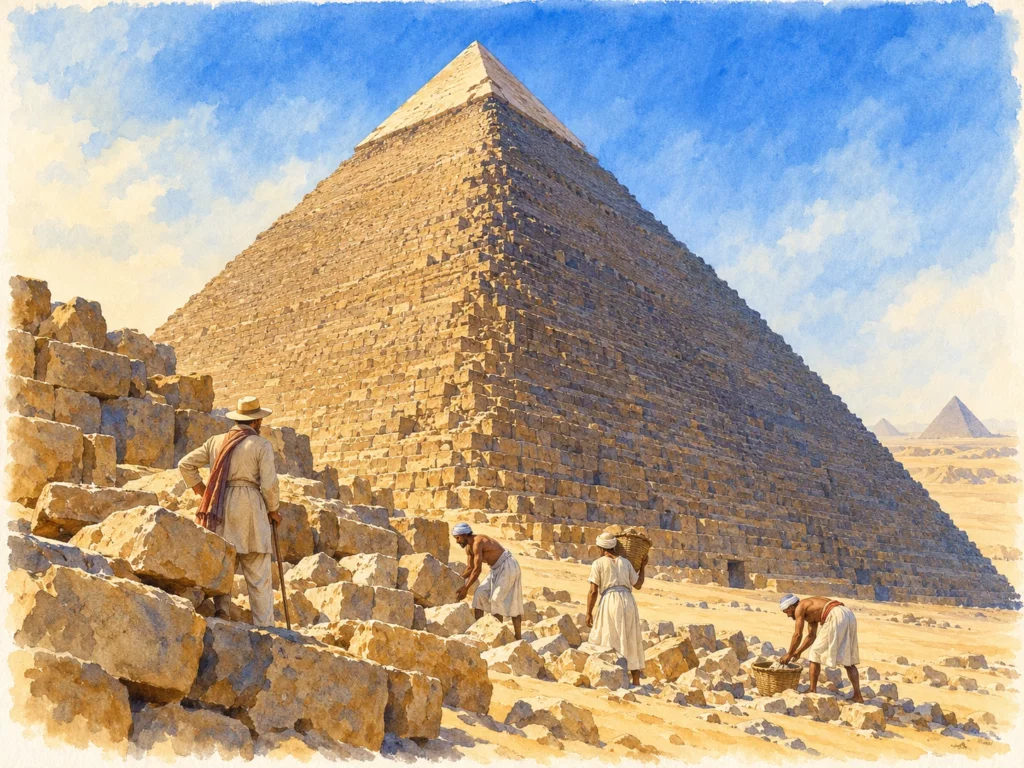
My companions have gone into the Great Pyramid. I stay outside, circling the second one. Almost everyone has given up hope of finding its entrance. In the shade of the stones of an ancient temple, I start thinking about it again.
The wrong opening
I look at the north side, at the material fallen from the casing, at the way it lies at the foot of the face. In some places, the heap seems less compact to me. These differences are enough to make up my mind. They are not yet enough to prove me right.
The first works advance with difficulty. The tools suffer, the workmen tire. Then one of them notices a crack between two stones. A pole sinks into it; we clear an opening. Hope returns with an ease that ought to make me cautious.
The passage is irregular, choked and dangerous. Someone has already tried to get in this way by forcing the masonry. A block falls from the roof and hangs above a workman, fortunately held by two projections. We remove it with difficulty. We have to stop: going on would risk cutting off everyone’s retreat.
So here I am, back in front of the pyramid after a great deal of work, without the entrance I was looking for.
Taking the measurements again
I give the men a day’s rest and go back to examine the first pyramid. Its entrance is not exactly in the middle of the face. The passage ends at one side of the central chamber; it is offset accordingly. Why did I look for that of the second pyramid in the centre with such confidence?
I apply this observation to our own site. Further east, the ground shows signs similar to those that encouraged me the first time. We start again.
This time, sloping blocks of granite appear. On 2 March, we reach the true entrance. The Chevalier Frediani, whom I had asked to delay his departure, is still there. I am glad to have been able to offer him something better than an uncertain dig.
A straw behind the slab
There is still a corridor to clear, then a slab that blocks it. Through an opening above the stone, I slide a long straw of barley. It goes in: there is space behind.
The levers are hard to work in this narrow passage. We raise the slab just enough for a man to slip underneath with a candle. He comes back to announce a fine chamber. When the opening at last lets me through, I follow him.
By the light of my torch, I look for the sarcophagus. At first I do not see it; it is sunk into the floor. Its lid is broken. Others, then, have come before us. After thirty days of work, this ancient visit does not lessen my pleasure at having got this far.