In brief
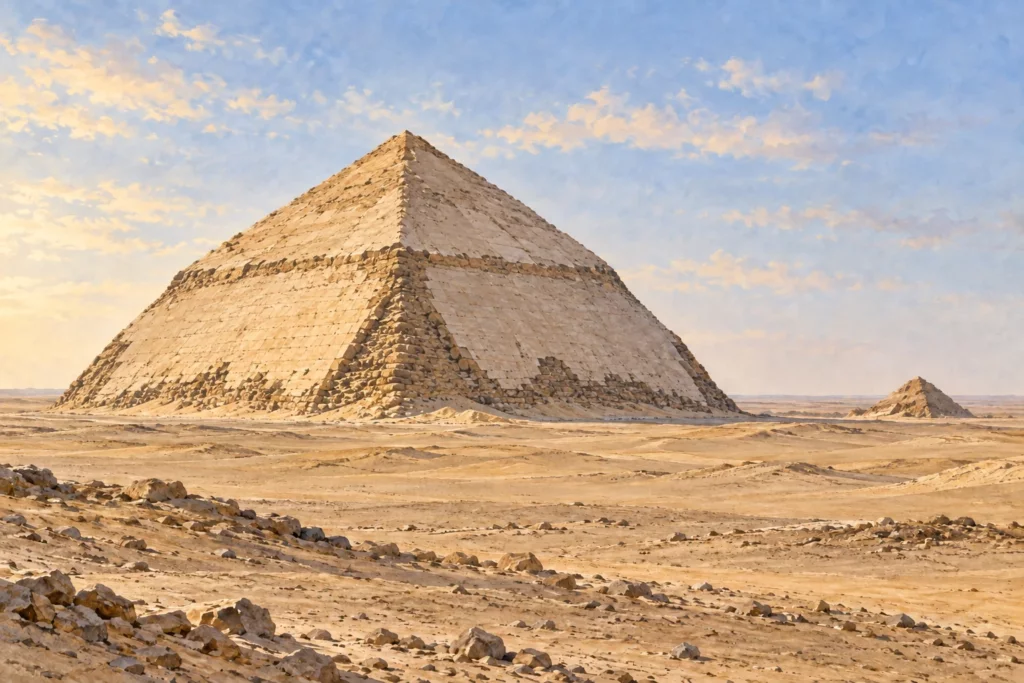
South of Saqqara, the Bent Pyramid of Dahshur is one of the great monuments of Sneferu, the first king of the 4th Dynasty. Its faces change slope sharply halfway up: the building looks ‘broken’ without being ruined. The shape results from a change to the project during construction. The exact reason is not recorded in any ancient text. This pyramid shows a remarkable stage in the experiments with the smooth-sided form.
What you discover
From a distance, you see the break in slope and large areas of limestone casing still preserved. Inside, two separate entrances are known: one on the north face, the other on the west face. They serve chambers with corbelled roofs, set at different levels. The monument belonged to a larger funerary complex. A small satellite pyramid stands to the south; a chapel, a causeway and a valley temple linked the desert heart of the complex to its eastern edge. The images supplied separately evoke these elements without measuring them.
Its history
Construction began with a steep slope, then the builders adopted a gentler slope for the upper part. A frequent explanation invokes the constraints of stability and the weight of the masonry; other factors may have played a part. Researchers have no building-site document giving the decision and its reasons. Sneferu then had the Red Pyramid, with a regular slope, built at Dahshur. The two monuments must not be confused: the Bent Pyramid is the king’s southern pyramid, the Red Pyramid his northern one.
Why this place matters
The Bent Pyramid preserves an exceptionally readable part of its envelope. It makes visible a change of project that pyramids with a uniform slope do not show. Its two entrances and its chambers also underline that the experiment concerned the internal layout, not only the silhouette. The installations around the pyramid shed light on the royal cult. Technical interpretations are useful, but no single cause of the change of slope is proven by the ancient sources.