In brief
South of the complex of Djoser at Saqqara, the pyramid of Unas is more modest than the giants of Giza. Unas, the last king of the 5th Dynasty, reigned according to this chronology c. 2375–2345 BC. Yet his monument is decisive: it is the first surviving royal pyramid whose chambers bear the funerary spells that scholars call the Pyramid Texts.
What you discover
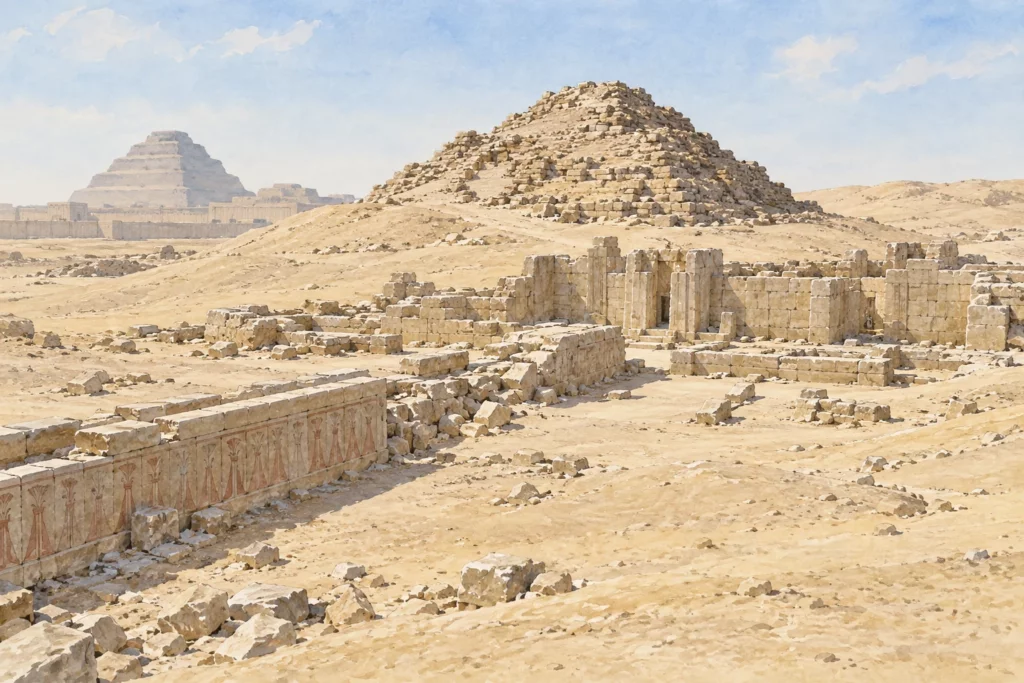
On the outside, the pyramid has lost its regular shape and its casing. The remains of the mortuary temple lie close to it; a long causeway linked it to the valley temple, remains of which can be seen near the modern entrance to Saqqara. Part of the decorated causeway survives, while many blocks were removed and reused. Inside, the walls of the burial chamber and of neighbouring spaces bear columns of hieroglyphs. These texts were meant to accompany the dead king and to secure for him offerings and passage to a transformed existence.
Its history
The spells were probably not all composed for the first time under Unas: they belonged to older ritual traditions. His pyramid is the earliest surviving example of their being inscribed in the chambers of a royal tomb. Kings and some queens of the following dynasties adopted these texts in their turn. Egyptologists have recorded, copied and compared them to study their variants. Their translations are still evolving, because the spells mix imagery, ritual language and allusions whose meaning is not always certain.
Why this place matters
The pyramid of Unas shows that a small external mass can house a major innovation in the history of written sources. Visitors can bring together three levels: the king’s tomb, the route of temples and causeway, and the texts inside. It is worth remembering that ‘first Pyramid Texts’ means the first surviving attestation in a pyramid, not the first religious text of humanity.