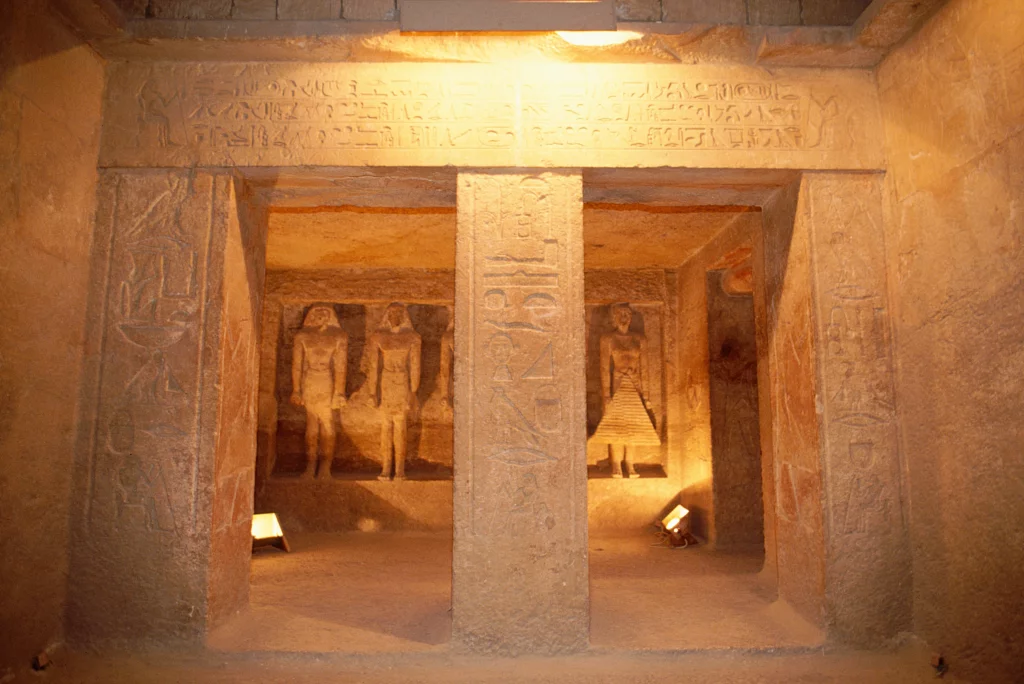
The Giza sun crushes the plateau under its white light, but a few steps from the Great Pyramid of Cheops, another journey awaits me. I have decided to set off to discover mastaba G 7101.
Armed with the pass provided by the Ministry of Tourism, which allows me to wander everywhere on my own, I feel like an adventurer setting off to discover the lesser-known tombs of the Giza plateau. To reach the tomb of Qar (mastaba G 7101) from the eastern flank of the gigantic pyramid of Cheops (Khufu), I leave the beaten track. First, I cross the discreet remains of the mortuary temple of Cheops. Beneath my feet lie the remains of the black basalt paving, polished by time and sand, which still bear witness to the splendour of the rituals once held there. Continuing my walk eastwards, through this maze of stones, I pass the more modest, time-worn silhouette of the pyramid of Hetepheres I, the mother of Cheops. This solitary sentinel seems to watch over her son’s privacy, far from the hurried gaze of tourists. It is right there, at the heart of this Eastern Cemetery, which seems to float in the shadow of the giants, that the earth opens. I have arrived.
A new vertical journey, far from the bustle of the tourist crowds. I am about to go down into the mastaba of Qar, the high dignitary of the 6th Dynasty who kept the secrets of the palace more than four thousand years ago.
In front of me, a steep staircase plunges straight into the limestone rock. As I go down the steps cut into the ground, the stifling heat of the desert gives way to a sudden, almost sacred coolness. The air grows thin, heavy with the smell of age-old stone and the dust of history.
At the bottom of the steps, after passing through a narrow passage, I come out into the pillared hall. The visual shock is immediate. The floor lights draw shifting shadows on the walls of golden rock. Facing me, carved straight into the rock, figures literally emerge from the stone. They are the high-relief statues of Qar, shown at different ages of his life. The work of the Old Kingdom craftsmen is unsettlingly precise: the pleated kilts seem almost to quiver in the raking light, and the stone eyes gaze into eternity, across the millennia.
Raising my eyes, I am fascinated by the architrave above the pillars. It is entirely covered with lines of hieroglyphs of incredible delicacy, setting out Qar’s titles, his offerings and his prayers for the afterlife. Alone at the bottom of this crypt, the silence is total. You instantly forget that the surface is teeming with people. You are no longer a mere visitor; you become the privileged witness of a timeless devotion.
I spend long minutes looking at the scenes of daily life carved on the neighbouring walls, before slowly climbing back up towards the blinding light of the 21st century, with the strange and heady feeling of having shared, for a moment, the private world of one of the great men of Egypt.
Find out more
- The official archaeological publication (MFA Boston): The Mastabas of Qar and Idu — Digital Giza.
- Harvard University’s database and 3D tour: The Tomb of Qar (G 7101) — Digital Giza / Mused.
- The original archaeological plans: G 7101, Plan — Digital Giza.