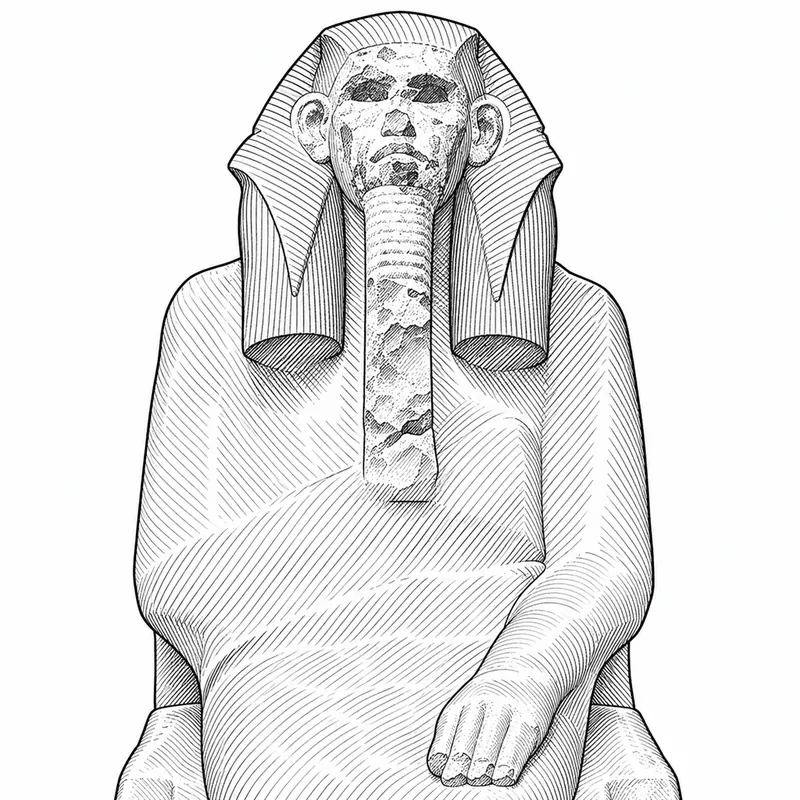
Netjerikhet, later called Djoser
The king we now call Djoser bears, in the sources of his own time, the Horus (in French) name Netjerikhet. ‘Djoser’ is a name attested in later documents. In most reconstructions he opens the 3rd Dynasty, around the beginning of the Old Kingdom. Absolute figures vary from one chronology to another, and there is no continuous account of his decisions. His name nevertheless appears on seals and other objects, while his immense funerary complex at Saqqara sheds direct light on the ambition of his reign. The ruler’s history can therefore be read as much in architecture as in inscriptions. In the chronology of Ian Shaw (Oxford, 2000), his reign falls c. 2667–2648 BC.
The complex at Saqqara
On the Saqqara plateau, south of Memphis, Netjerikhet had a complex built, surrounded by a high niched wall. The six-stepped pyramid is only its most visible element. The courts, chapels, passages, colonnades and underground spaces make up a landscape intended for the funerary protection and symbolic regeneration of the king. Forms that had existed in brick, wood or reeds were translated into dressed stone. This durable materialisation was a decisive innovation of scale. It does not imply that all stone architecture began under Djoser, but his building site permanently transformed the possibilities of the royal monument.
A pyramid built in stages
The pyramid was not conceived from the outset in its final form. Studies of the masonry distinguish several enlargements of an initial, lower structure close to a mastaba. Each extension changed the mass and silhouette of the building. Beneath the monument, shafts and galleries led to the funerary spaces. These phases show that the building work was a process of successive decisions rather than the unchanging execution of a single design. The exact dates of each enlargement are not known. A distinction must also be made between what has survived and what modern restorations make visible today.
Kingship on stage
Several parts of the complex evoke the ceremonies of the renewal of power. The Sed festival court and its chapels represent in stone a ritual setting intended to maintain the king’s power beyond death. The ‘South Tomb’ is another underground structure, whose exact function is still debated. It can be tempting to describe each building as a hall used according to a known programme; the sources do not allow such precision. The funerary spaces nevertheless make it clear that the king was conceived as a figure destined to renew himself, and that the architecture served this idea as much as it housed a burial.
An administration able to build
A building site on this scale required quarries, the transport of blocks, specialist stonecutters and a lasting supply of labour. It bears witness to the court’s ability to concentrate resources. Impressions bearing the name of Netjerikhet have been found at Saqqara, Abydos, Hierakonpolis and Elephantine (in French); an inscription is also recorded in Sinai. These traces do not describe the daily workings of the state, but they place the complex within a territorial network. The monumentality of Saqqara is therefore not only a technical feat: it is also the product of institutions able to coordinate people and materials.
Imhotep between history and memory
Tradition associates the name of Imhotep (in French) with Djoser’s building works and credits him with exceptional wisdom. He was later venerated as a deified figure. All the later stories should not, however, be projected onto the king’s own time. The personal attribution of every architectural decision to Imhotep cannot be demonstrated from the remains. His memory does, on the other hand, reveal the importance that the Egyptians themselves attached to this reign and to its programme in stone. Modern research first examines the monuments and contemporary documents, then studies the religious and literary reception of Imhotep separately.
A stage, not an isolated beginning
Djoser is often presented as the king of the ‘first pyramid’. The phrase refers to the first large surviving pyramidal monument in Egypt; it should not erase the tombs and experiments of the earlier dynasties. His successor Sekhemkhet took up at Saqqara the project of a great step pyramid, which remained unfinished. In the following century, Sneferu transformed the form and technique of these buildings once again. Djoser’s place is best understood within this chain of transformations. His reign was a major moment in funerary kingship, without it being possible to reduce his whole history to a single architect or a founding date.
Main sources
- Egyptian Ministry of Tourism and Antiquities, Djoser complex
- UCL Digital Egypt, King Djoser
- UCL Digital Egypt, Egypt in the Old Kingdom
- Model for the line portrait: statue of Djoser, Egyptian Museum, Cairo.
- Reference photograph: Olaf Tausch, CC BY 3.0.
Reference works
- Ian Shaw (ed.), The Oxford History of Ancient Egypt, Oxford, Oxford University Press, 2000, chronology pp. 479–483
- Aidan Dodson and Dyan Hilton, The Complete Royal Families of Ancient Egypt, London, Thames & Hudson, 2004