In brief
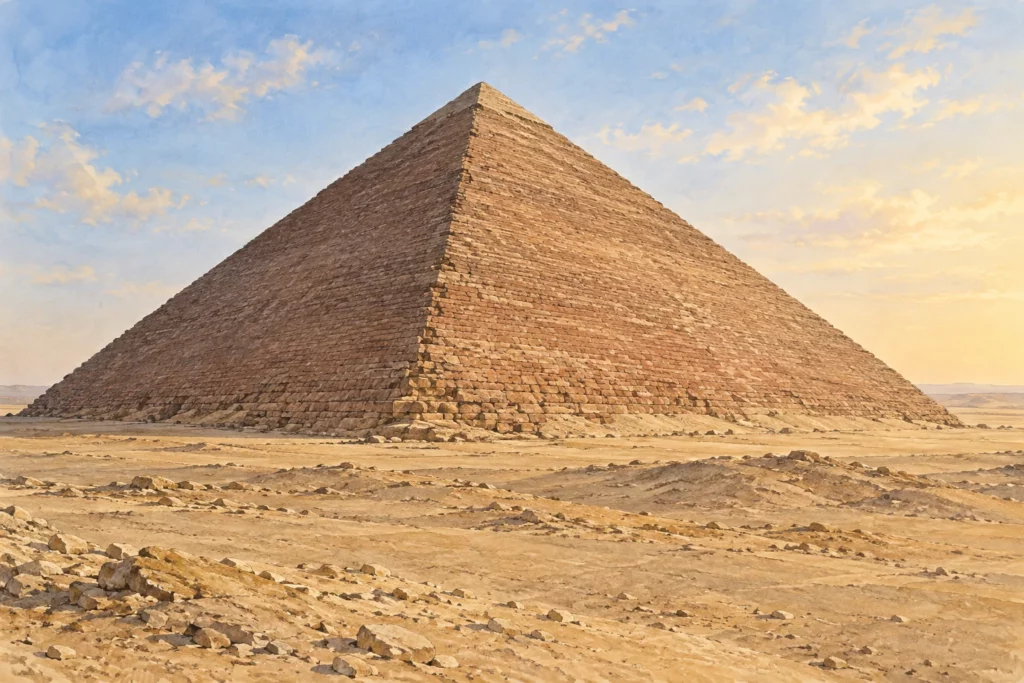
At Dahshur, the Red Pyramid is the tallest on the site. It was built for Sneferu, the first king of the 4th Dynasty, after the Bent Pyramid further south. Its regular slope makes it a major milestone of the smooth-sided pyramid. Its present name comes from the reddish tint of the exposed blocks; in antiquity, a casing of white limestone covered the monument. The colour seen today therefore also tells of the loss of this envelope.
What you discover
The pyramid dominates the plateau with a very broad volume and a relatively gentle slope. Its entrance is on the north face. A long descending passage leads to two successive chambers with corbelled roofs; another passage gives access to a third chamber, generally interpreted as the burial chamber. This route conveys the thickness of the masonry and the care given to the internal spaces. To the east, the remains of a temple belonged to the royal complex. Around it, research has also found traces linked to the people and the works of the necropolis.
Its history
In Sneferu’s programme, the Red Pyramid follows Meidum and the Bent Pyramid. Its profile does not show the break in slope of the latter. The exact dates of the building work are debated: one proposal places its start around the thirteenth year of the reign and estimates its duration at about ten years, without absolute certainty. The white casing was largely removed after antiquity, revealing the reddish core. Modern archaeological studies have documented the monument, its surroundings and nearby work installations.
Why this place matters
The monument shows the culmination of a series of building choices under Sneferu, while keeping its own architecture. Its three chambers and their corbelled roofs are as instructive as its external profile. The name ‘Red Pyramid’ should not suggest an ancient pyramid that was entirely red: the present colour results from the disappearance of the white casing. Nothing allows Sneferu’s burial in a specific chamber to be presented as certain.