In brief
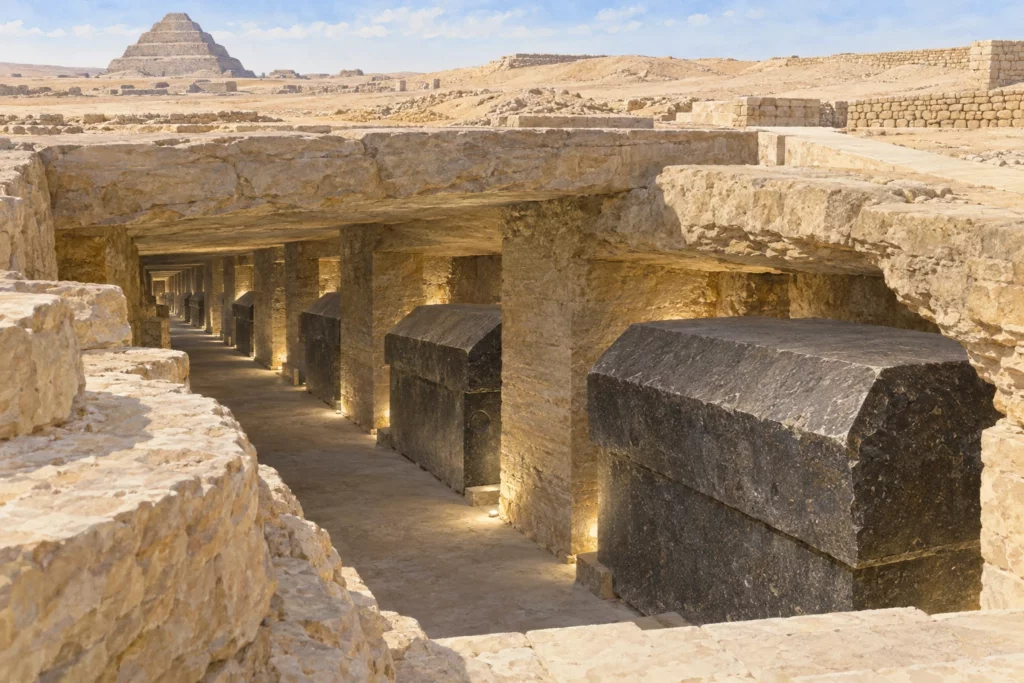
The Serapeum lies in North Saqqara, in the vast necropolis of Memphis. The name refers to the catacombs in which the Apis bulls were buried, sacred animals linked to Ptah, the great god of Memphis. There was only one Apis at a time: when it died, the bull was mummified and buried with full honours, while the priests looked for its successor according to the markings of its coat. The Egyptian Ministry of Tourism and Antiquities places the use of the site between the reign of Amenhotep III, in the New Kingdom, and the Ptolemaic period.
What you discover
On the surface, an avenue of sphinxes led to the funerary complex. It also linked sanctuaries: it was in a small chapel on the north side of the avenue joining two temples that the great painted limestone statue of Apis now on display in the Louvre, dated to the reign of Nectanebo I, was found on 23 March 1851. These surface buildings have almost disappeared, and most of the visit takes place underground.
The descent leads into two long corridors that held the mummified remains of the bulls, placed in stone sarcophagi. The dominant impression is one of repetition: the great tanks follow one another in the half-light, each linked to an animal, and therefore to a precise moment of the cult. This underground landscape is nevertheless the final state of a long history. Before the catacombs, at the end of the 18th Dynasty, each bull received its own tomb, made up of a chapel on the surface and an underground chamber; the communal galleries appear only from the reign of Ramses II.
What to look at
The Serapeum is first of all a place of writing. Priests, officials and visitors deposited dated stelae there, and many were brought back to the Louvre by Auguste Mariette. One of them, found on 22 February 1852 in the part of the galleries called the ‘Lesser Vaults’, shows Psamtik I in a ritual kilt, holding a ewer and a censer before Apis, who wears the sun disc and the uraeus. The text states that the animal died in year 20 of the reign and was buried in year 21. Each inscription of this kind anchors a burial in the royal chronology.
A second detail can be read on the Louvre statue of Apis: between the bull’s forelegs, graffiti in Demotic were traced by worshippers. The same gesture is found on the jambs of the door of the ‘Greater Vaults’, covered under Ptolemy VI with Demotic inscriptions naming the priests and servants of Apis-Osiris with their parentage. The stone thus keeps the trace of those who frequented the sanctuary, and not only that of the kings.
Its history
The cult of Apis is very old, but the funerary rites devoted to it are documented only from the New Kingdom. Under Ramses II, two of his sons, Khaemwaset and Merenptah, then princes and high priests of Ptah, made offerings for the burials, notably jewellery and shabtis. The galleries were then enlarged over the centuries; the stele of Psamtik I shows that the Lesser Vaults were still in use at the beginning of the 26th Dynasty, and the door of the Greater Vaults attests to activity at the site under the Ptolemies.
Several points remain uncertain. The earliest surviving bulls are not true mummies, but broken bones gathered into a mass with resin and linen. The end of the site is also dated in different ways: the ministry places it in the Ptolemaic period, while the Egyptologist Aidan Dodson dates the end of the burials to the reign of Augustus. Finally, the exact distribution of the animals among the different galleries rests on stelae that have often been moved, which leaves many attributions open.
Sources
Consulted on 30 September 2026: Serapeum, Egyptian Ministry of Tourism and Antiquities; Round-topped stele of Psamtik I before Apis (N 403), Musée du Louvre; Statue of the Apis bull (N 390), Musée du Louvre.