In brief
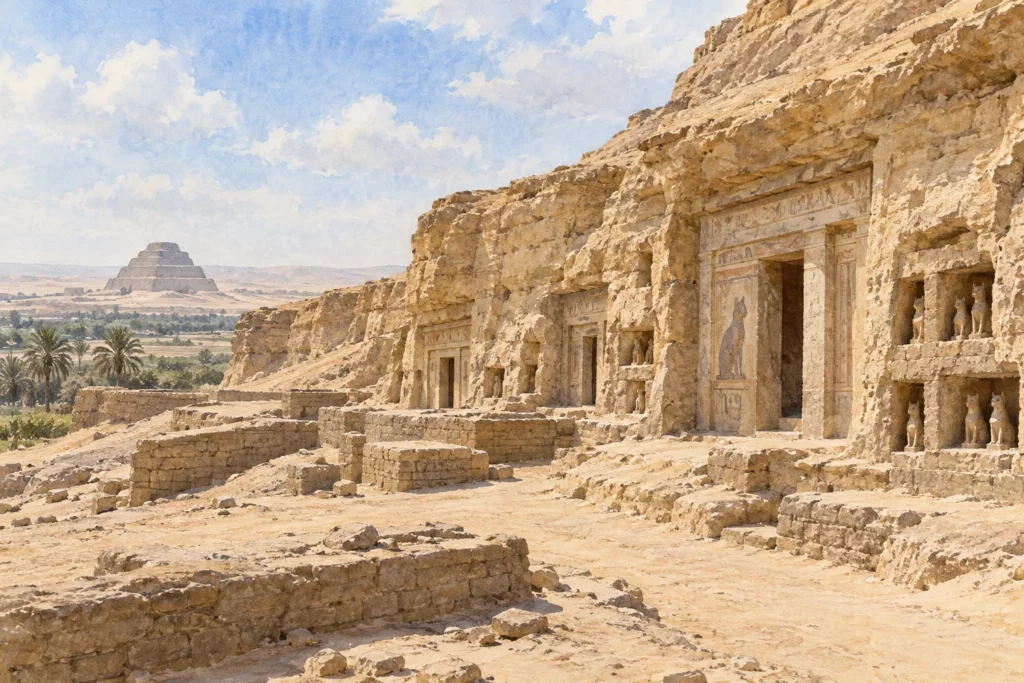
The Bubasteion is the sanctuary of Bastet at Saqqara, known by a Greek name. It occupies the eastern escarpment of the plateau, where a cliff still emerges from the sands. The goddess, first a lioness or a lion-headed woman, later took the form of a cat or a cat-headed woman. Her domain developed greatly in the Late Period and above all in the Ptolemaic period, with a vast necropolis of mummified cats. But the cliff had first served as a cemetery for high-ranking figures of the New Kingdom, whose tombs were later turned into catacombs for the cats.
What you discover
The site appears as a rock face pierced by the entrances of rock-cut tombs, gradually cleared of sand. Behind these openings, the chambers of the 18th Dynasty are often blocked by late masonry bonded with a pinkish mortar, built when the tombs were reused. Some descend over several levels linked by shafts 7 to 8 metres deep. The rock, made up mainly of marls and gypsum, is fragile, and the tomb of Aper-El had to be consolidated before work could progress inside it.
The owners of these tombs were almost all unknown before their discovery, despite their rank: the vizier Aper-El, a chancellor of Amenhotep III named Meryra, an overseer of the granaries, royal cup-bearers, an overseer of painters and the royal nurse Maia.
What to look at
In the first chamber of the tomb of Maia, a relief shows Tutankhamun, with very youthful features and wearing the royal insignia, seated on the knees of his nurse, who is herself sitting on a chair with a back. Behind her, in two registers, six high-ranking figures carrying fans and insignia of command salute the king. Beneath the chair, a lying dog raises its muzzle towards him. The right-hand part of the wall is missing: a shaft was cut there later, probably for cat burials. Maia bears the title ‘royal nurse’, often followed by the epithet ‘who fed the body of the god’.
This single panel sums up the history of the place: a court decoration from the end of the Amarna period, cut into by the installations of an animal cult several centuries later.
Its history
The Egyptologist Alain Zivie took an interest in the site in 1976; excavations began in November 1980, and the French Archaeological Mission of the Bubasteion was created in 1986 with the support of the French Ministry of Foreign Affairs. In November 1987, it discovered the burial chamber, robbed but still rich, of the vizier Aper-El, his wife Tawaret and their son Huy. The tomb of Maia appeared in the spoil at the end of November 1996; its discovery was announced on 7 December 1997.
The cats of the Bubasteion also have a modern history: in the last decades of the 19th century, their mummies were exploited on an almost industrial scale and exported to Europe as fertiliser. Several questions remain open. The date of the cat deposits varies between authors, from the Late Period to the Roman period. The meaning of the title of royal nurse, a real or an honorific office, is debated, as is the identity of the six dignitaries in the relief of Maia.
Sources
Consulted on 30 September 2026: Alain Zivie, ‘La nourrice royale Maïa et ses voisins : cinq tombeaux du Nouvel Empire récemment découverts à Saqqara’, Comptes rendus de l’Académie des inscriptions et belles-lettres, 1998, Persée (in French); Alain-Pierre Zivie, ‘Recherches et découvertes récentes dans la tombe d’Aperia à Saqqarah’, Comptes rendus de l’Académie des inscriptions et belles-lettres, 1989, Persée (in French).