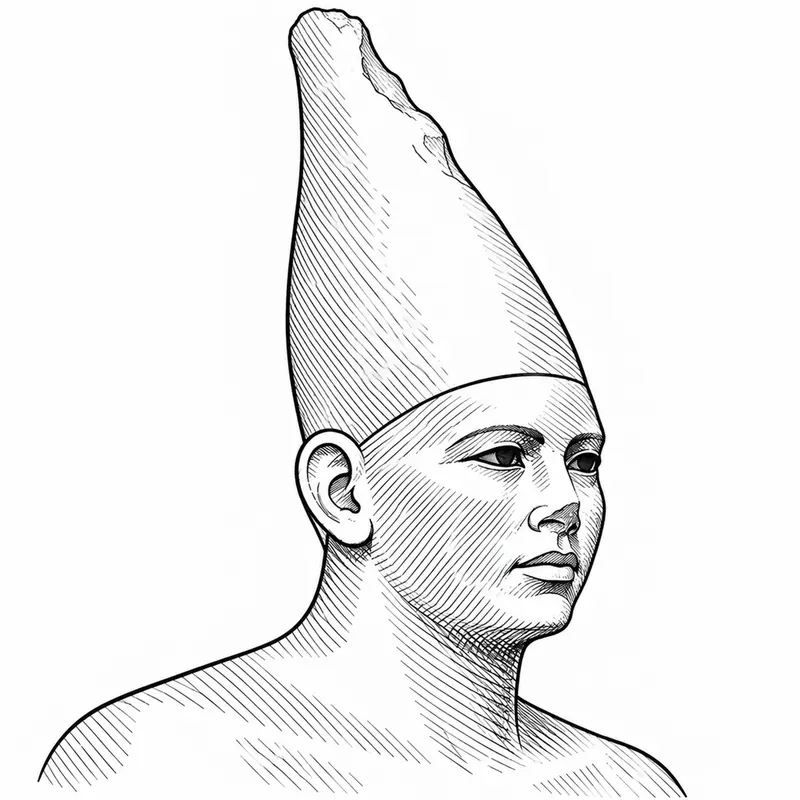
The first king of the 4th Dynasty
Sneferu opens the 4th Dynasty and precedes Cheops (Khufu). His reign stands out for exceptional monumental activity: three large pyramids are associated with him, at Meidum and at Dahshur. This concentration of building sites makes it possible to follow the trials that led to the smooth-sided pyramid. The absolute dates of the reign differ between chronologies; the general sequence of the 3rd Dynasty, Sneferu and Cheops is more secure. The monuments do not tell his whole story. Inscriptions in Sinai, entries on the Palermo Stone and the memory kept alive after his death complete the portrait of a king whose power reached far beyond the Memphite region. In the chronology of Ian Shaw (Oxford, 2000), his reign falls c. 2613–2589 BC.
Meidum, a transformed project
At Meidum, construction moved from a stepped plan to a casing intended to produce continuous faces. Archaeologists distinguish several major phases, designated E1, E2 and E3. The present monument, whose tall core rises out of a mound of debris, corresponds to no complete image of these earlier phases. The attribution of the work to Sneferu is better founded than the old proposal making his predecessor Huni the main builder. The date of the first choice of site can still be discussed, but this uncertainty cannot be turned into the opposite certainty. Above all, Meidum shows a kingship ready to modify a monumental project while it was being carried out.
The two pyramids of Dahshur
The Bent Pyramid at Dahshur shows a visible change of slope, reflecting decisions taken during construction. Further north, the Red Pyramid is one of the first large smooth-sided buildings to be completed. The two monuments do not, on their own, tell a simple story of failures and repairs. The hypotheses about the reasons for the change of slope concern loads, masonry and the building timetable; they must be kept separate from the observations. Together with Meidum, these pyramids represent a considerable investment in quarries, transport, technical control and labour. They lead directly to the Great Pyramid of the following reign.
A policy beyond the necropolises
The Palermo Stone preserves annalistic entries attributed to Sneferu’s reign, notably an operation towards Nubia. Royal inscriptions are known in Sinai, at Wadi Maghara. They show the court’s interest in regions of resources and desert routes. The data are too fragmentary to reconstruct the king’s entire foreign policy or to quantify his campaigns with certainty. They are enough, however, to remind us that a builder king governed a territory and sought materials, goods and prestige beyond his funerary building sites. The pyramids should not, therefore, hide the administrative and external dimensions of the reign.
The court and the organisation of labour
Building three large funerary complexes, perhaps on partly overlapping timetables, required a court able to plan and reallocate resources. Quarrying, cutting the blocks and transporting them formed a chain of specialised tasks. The tombs of high officials around Meidum are a reminder that the royal programme was embedded in a court society. The monuments do not provide a complete register of the work teams or their living conditions, but they make visible the scale of the coordination required. At each phase, the reconstructed dimensions of a building must be related to the state being studied, so as not to confuse project, completed construction and present-day ruin.
A lasting memory
Sneferu’s cult survived long after his death. His name remained associated with Meidum and Dahshur; in the Middle Kingdom it was still invoked in personal names and in literature. The Prophecy of Neferti sets its story at his court, without being a contemporary account of his reign. This afterlife sheds light on the image of a model king, distinct from the archaeological evidence of the 4th Dynasty. It also explains why visitors in later periods left inscriptions at the places linked to Sneferu. His influence was thus at once architectural, ritual and commemorative.
What remains debated
The precise order of the work at Meidum and Dahshur, the length of the reign and the reasons for certain changes in construction are not the subject of unanimous certainty. The idea of a sudden collapse at Meidum that forced the king to start again elsewhere simplifies layers of debris that bear witness to gradual deterioration. The main fact remains: under Sneferu, the builders moved from stepped experiments to a completed smooth pyramid. This series of monuments and the external inscriptions provide enough material to study his reign well beyond a simple note on the shape of pyramids.
Main sources
- UCL Digital Egypt, Snefru
- Egyptian Ministry of Tourism and Antiquities, Meidum pyramid
- UCL Digital Egypt, Old Kingdom
- UCL Digital Egypt, Cult of kings after their death
- Model for the line portrait: statue of Sneferu from Dahshur, scientific documentation hosted by Harvard, JE 98943.
- Reference photograph: Amr F. Nagy, CC BY-SA 4.0.
Reference works
- Ian Shaw (ed.), The Oxford History of Ancient Egypt, Oxford, Oxford University Press, 2000, chronology pp. 479–483
- Aidan Dodson and Dyan Hilton, The Complete Royal Families of Ancient Egypt, London, Thames & Hudson, 2004