In brief
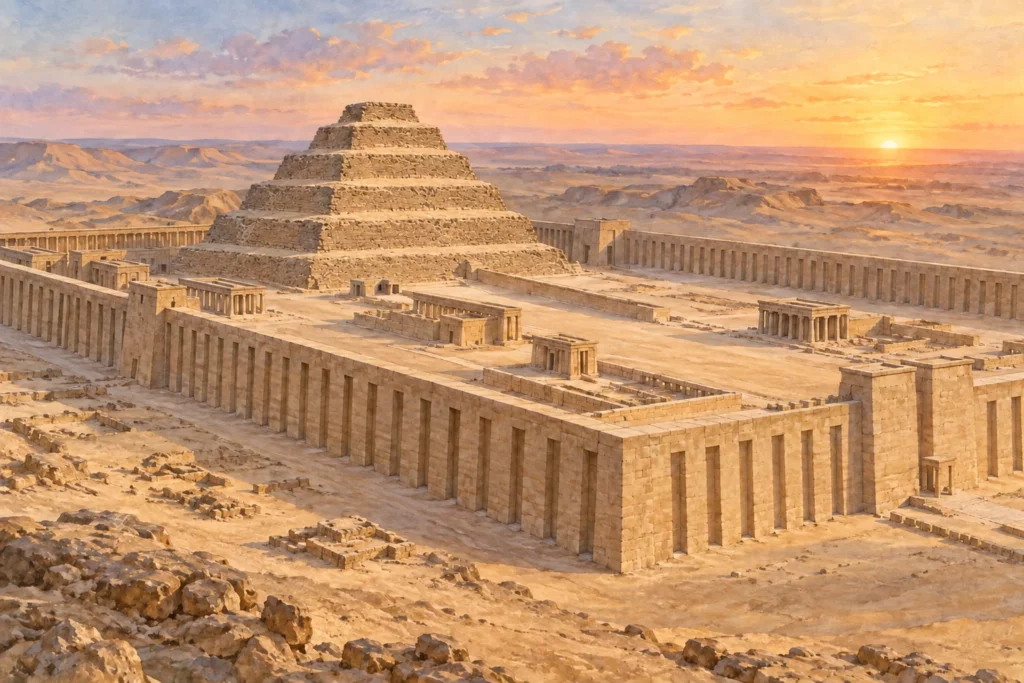
At the beginning of the 3rd Dynasty, c. 2667–2648 BC according to the chronology of the Egyptian ministry, King Netjerikhet had an unprecedented funerary complex built at Saqqara. Today he is best known by the later name of Djoser. At the centre of the complex stands a limestone pyramid of six steps. It marks a decisive stage in the monumental use of stone and in the way kingship was represented after death.
What you discover
The pyramid is only one part of the whole. A great enclosure with niched façades delimits courts, festival chapels and spaces linked to royal ceremonies. Beneath the monument are a shaft and underground chambers associated with the burial. To the south, another structure called the ‘South Tomb’ probably played a symbolic role; its exact function is still debated. The buildings of the Sed festival court evoke in stone the temporary structures used for the celebrations renewing royal power. The site is therefore a complete ritual landscape, not a simple isolated pyramid.
Its history
The project evolved during construction: an initial form close to a mastaba was enlarged and transformed until it became the Step Pyramid. The shift from mudbrick to large ensembles of dressed limestone bears witness to new organisation and skills. Imhotep is traditionally associated with this innovation, but the precise attribution of each architectural choice rests partly on later sources. The name ‘Djoser’ itself is attested later than the royal name Netjerikhet found in contemporary documents.
Why this place matters
The complex at Saqqara shows how architecture could extend royal ceremonies through time: courts, chapels and tomb formed a coherent programme. The Step Pyramid precedes the smooth-sided pyramids of the following generations, without being their final form. It belongs to the Memphis necropolis, inscribed on UNESCO’s World Heritage List. Restoration and conservation now make more of its elements readable.