In the footsteps of Jean-François Champollion · 4–5 October 1828. A story adapted from his travel letters; it is not a quotation.
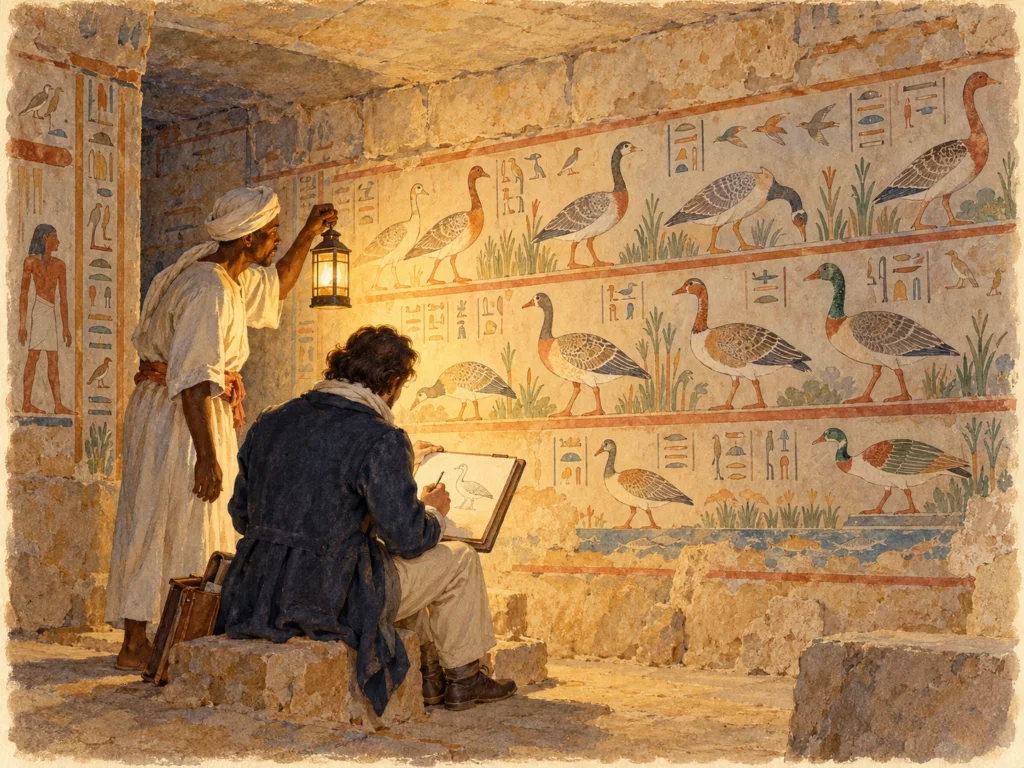
At Saqqara, two tombs are going to save my day. The birds there are accompanied by their names; elsewhere, milk is being drawn and two cooks are busy. After the plundered tombs and the bones scattered in the sand, these scenes at last call for us to open our portfolios.
A head in the ruins of Memphis
Before coming to camp here, we crossed the site of Memphis. A grove of date palms covers part of the ancient city. Between the villages, the blocks of granite breaking the surface are enough to show that we are walking on something other than an ordinary plain.
Above all, I wanted to see the great colossus cleared by Caviglia. I had heard a great deal about it. The statue lies overturned and part of the legs is missing; the face, protected by its fall against the ground, has remained intact. I find it strikingly like a statue I know in Turin.
The inscriptions on the arms, the chest and the belt allow me to recognise the same ruler. I have the head drawn with particular care and all the inscriptions copied. Around this giant, other fragments make one want to search further. We do not have the time to take on the whole city.
The camp of 4 October
At Saqqara, we are under canvas. The servants have their own tent. Men chosen locally keep watch at night and run errands during the day. This camp is meant to give us the leisure to explore the necropolis of Memphis.
The walk is a sad one. Excavations and upheavals have multiplied the mounds. Human bones are strewn over the ground. Many decorated tombs have been devastated; others, plundered, have already been filled in again. What the dealers have carried off is far from all they have caused to disappear: the walls and their arrangement have suffered along with the rest.
A name beside a bird
In two tombs, however, there is still enough to hold us. I record a series of carved birds, each accompanied by its name in hieroglyphs. Five species of gazelle are also named. Here, drawing and writing can be examined together, on their wall, instead of being compared at a distance in a study.
The domestic scenes count just as much for our records. Milking, cooks at work: these gestures deserve their place in the drawings we shall bring back. They give back something of their life to the men whose tombs we are exploring.
Our portfolios grow thicker. For a moment I leave the sight of the destroyed chambers to follow the details of a surviving scene. After the ruins of the great city and its colossus, a bird with its name is still enough to hold me.