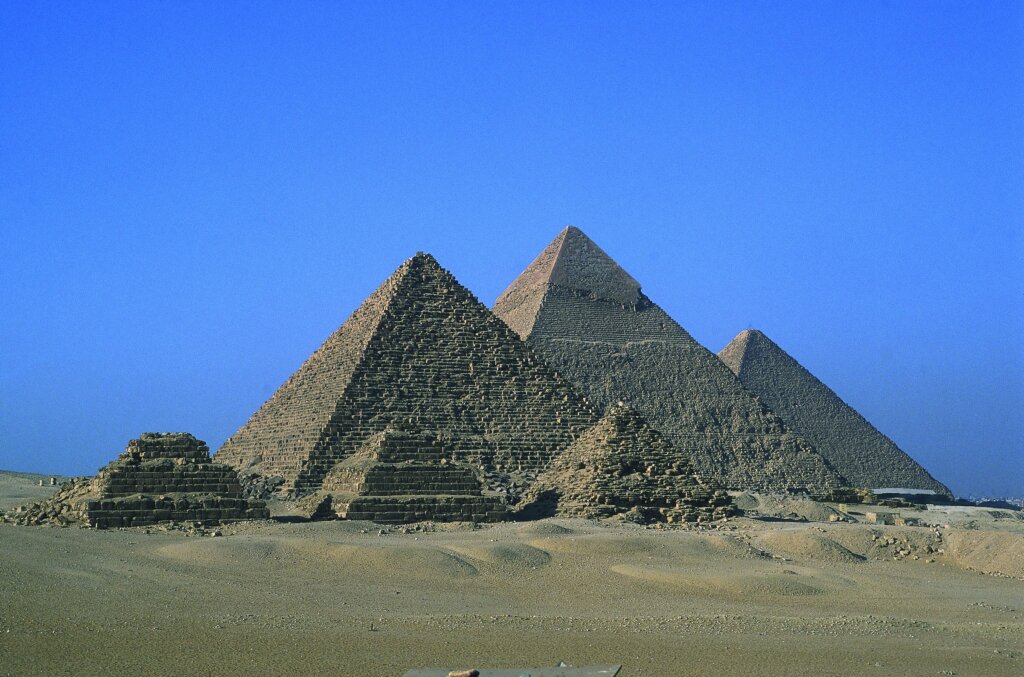
After the farewells in Luxor, the early flight and the din of Cairo, I finally reach Giza. I thought I knew what I was going to feel. The pyramids look small to me.
Disappointment
There they are, and I do not know what to do with my disappointment. I have waited so long for these pyramids, seen so many pictures of them, read so many descriptions. In the hazy light of this late afternoon, they look incredibly small. Have the too-short night in Luxor, the farewells to my cruise companions, the early flight and the day in the din of Cairo dulled my eye? I would like to be dazzled to order. It does not work.
Figures learnt by heart
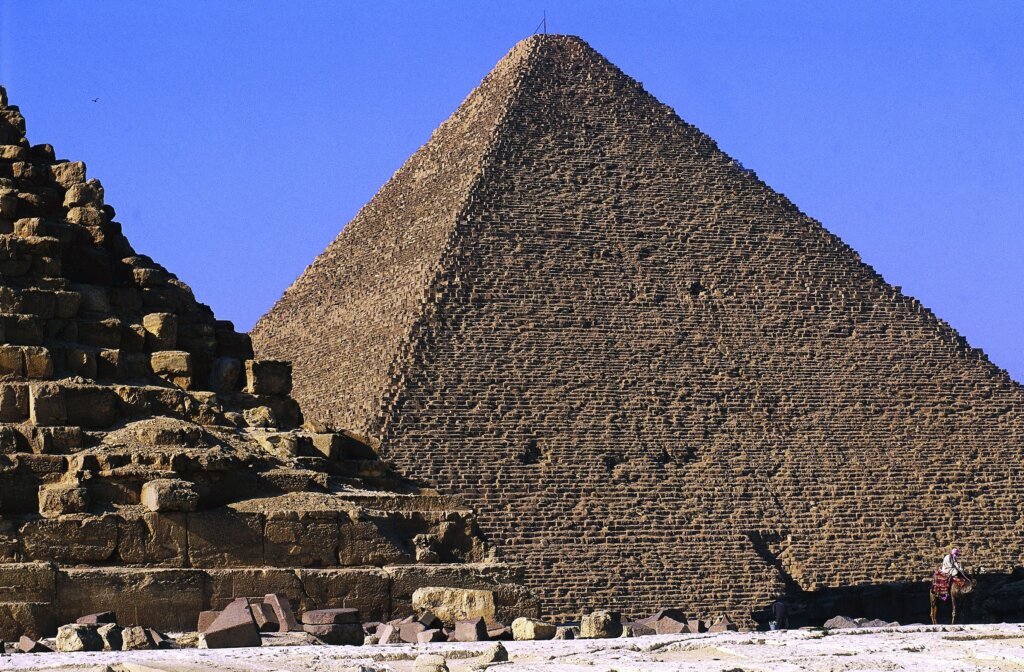
I sit down on a stone and close my eyes. To put my head in order, I recite the dimensions of Cheops (Khufu): one hundred and forty-six metres high originally, one hundred and thirty-eight now, two hundred and thirty metres along each side; some two million three hundred thousand blocks, two and a half tonnes on average. Bonaparte’s scholars are even said to have imagined a wall around France built with the stones of the three pyramids. The figures have lost none of their scale. So I am the one who has to adjust.
Right. It rains far too little here for anything to have shrunk. I open my eyes again. Cheops, Chephren (Khafre) and Mycerinus (Menkaure) take back a little of their place. Massive, yet slender, patiently settled in their age. I still have to find where to look at them from.
Looking for the viewpoint
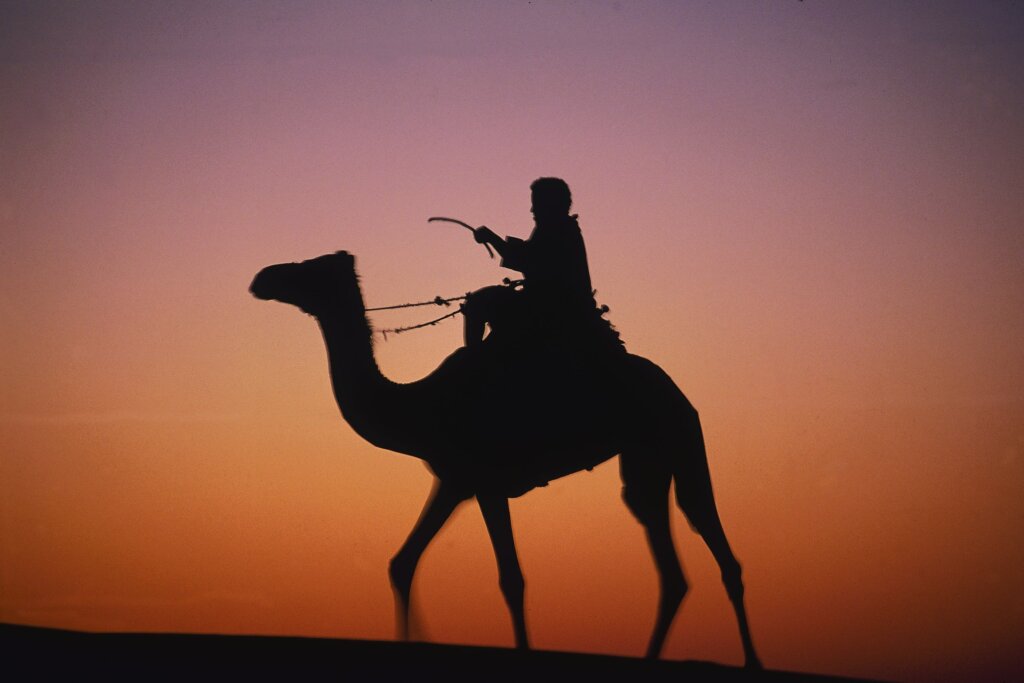
So I walk. I hitch a lift, hire a camel, take a taxi. Too close, the perspective flattens; too far away, something is still missing. The camel drivers know the answer: a rocky outcrop to the south of the plateau. At the end of the day, the low light catches in the dust raised by the camel caravans, and the three pyramids at last hold together in my gaze. The camel ride leaves me with a few aches. The search for the viewpoint, though, has done its work: I no longer think about my disappointment on arrival.
I also try to give them back their casing of fine limestone, the one that reflected the sun, and perhaps a gilded pyramidion. Looters and the builders of medieval Cairo drew heavily on the necropolis; temples, causeways and mastabas were levelled. Time has taken away far more than I can restore. As for climbing to the top, that is out of the question: the ascent is forbidden. I shall go on changing places at ground level.
Beneath the sand, the mystery
The longer I look, the more the discoveries made beneath this plateau come back to me. The burial chamber of Hetepheres, mother of Cheops, and her funerary furniture, found in 1925; the two boat pits discovered in 1954, with their dismantled vessels. More than twelve hundred pieces for the first one: it took years to give this boat its shape again. I, who struggled to find the right distance, can measure the patience needed to recover a whole object from beneath the fragments.
The Great Sphinx, traditionally associated with Chephren, extends my questions. The valley temple keeps its granite pillars. Between the Sphinx’s paws, the stela of Thutmose IV tells of the dream that is said to have led the king to clear the sand-buried monument. I arrived with ready-made images; I leave with more questions. The tiredness is still there, but the pyramids no longer look small to me.
Today: the solar boat of Cheops left the foot of the pyramid in 2021 for the Grand Egyptian Museum, where the second one is also being restored. The museum, fully open since 2025, lies two kilometres from the plateau.
To go further (in French): Giza, beyond the pyramids · The Great Pyramid of Cheops · The Great Sphinx · The shaft of Hetepheres · Cheops · Chephren · Mycerinus · Thutmose IV · The French expedition