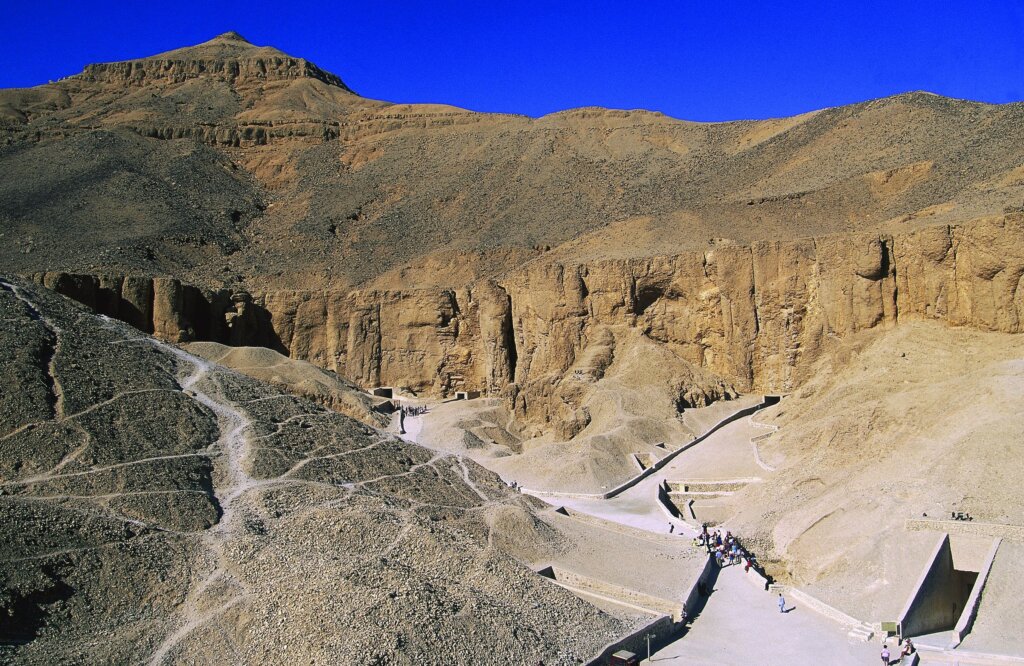
As I cross the Nile, I think of the boats of the dead. But at the threshold of the tombs, it is above all the slope, the heat and the darkness that occupy me. At Nefertari’s, I shall also have to watch the clock.
The silent guardians
The Colossi of Memnon await us at the edge of the fields and the desert. Two motionless figures of Amenhotep III, in front of a temple that has almost vanished. One of them, however, once had a voice: after the earthquake of 27 BC, it gave out at dawn a sound that the Greeks heard as Memnon greeting his mother, the Dawn. A Roman restoration, around the year 200, silenced it. Today, the guardians of the necropolis let us pass without a word.
During the crossing of the Nile, the feluccas had reminded me of the solar boats that carried the kings into the afterlife. Now that I am on the west bank, the mountain takes over. That is where we must go.
The shadow of Tutankhamun
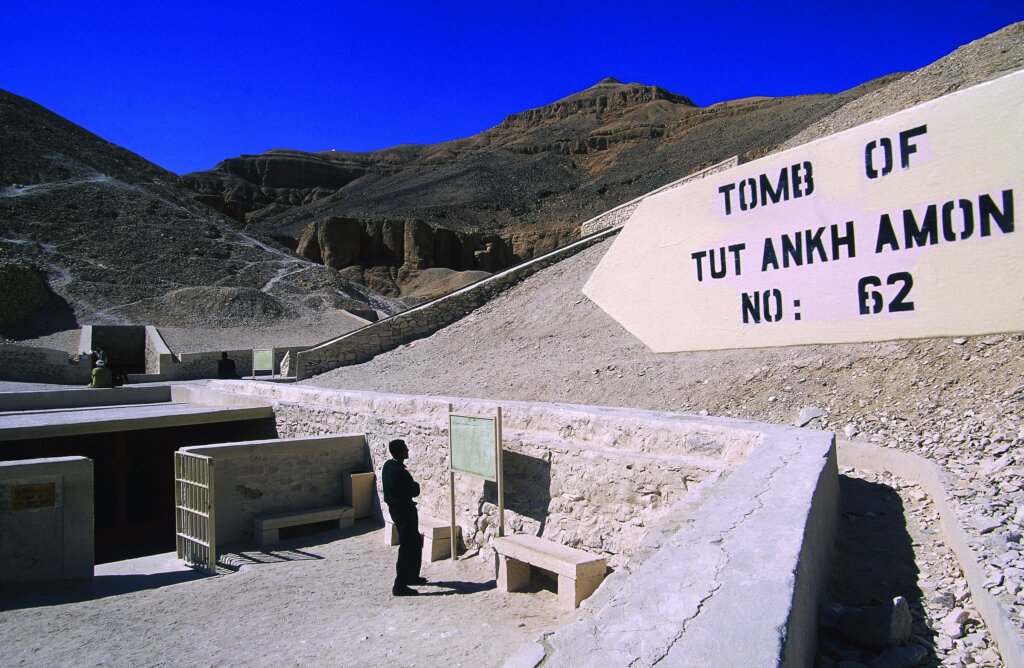
In the Valley of the Kings, I cannot help thinking of Tutankhamun. Howard Carter found his tomb almost intact in 1922. The inner coffin, of solid gold, weighs more than a hundred and ten kilos; even the small objects of the treasure bear witness to astonishing workmanship. And this king died young, after a short reign. I try to imagine what Ramses II (Ramesses II), who reigned for more than sixty years, might have taken with him. The comparison gives me no measure: it only enlarges what has disappeared.
Not for the claustrophobic
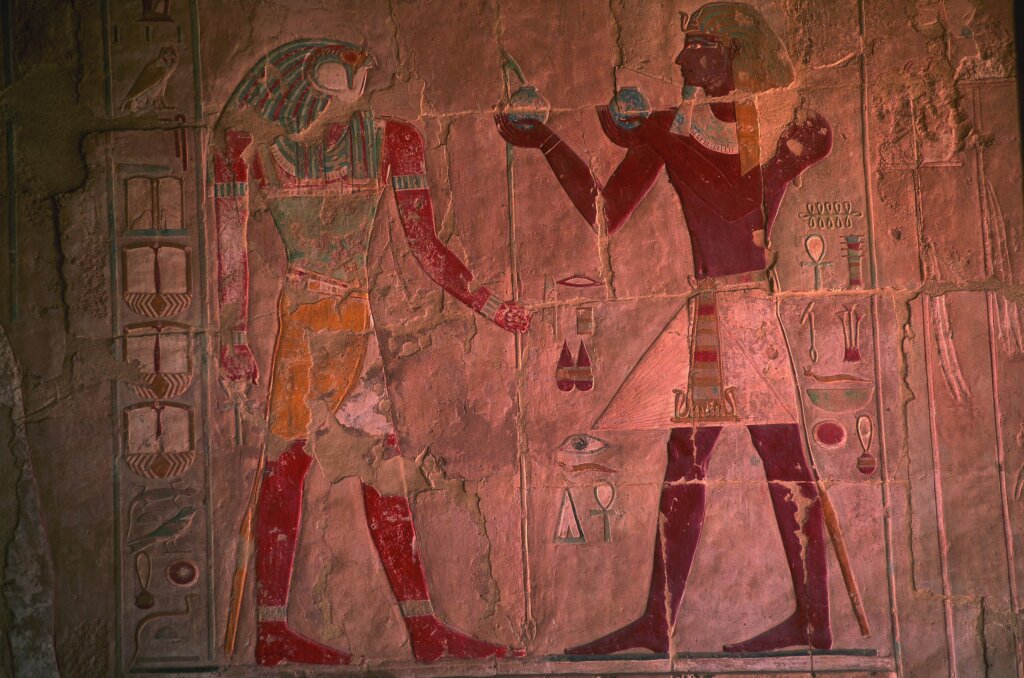
At the entrance to a tomb, however, gold ceases to be my first concern. The corridor goes down into the rock; the lighting is dim, the air hot, dry and stifling. I move forward with slight apprehension. The painted figures seem to accompany me ever deeper. Shafts, false doors and dead-end passages were meant to stop the robbers. They hardly resisted the lure of the treasures. For the visitor, the slope and the heat are already enough to slow one’s steps.
The sarcophagus hall rewards the descent. Paintings cover the walls, and I try to follow their story: the books of the afterlife, Ra in his many forms, the twelve hours of the night, then rebirth in the morning. Other funerary texts come back to me, with the weighing of the heart against the feather of Maat, under the gaze of Thoth. Osiris awaits the one whose heart is light; Ammit devours the one who fails. I look at these figures with all the attention I can, without claiming to untangle their world in a single visit.
Choosing a tomb
Then a choice has to be made: the valley has some sixty tombs, but only some of them are open, in rotation. The names make one hesitate. Thutmose III, with the hundreds of deities of the Amduat on his walls; Amenhotep II and the cache of royal mummies; Seti I, with its paintings and more than a hundred and thirty metres of depth; Ramses VI and its astronomical ceiling. The list promises more than I shall be able to see. Each descent takes its time, even when the programme urges us on.
Ten minutes at Nefertari’s
In the Valley of the Queens, at Nefertari’s, time becomes on the contrary the main concern. After years of restoration, the paintings of the wife of Ramses II have recovered a splendour that justifies many expectations. The price is high, the visit timed. The guard royally grants me ten minutes. I go down, look up at the starry ceiling, and would like to linger. Already, I have to climb back up. One minute nibbled off the schedule earns me his wrath.
I come out furious and frustrated. The tombs of the sons of Ramses III, Khaemwaset and Amenherkhepeshef, do not even catch my eye. I shall regret it later. For now, I think of everything those ten minutes did not let me see.
Today: the mummy of Tutankhamun still lies in its tomb; his treasure is now displayed at the Grand Egyptian Museum, at the foot of the pyramids of Giza.
To go further: Thebes, the landscape of the two banks (in French) · Valley of the Kings · Tomb of Tutankhamun · Tomb of Seti I · Tomb of Nefertari · Kom el-Hettan (Colossi of Memnon) · Howard Carter (in French) · Tutankhamun · Maat (in French) · Thoth (in French) · Anubis (in French)