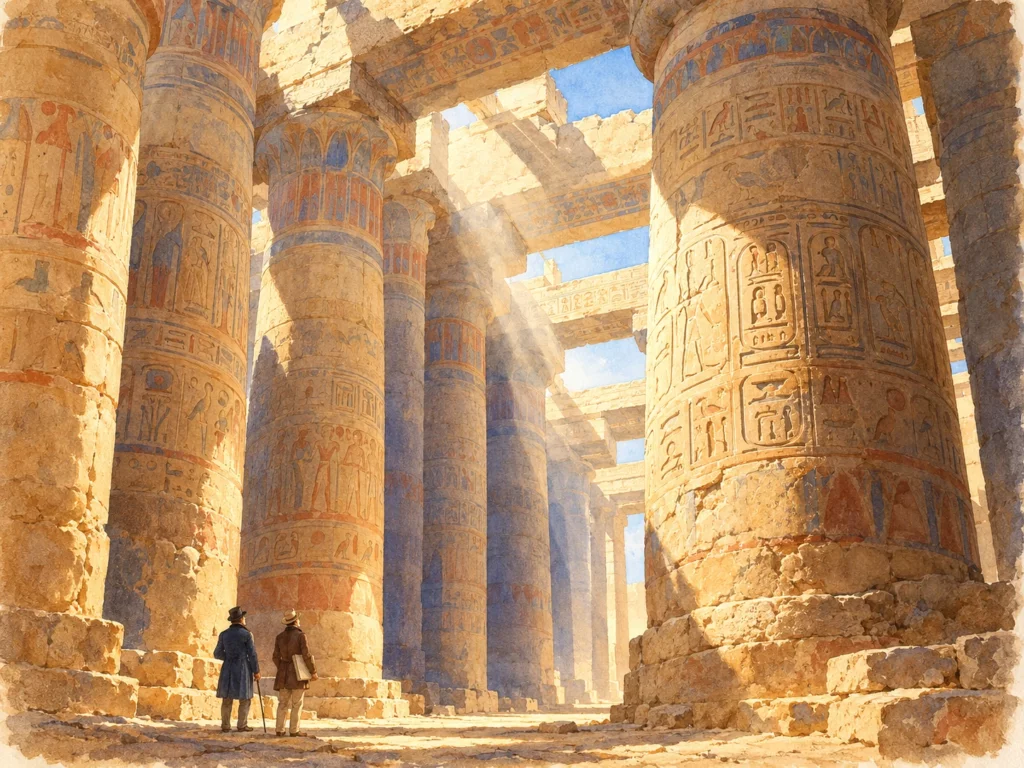
In the footsteps of Jean-François Champollion · 23 November 1828. A story adapted from his travel letters; it is not a quotation.
Four days in Thebes, and I thought I had begun to take its measure. Then I reached Karnak. Everything I had admired on the other bank had just met something greater than itself. I shall have to come back for a long time: today, I can barely take in my own astonishment.
The first three days
The wind at last let us land on 20 November. Thebes already occupied an immense place in my thoughts. Since I began exploring its ruins, the name has come to mean an expanse and a succession of monuments whose full scale my reading had not given me.
I began with the west bank, with Qurna, the great colossi and the Ramesseum. The next day was devoted to Medinet Habu. On the third day, we went into the royal tombs. From morning to evening, by torchlight, the painted rooms followed one after another. Everywhere, we had to look at the images and take the time to read their inscriptions.
Those three days would have provided enough material for a long letter. The fourth takes me to the other side of the Nile.
From Luxor to Karnak
At Luxor, I still find the two obelisks in front of the temple. The neighbouring colossi are buried in the ground up to the chest. Yet the delicacy of the work can be seen in the granite. The royal names allow me to distinguish several phases of work in this vast complex.
Then comes Karnak. To say that I am visiting a monument no longer quite fits: before me is an accumulation of buildings. The structures go on and on, the walls bear immense scenes, the columns impose their height. The comparisons that had accompanied me from Europe are of little use to me any more.
I would like to tell of this without being taken for an enthusiast incapable of restraint. But toning down my words to seem reasonable would lose what I feel on the spot. I put off the detailed description; the proportions alone already demand time.
Names amid the grandeur
I am not only looking at masses. The rulers recur in the reliefs, scenes of military campaigns fill the walls, and the inscriptions offer a hold for study. Amid this vastness, I can begin to recognise names, distinguish reigns and prepare records.
This first four-day tour remains a reconnaissance. I must go on to Nubia, then come back and settle here for several months. It would be unreasonable to claim to have finished with Thebes now.
In the evening, in my letter, I gather what I can. I have news of the monuments, much less of my own people: the mail from Europe has still not arrived. Karnak is very close; my family, from whom I am waiting for a few lines, seems infinitely further away.