
I begin Karnak by photographing everything. Then the courts follow one another, the columns stop me in my tracks, and I end up no longer knowing where to go. I shall have to give up seeing it all.
Two thousand years of building work
I have barely come in and I am already photographing without restraint. The memory card meant for the day may not last long. A classic: the sellers at the exit know this lack of foresight well. For now, every passage opens onto something I want to take away with me.
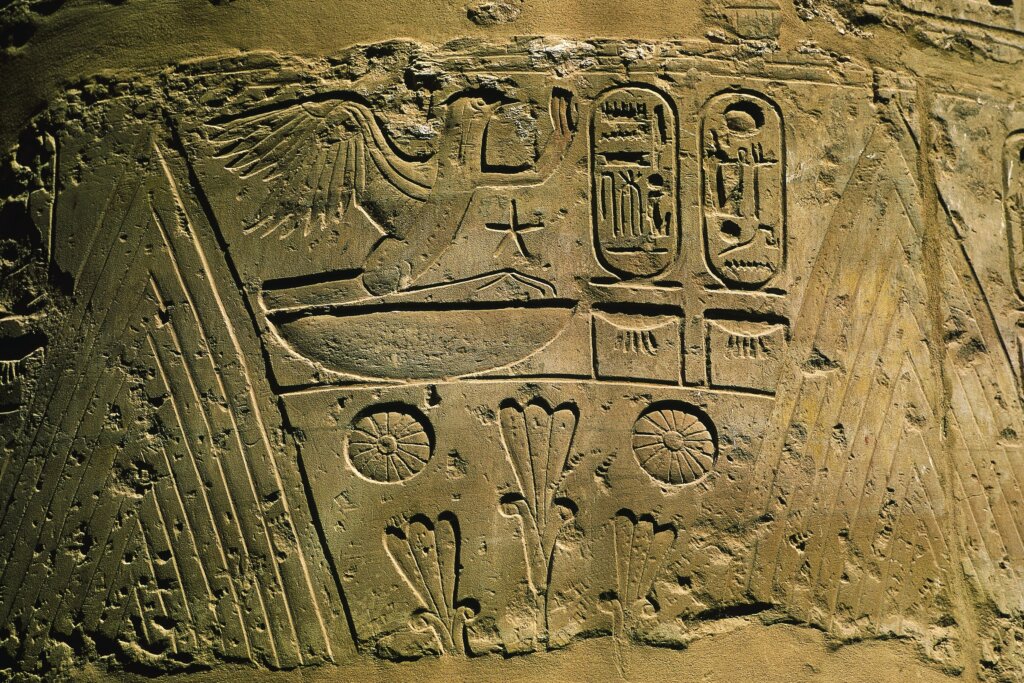
A court, a pylon, colossi, then another court. The precincts of Montu to the north, Amun in the centre and Mut to the south form a maze built over two millennia. I would like to follow the thread of the pharaohs, but the cartouches simplify nothing. Ramses II sometimes carved his name in place of a predecessor’s; blocks have travelled from one temple to another. I think of the archaeologists busy putting all this back in order. As for me, I carry on, already overwhelmed.
The hypostyle hall
In the great hypostyle hall, I look up and lose my bearings a little more. One hundred and thirty-four papyrus columns, raised under Seti I and Ramses II; the twelve of the central aisle rise more than twenty metres. The light falls at an angle between the shafts covered with religious scenes and feats of war. I go from one to the next, unable to take it all in. The word forest ceases to be a convenient comparison: it describes rather well the way I get lost in it.
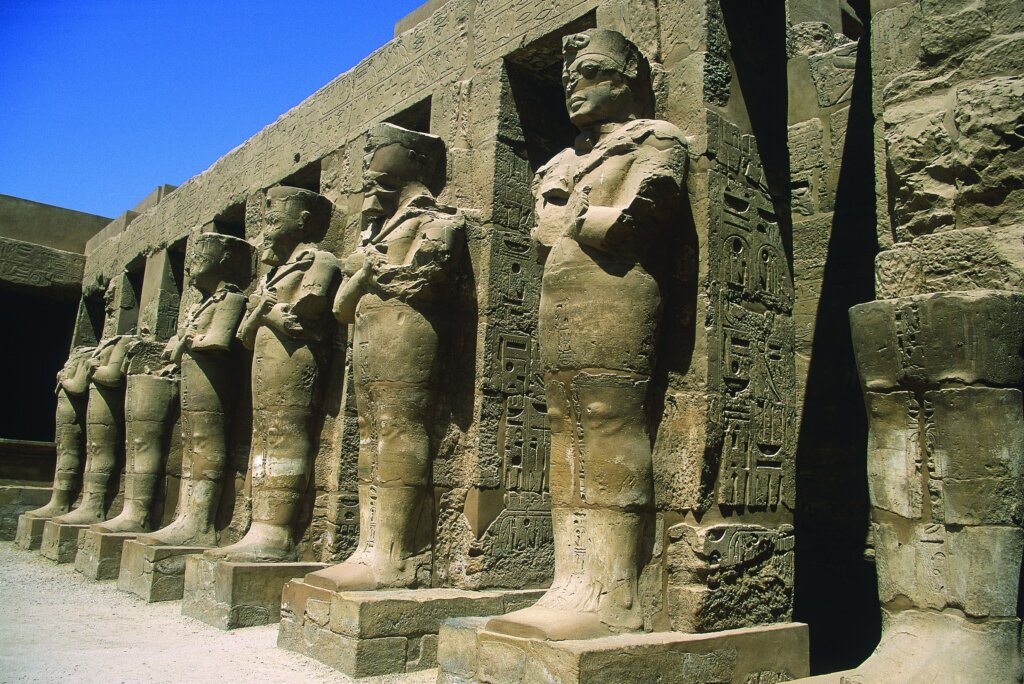
I then think back to the small temple of Ramses III, to the right of the great court. On another scale, it sets out the sequence of colossi, courts and hypostyle hall. One could almost learn there to read what, everywhere else, is beyond me. The lone column of Taharqa, the survivor of a vanished kiosk, also offers a place to pause: a single great stone papyrus in this immense building site.
Seeing everything, seeing nothing
Beyond the fourth pylon, the tangled stones, the truncated columns and the broken statues finish disorienting me. At the edge of the sacred lake, I no longer know where to go. The temple of Ptah and its Sekhmet in the half-light? The open-air museum? Khonsu and its sacred barques? It would take days. The cache of statues unearthed at Karnak in 1903 also comes back to me. Having stamped my feet at Luxor, am I going to jump around the broken obelisk of Hatshepsut? I would do better to admit that this visit will not be complete.
The scarab
Near the great scarab of Amenhotep III, the visitors have another method: walking round it. Three times round to get married, seven to have children, once for luck, so tradition says. I can spare myself the effort. I am married, I have plenty of children and, as for luck, Karnak seems proof enough to me. I leave with my photographs and everything that escaped me. There will be some left for another time.
To go further (in French): Karnak · Great hypostyle hall · Temple of Khonsu · Sanctuary of Mut · Amun · Sekhmet · Seti I · Ramses II · Georges Legrain · Ramses III