In brief
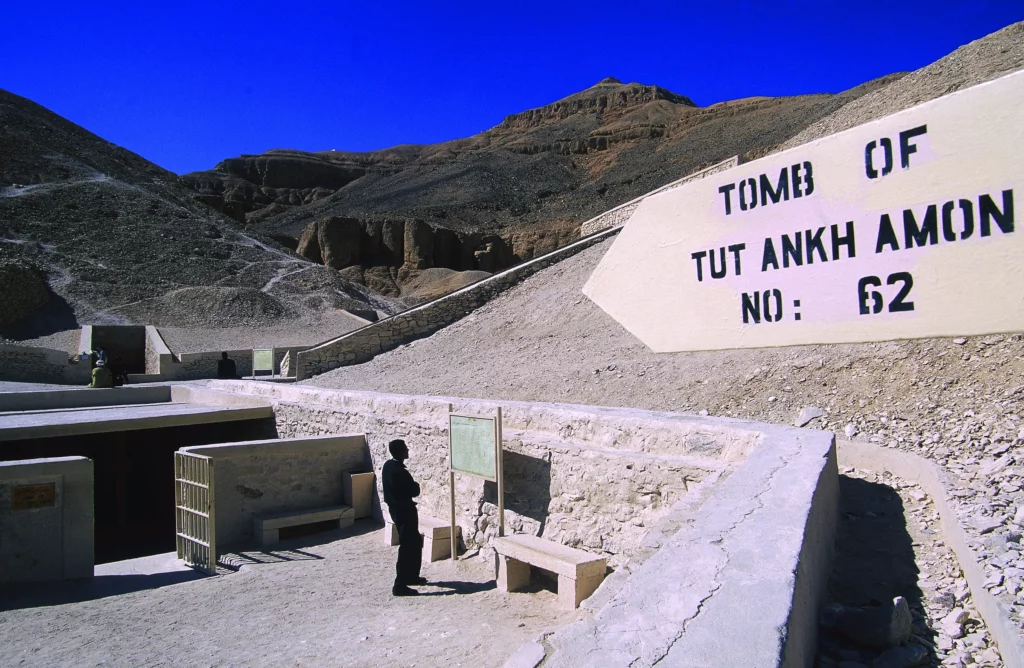
In the Valley of the Kings, on the west bank of ancient Thebes, KV62 is the tomb of Tutankhamun, uncovered by Howard Carter in November 1922. The king, who belongs to the 18th Dynasty, lived according to the Egyptian Ministry of Tourism and Antiquities around 1336–1327 BC. His reign of about nine years explains the character of the burial: small, plain, out of all proportion with the great neighbouring royal tombs. Its fame, moreover, comes less from its architecture than from what it contained, found relatively intact.
What you discover
A staircase and a corridor lead to the Antechamber. The Annexe opens directly off it; the Burial Chamber lies to the north, and the Treasury to the east of the latter. The ministry counts about 5,000 objects, packed into these rooms: clothing, jewellery, toiletries, furniture, chariots and weapons, that is, court possessions as well as funerary equipment. The visit today gives access to an emptied monument, with modern walkways, barriers and lighting, not to the crowded arrangement that Carter and his team recorded.
What to look at
In the Burial Chamber, the eye should go to the walls: it is the only room in the tomb to bear painted decoration. Unlike other royal burials adorned with great texts such as the Amduat or the Book of Gates, it shows only a single scene of the Amduat, completed by funerary images and by depictions of the king with the deities. This simplicity is itself information about the scale of the project.
Look also for the brown spots on these paintings. They had already been noted by the excavation team in 1923, and the Getty Conservation Institute points out that their nature and origin have never been fully established. This detail prevents us from seeing the decoration as a state frozen since Antiquity.
Its history
The funerary equipment was found in good condition, but this relative integrity does not mean an absolutely intact discovery: the Antechamber had undergone ancient disturbances before being sealed again. The order of the rooms and Carter’s object cards make it possible to retrace the archaeological investigation. The small size of the tomb has fed hypotheses: according to the ministry, it may originally have been intended for another use, perhaps as a private burial or a storage place, then adapted for a king. None of these proposals is demonstrated by the plan alone.
Why this place matters
KV62 combines an exceptional context of discovery with detailed excavation documentation. The funerary equipment sheds light on the material life of the court as much as on funerary rites. Between 2009 and 2019, the Getty Conservation Institute and the Supreme Council of Antiquities carried out a project for the conservation and management of the site. Faced with fears that visitors were worsening the deterioration, they replaced the walkways, installed protective barriers, improved the lighting and ventilation, and set a visitor capacity to avoid overcrowding. These arrangements are now part of the experience of the place, without belonging to its ancient architecture.
Sources
Consulted on 30 September 2026: Tomb of Tutankhamun, Egyptian Ministry of Tourism and Antiquities; Conservation and Management of the Tomb of Tutankhamen, Getty Conservation Institute.