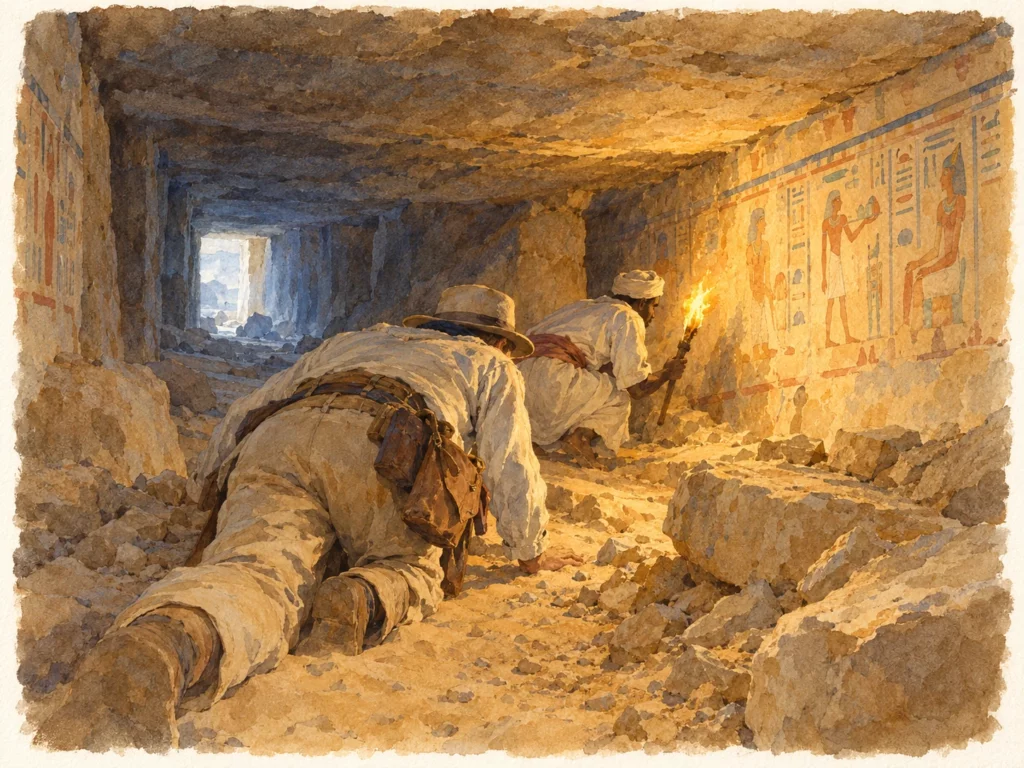
In the footsteps of Giovanni Battista Belzoni · 1817. A story adapted from the traveller’s account.
At the entrance, the galleries seem easy enough. Further on, sand and rockfalls narrow the passage. You have to stoop, then crawl. I am looking for papyri and have decided to go beyond what most visitors can see.
The length of the passage
The guides carry torches. Their light leaves the walls dark and reveals the figures piece by piece. The rooms follow one another, linked by corridors where it is hard to make progress. Sharp stones hurt wherever you lean; under some ceilings, there is only room left to slide your body through.
The dust rises at the slightest movement. It gets into the mouth, irritates the lungs and makes the air harder to breathe. I have already made several of these excursions; I know how tired one is on coming back. Repetition dulls the fear, but it does not make the air any better.
The bodies have been piled up, moved and heaped together in chambers that have become almost impassable. I do not come across an isolated burial with its objects neatly arranged, but disturbed spaces where every step means looking for somewhere to put one’s foot.
A support that gives way
Once, after a long corridor, I want to rest in a wider vault. I sit down on a heap that gives way under my weight. As I try to hold on to the neighbouring bodies, I make them crumble too.
The dust envelops me. I stay motionless for about a quarter of an hour, until it clears enough for me to move again. The spot where I thought I had found a seat no longer holds.
In another passage, the human remains are packed so tightly that only the width of a body is left. The slope helps me forward, but it also drags along with me fragments I cannot help displacing. My face passes very close to those of the dead. I struggle on to the next vault.
What I came to look for
The rolls are not always placed separately. I have found some under the arms of the mummies, near the chest, around the legs, wrapped with them in the linen bands. This possibility makes me take up again explorations whose difficulties I know only too well.
I often come back exhausted, sometimes close to fainting. The search for papyri has occupied my attention; the narrow passages, the dust and the supports that collapse have occupied the rest of my body.
In my account, I can describe the route I followed. On the spot, the main thing is to find out how to retrace it in the opposite direction.