In brief
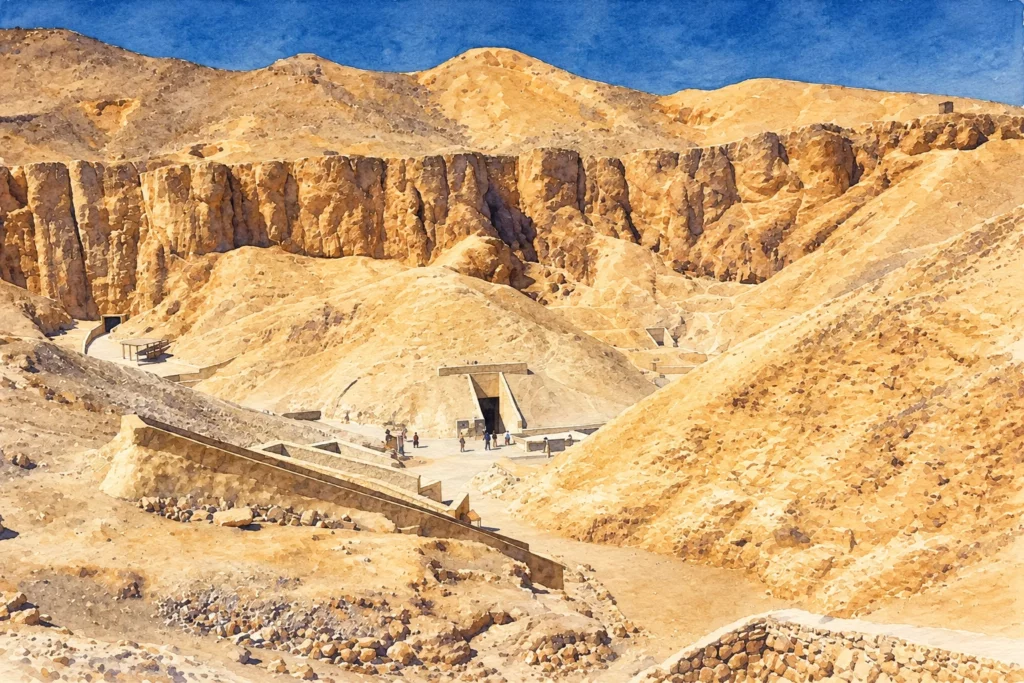
KV17, the tomb of Seti I, is cut into the Valley of the Kings, on the west bank at Thebes. The king, the second ruler of the 19th Dynasty, reigned c. 1294–1279 BC and was the father of Ramses II (Ramesses II). The Egyptian Ministry of Tourism and Antiquities presents it as the first fully decorated tomb in the valley, and also as the first with a burial chamber with a vaulted ceiling. His temple at Qurna and the one at Abydos are other monuments.
What you discover
The layout of the tomb follows an offset axis, known as ‘bent’. A descending corridor leads to a pillared hall, then a further passage leads to the burial chamber. A room on the original axis is interpreted by the ministry as a decoy intended to mislead intruders, a hypothesis that should be kept as such. The walls bear the Litany of Ra, the Amduat, the Book of Gates and the Book of the Heavenly Cow. On the vaulted ceiling of the burial chamber, astronomical scenes simulate the night sky.
Its history
Giovanni Battista Belzoni discovered the tomb in 1817, hence its nickname of ‘Belzoni’s tomb’. In 1821, the exhibition at the Egyptian Hall in London presented painted reconstructions of several of its rooms, which made it one of the first monuments to draw the attention of the general public to ancient Egypt, according to the ministry. The king’s sarcophagus also found its way to London. Belzoni wanted to sell it to the British Museum, which refused the price of £2,000; Sir John Soane then bought it, and it was the most expensive object he ever acquired.
What to look at
The sarcophagus, now in Sir John Soane’s Museum, is one of the most remarkable objects to have left the tomb. It is carved from a translucent calcite, known as alabaster, and covered, outside and inside, with the Book of Gates carved in hieroglyphs. At the bottom of the case, a figure of the goddess Nut, guide and protector of the dead, is finely drawn. On the rim, Belzoni’s name can still be read, carved there by himself. In the tomb, a passage descending from the floor of the burial chamber remains a curiosity: the ministry sees in it a deliberate link with the primeval and regenerative forces of the afterlife.
Why this place matters
KV17 marks a stage in the history of the Valley of the Kings through its complete decoration and its vaulted chamber, two innovations noted by the ministry. The Valley of the Kings is part of the property ‘Ancient Thebes with its Necropolis’, inscribed by UNESCO in 1979.
Sources
Consulted on 30 September 2026: Tomb of Sety I (KV17), Egyptian Ministry of Tourism and Antiquities; Sarcophagus of Seti I, Sir John Soane’s Museum; Ancient Thebes with its Necropolis, UNESCO World Heritage Centre.