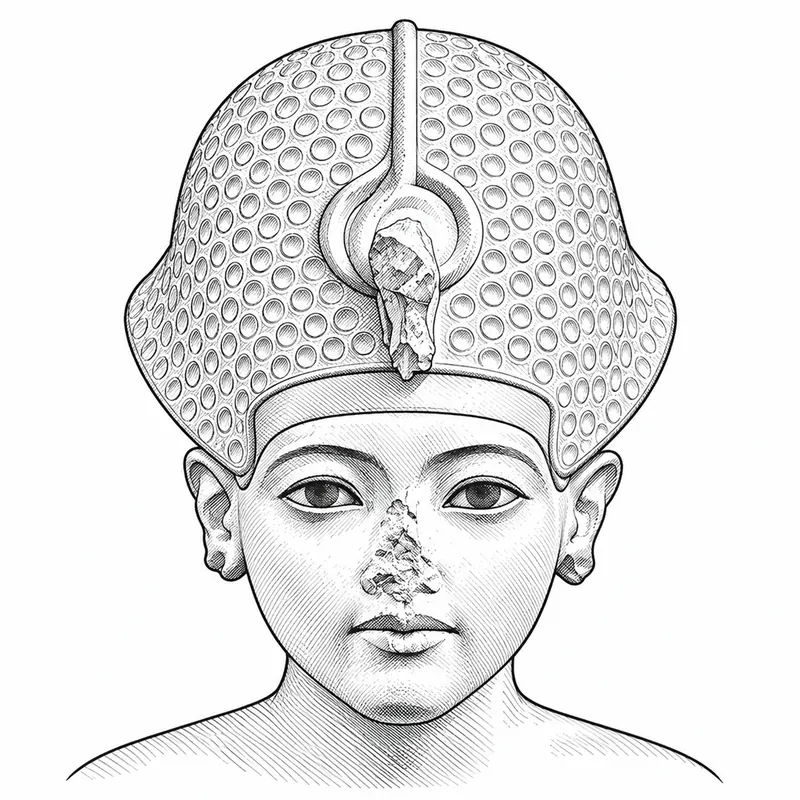
A young king in a period of transition
Tutankhamun came to the throne as a child at the end of the 18th Dynasty. UCL Digital Egypt places his reign approximately between 1333 and 1323 BC. His original name, Tutankhaten, recalled the religion of the Aten; the change to Tutankhamun accompanied the return of the traditional cults. The details of his parentage and of the succession after Akhenaten continue to be studied from inscriptions and biological analyses. The king should not be reduced to his famous tomb. His government, exercised with powerful advisers, marks a religious and political reorientation. The contemporary monuments and the funerary objects tell two linked but distinct stories: the decisions of the reign and the memory created by the modern discovery.
The restoration of the cults
The so-called Restoration Stela, associated with Tutankhamun and known from Karnak, describes the state of the sanctuaries after the Amarna Period and announces the re-establishment of the gods, the offerings and the priests. Its language seeks to legitimise a new policy. It bears witness to a real change, but its claims about general ruin must be read as an official staging. The return to Amun (in French) and the other cults did not erase the practices of Amarna overnight. Names, objects and people passed through the transition. The court also moved its centre of gravity away from Akhetaten. The reign thus offers an example of a restoration carried out in stages, with ritual, administrative and material decisions.
The monuments beyond the tomb
UCL records inscriptions of Tutankhamun at Karnak, at Luxor and in the temple of Faras in Nubia. These attestations are a reminder that the court continued building projects and maintained a representation of power beyond the Delta and Thebes. Blocks may have been reused or reinscribed under his successors, which complicates their attribution and reading. Each monument must be placed in its material history. The presence of the king’s name at Faras shows a southern horizon; it does not on its own tell us about all the Nubian operations. The whole body of inscriptions nevertheless allows us to describe an active state despite the ruler’s youth and the relative brevity of the reign.
Tomb KV62 and its discovery
Tomb KV62, discovered in 1922 by the team of Howard Carter (in French), contained an exceptional quantity of funerary objects. It changed our knowledge of the royal art of the New Kingdom. The excavation archives kept by the Griffith Institute in Oxford make it possible to follow the position, recording and conservation of the pieces. The tomb was not a frozen palace: its objects had been chosen, made or sometimes adapted for the rites of burial. Their present state is also the result of excavation, restoration and moves between museums. To write the history of Tutankhamun, what these objects say about his funeral must be distinguished from what they prove about the decisions of his government.
An early death with debated causes
Tutankhamun died young, after about a decade of rule. Analyses of his mummy have prompted proposals about his health, his injuries and the causes of his death. None should be turned into a certain plot while the evidence remains disputed. Medical methods can identify bone lesions or other clues, but they do not automatically reconstruct the king’s last days. The probable speed of the funeral is often linked to the size of the tomb and to possible reuse of objects. These observations are useful provided that material observation is distinguished from interpretation. The modern mystery should not make us forget the far more solid sources on the religious restoration.
The successors and the erasure of the period
After Tutankhamun, Ay and then Horemheb took power. Horemheb and the first kings of the 19th Dynasty reorganised the memory of the end of the 18th: some names were omitted from the lists and monuments were reattributed. This treatment partly explains why the tomb escaped the large-scale plundering that affected other royal burials, even if the exact history of its preservation remains complex. It also complicates the reconstruction of the succession. The inscriptions of the reign must be checked to detect later alterations. The history of Tutankhamun illustrates a transition in which immediate political action and later work on memory were closely linked.
A reign more important than its fame
Tutankhamun’s fame comes from KV62; his historical importance comes from the exit from the Amarna Period. His reign includes the restoration of the cults, the continuity of institutions, inscriptions in several regions and the role of the advisers; the discovery of 1922 belongs to another history. The Oxford archives make a verifiable study of the tomb possible, object by object. The uncertainties about his death and his parentage must remain identified as such. This approach does not diminish wonder at the treasures; it connects it to wider historical questions: how a young king was represented, buried and finally rediscovered.
Main sources
- UCL Digital Egypt, Tutankhamun and his attestations
- Griffith Institute, archives of the discovery of KV62
- Metropolitan Museum of Art, publication on the funeral of Tutankhamun
- Model for the line portrait: head of Tutankhamun, Metropolitan Museum of Art, 50.6.
Reference works
- Ian Shaw (ed.), The Oxford History of Ancient Egypt, Oxford, Oxford University Press, 2000, chronology pp. 479–483
- Aidan Dodson and Dyan Hilton, The Complete Royal Families of Ancient Egypt, London, Thames & Hudson, 2004