In brief
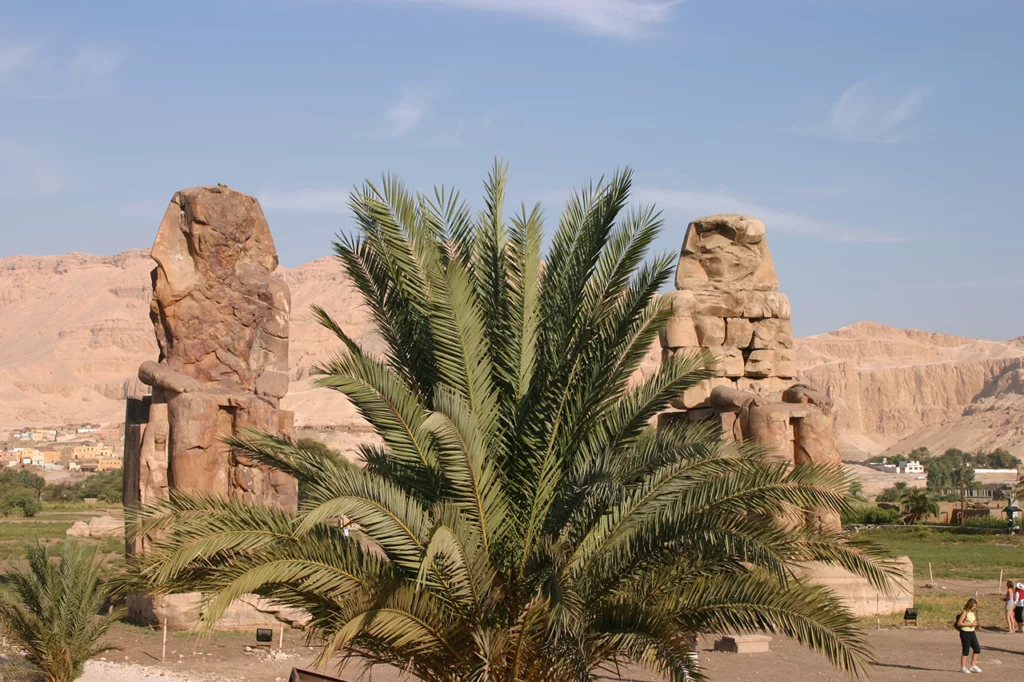
On the west bank at Thebes, two seated statues of Amenhotep III, the Colossi of Memnon, marked the entrance to his temple of millions of years at Kom el-Hettan. They still dominate the plain, whereas the temple that stretched behind them has almost disappeared. Since 1998, an Egyptian-German mission has been excavating and conserving the site, under the authority of the Egyptian Ministry of Tourism and Antiquities and with the German Archaeological Institute. The project is directed by Hourig Sourouzian. It reveals a complex far larger than the statues alone.
What you discover
In front of the two colossi, the Nile plain looks almost empty. The remains are read lower down: column bases, decorated blocks, fragments of statues. They indicate that the monument comprised courts, pylons and a great columned hall. The excavations have yielded figures of the king, of Queen Tiye and of deities. Some pieces have been cleaned, restored or reset: they are therefore not all at the exact spot where they were found.
What to look at
Several finds give a precise idea of what this temple was. Two colossal limestone sphinxes representing Amenhotep III were found near the gateway of the third pylon. According to the mission’s studies reported by the ministry, they are about 8 metres long. Wearing a headdress with a mongoose head, they bear an inscription describing the king as ‘beloved of the god Amun-Ra’. Their presence confirms the existence of a processional way.
Another remarkable piece, a black granite statue of Horus 1.85 metres high, was discovered in the columned hall. The falcon-headed god is shown there in human form, wearing a kilt; the arms and legs are broken, but the whole is well preserved. Busts of Sekhmet in black granite were found in the court and the columned hall. Sandstone walls also show scenes of the Sed festival, the royal jubilee.
Its history
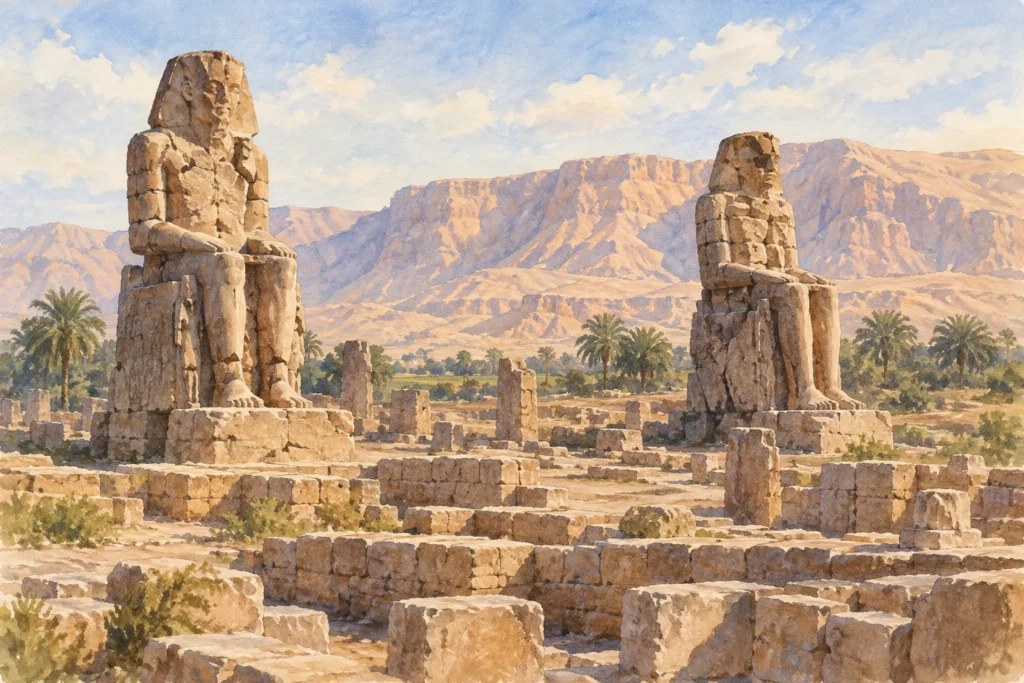
Amenhotep III had this temple built in the 14th century BC for his royal cult. The monument was later badly destroyed. The ministry refers to ancient earthquakes, and the builders of the Ramesside period reused its stones for other buildings. The modern excavations form a final phase: the mission identifies fragments, studies them and resets some of them. On site, therefore, the preserved ancient elements, the pieces taken out of the ground and the conservation work must be distinguished.
Why this place matters
Kom el-Hettan shows how a monument can survive in memory thanks to two statues, even though most of its buildings have disappeared. It belongs to the west bank at Thebes, inscribed on UNESCO’s World Heritage List among the many temples and tombs of the necropolis. The discoveries make it possible to recover part of its religious and royal programme. They are also a reminder that reconstructing the whole temple remains an investigation: the foundations and find spots provide the clues, not a certain image.
Sources
Consulted on 30 September 2026: New archaeological discoveries in the project to restore the Colossi of Memnon and the temple of King Amenhotep III, Egyptian Ministry of Tourism and Antiquities; Large Fragment of a Monumental Statue of Horus Discovered in the Mortuary Temple of Amenhotep III, Egyptian Ministry of Tourism and Antiquities; Ancient Thebes with its Necropolis, UNESCO.