In brief
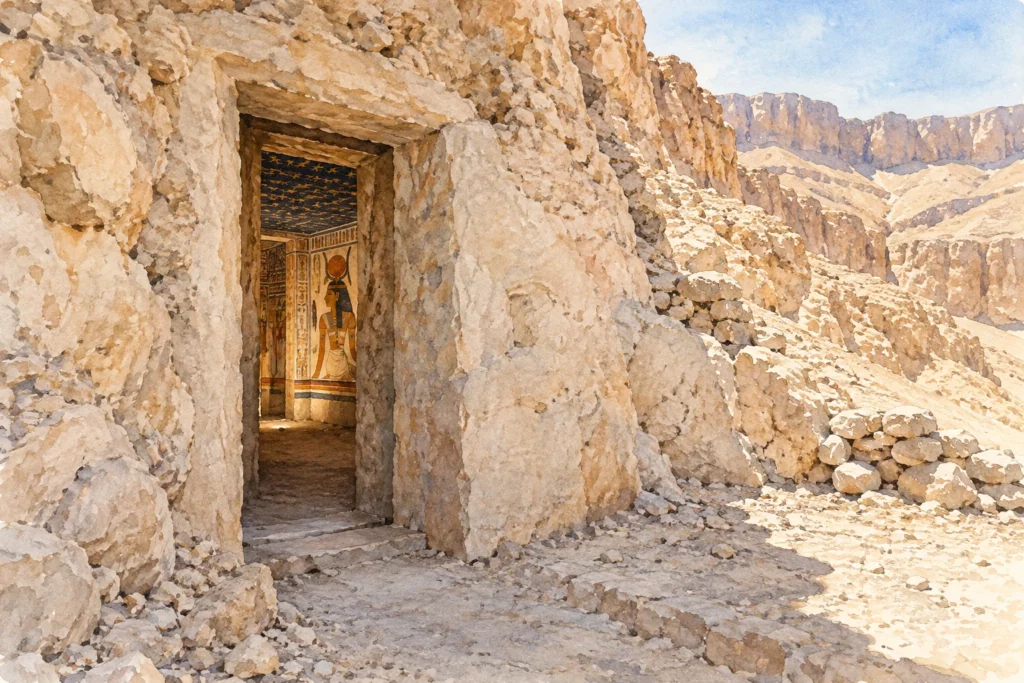
The tomb of Nefertari, QV66, lies in the Valley of the Queens, on the west bank at Thebes. Nefertari was the wife of Ramses II (Ramesses II), and UNESCO mentions her tomb together with that of Tuya, mother of Ramses II, among the remarkable burials of this valley. Its paintings, about 3,200 years old, are among the most famous of ancient Egypt, and also among the most fragile.
What you discover
What you discover here is above all a group of wall paintings, not monumental architecture. The Getty Conservation Institute, which led the conservation project, stresses that the treatment of the paintings was limited to consolidation and cleaning, in order to preserve the historical integrity of the place. What visitors see is therefore, as far as possible, the original decoration, with its alterations, not a repainted version. The fragility of these surfaces, due to the way they were executed, explains the care given to the tomb.
Its history
Ernesto Schiaparelli opened the tomb in 1904. He already found damaged paintings there, a consequence, according to the Getty Conservation Institute, of the way they had been executed. In the following decades, the deterioration accelerated, mainly because of visitors’ neglect and vandalism; by the 1980s, at least a fifth of the paintings had been lost. From 1986 to 1992, the Getty Conservation Institute, with the Egyptian Antiquities Organisation, carried out a six-year campaign: assessment of the condition, analyses, emergency treatment and then conservation. It also included the training of Egyptian and foreign conservators.
What to look at
One scene is enough to give an idea: Nefertari seated in a booth, playing senet, a board game. The Getty reproduces it at the head of the presentation of its project (photograph by Guillermo Aldana). Then look at the colour: what can be seen is the ancient decoration, consolidated and cleaned, not a modern reconstruction. The gaps, where the paint is lost, remain visible.
Why this place matters
The tomb of Nefertari has become a textbook case in the conservation of wall paintings. The diagnostic method developed during the project can be applied to other sites, and a 1992 exhibition, organised with the J. Paul Getty Museum, reported on the work done. The Getty also published in 1993 Art and Eternity, devoted to this campaign, then in 1996 House of Eternity. The Getty also keeps the project archives, for which a finding aid was published in 2023. This documentation also outlines the limits of our knowledge: knowing how the tomb was painted and what it has lost remains work in progress.
Sources
Consulted on 30 September 2026: Tomb of Nefertari, Getty Conservation Institute; Ancient Thebes with its Necropolis, UNESCO World Heritage Centre.