In the footsteps of Giovanni Battista Belzoni · 1817. A story adapted from the traveller’s account.
The workmen do not expect to find a great tomb in this ravine where the rainwater runs. Yet I have asked them to dig here. Beneath the earth, cut rock finally appears. Then comes a painted corridor, and my expectations change scale.
The way is cut off
The passage goes down, a staircase continues it, then a new corridor leads us further into the mountain. The signs are carved and painted; the ceiling still bears its ornaments. The further I go, the more I want to know where all this leads.
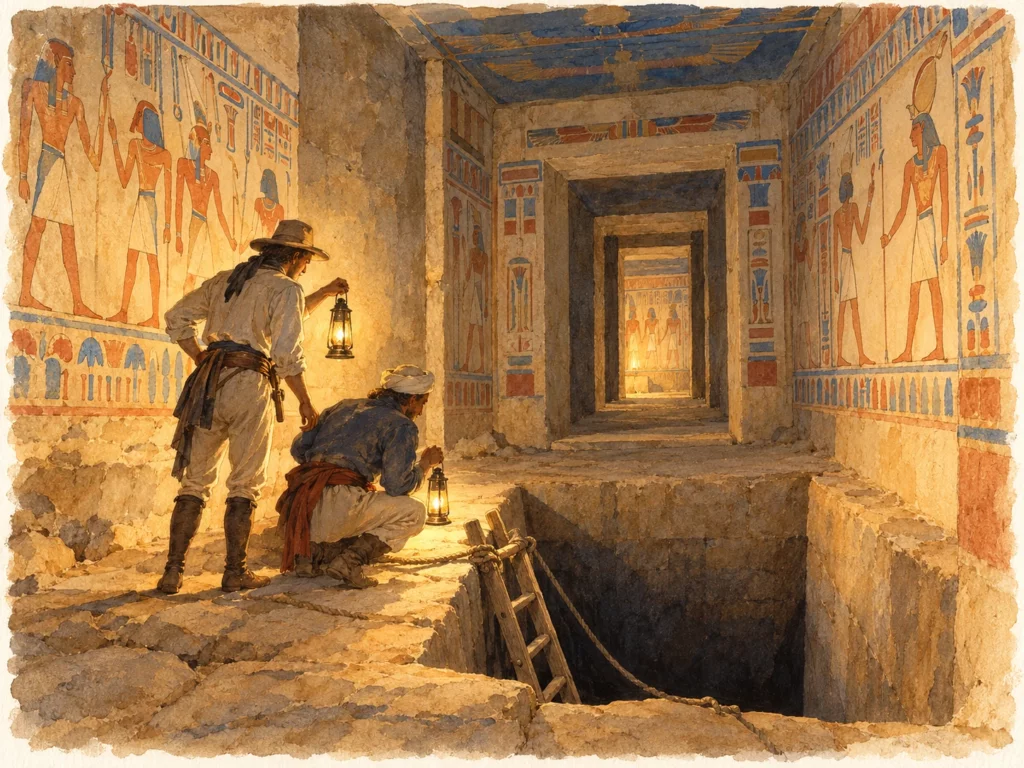
A shaft interrupts the way. It is wide and deep, too wide to be crossed without preparation. Opposite, on the other side, a small opening appears. An ancient rope hangs in the void; when we touch the one nearest to us, it crumbles to dust along with the wood that held it.
The visit has to be suspended. Beechey has come from Luxor to enter the tomb; he shares my impatience to get past the obstacle. We have found something considerable and do not yet know how far it goes on.
The two beams
The next day, we lay a long beam across the shaft. A workman reaches the opposite edge and helps to put a second beam in place. This bridge allows us to reach the opening.
It goes through a wall that the builders had plastered and painted to conceal what lay beyond. The breach already existed: we are not the first to have looked for a way past the shaft. But without this flaw in the wall, we might have thought the visit was over.
A pillared hall appears. Further on, figures have remained at the stage of drawings. I give the rooms names that will allow me to find them again in my notes: the drawing room, the hall of beauties. The names come from what strikes me; they do not yet tell me the name of the owner.
The stone and the light
We go down further still. The reliefs, the paintings, the halls and the side chambers make the whole much larger than I had imagined from the entrance.
In the burial area stands a sarcophagus of pale stone. Its sides are thin, covered with small figures carved inside as well as out. A light placed behind them makes them look translucent. The lid is missing; broken fragments have been found elsewhere.
I measure and I look. The tomb has been visited, forced and stripped; yet it keeps enough colour and workmanship to give me at moments the impression of a site completed only recently. From behind the first shaft, I could see none of this.