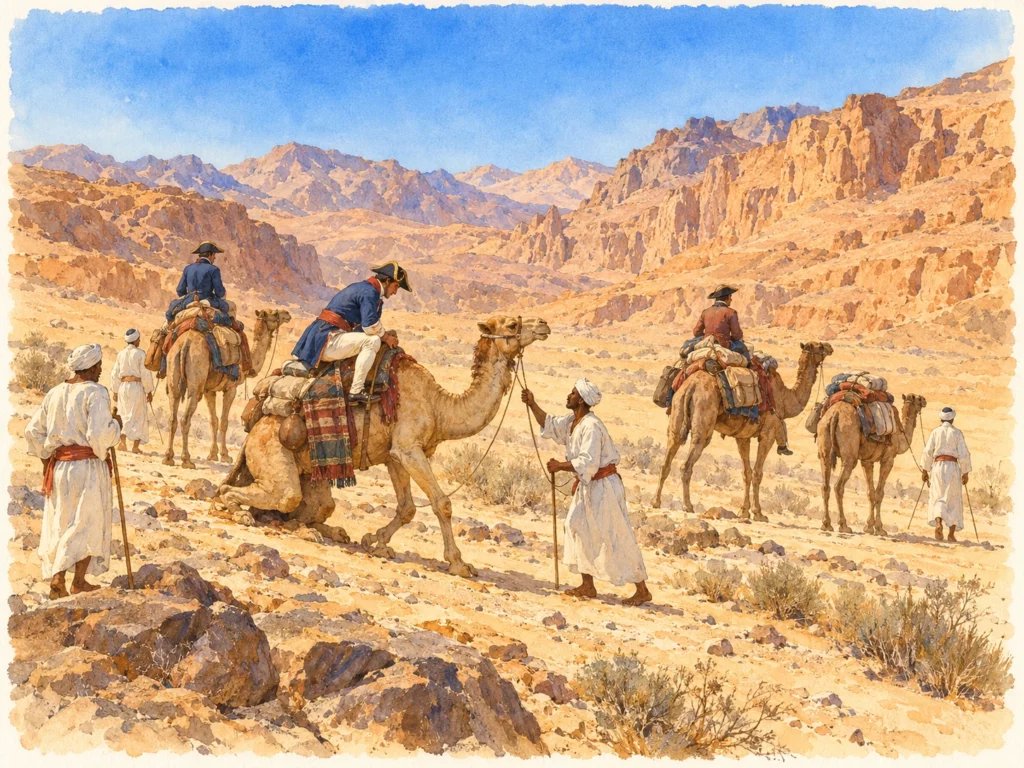
In the footsteps of Vivant Denon · 1799. A story adapted from the traveller’s account.
When the time comes to mount, everyone discovers that a camel gets up in stages. The hind legs go first; the rider pitches forward, then backward. We laugh at our neighbours, who have exactly the same reasons to laugh at us.
Leaving Qena
We leave the town in the morning. The caravan carries the men, their baggage and their water; other animals carry what is needed to set up a garrison at Kosseir. The guides and the tribesmen accompanying us know a route whose watering places we are about to learn.
I had dreaded the swaying of my mount. Once seated, I bear it better than I expected. You have to go with the pace and keep your attention for the moments when you want to change direction. Setting off had been harder than the march.
At Birambar, on the edge of the desert, the camels drink and eat. We set off again eastwards. The valley is so wide that only the points of rock at its far ends recall the mountains we are crossing. At the bivouac, everyone spreads out his rug beside his animal. The moon rises; soon the drum has everyone on their feet again.
The wells
At the Kittah, the water seeps into small wells dug through the sand and sandstone. This isolated spot governs the crossing: you do not choose your stage freely when the waterskins have to be filled.
Further on, the rock changes. The mountains draw closer; their colours and shapes at last fill a landscape I had found monotonous. In the small valleys, voices echo. The soldiers, silent until then, try out the echoes and start to sing.
One spring gives excellent water, but too little for our numbers. At another, we can spread ourselves out better. At El-Adoute, we renew our supplies. We know that the water of Kosseir is scarce and bad; no one has any interest in neglecting this one.
I take a view of the halt. The animals, the men, the vessels and the departure of part of the caravan give the drawing its movement. In a few hours, everyone will have left these wells.
The air of the sea
The mountains grow lower. A last abundant source of water delights only the camels: its taste makes us leave it. Then the air becomes lighter, and I recognise the approach of the sea before I see it.
It appears at the end of a ravine, breaking against the reefs. Inhabitants come out to meet us; the troops halt and the first exchanges take place. I had imagined a more wretched town and a more ruined fort. I find them almost imposing.
Now I look at the harbour and the roadstead. Since Qena, I have learned to stay on a camel and to measure a route by the water that can be found along it. The next day, I shall come back to draw the reefs from another side.