In the footsteps of Vivant Denon · 1799. A story adapted from the traveller’s account.
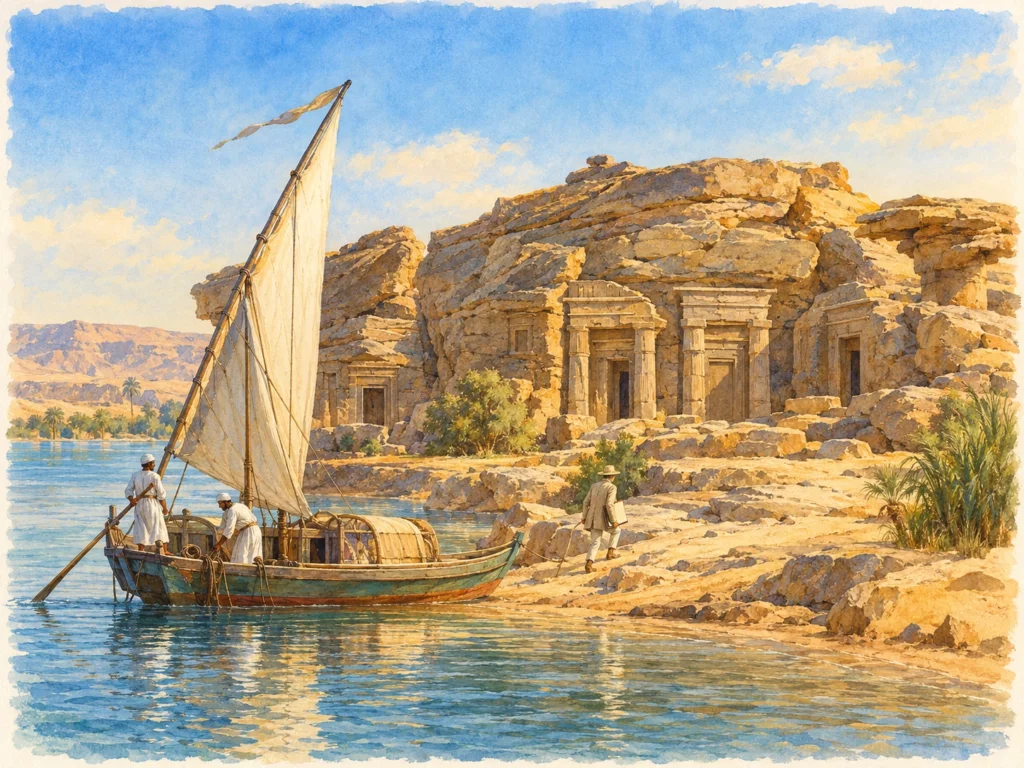
The boat runs aground in front of the quarries of Silsila. Usually, a boat coming to a halt is a setback for the journey. This time, it gives me what I do not always dare to ask for: time to go ashore.
The missing stones
On both sides of the Nile, the mountains have been heavily cut into. The volumes removed, the quarry faces and the spoil heaps suggest how long the work lasted. After looking at so many temples, I find myself in the place where part of their stones came from.
The sandstone has an even grain, great masses from which considerable blocks could be cut. The surfaces left in place give an idea of what the workmen carried away. The voids have to be looked at as carefully as the remaining rocks.
The river flows at their feet. I wonder how these masses were loaded and transported. The nearness of the water seems to explain why distant building sites could receive materials from these quarries. On paper, the journey is simple. Seeing the size of the stones, it is hard to forget the labour it required.
Facades in the cliff
The quarries are not just traces of extraction. Porticoes and chambers have been cut into the rock, with their door frames, their cornices and their figures. The monuments occupy the very material that people came to remove.
Inside some of the small rooms, figures are seated. I notice the hairstyles, the short beards, a woman’s arm passed under that of her neighbour. A hand holds a flower. The walls show offerings; on the ceilings, painted ornaments survive.
I draw the groups and arrangements that seem most interesting to me. I also try to understand who these people are, how these spaces were used, how their doors could be closed. The broken openings deprive me of some of the answers. I can record what remains; my explanations will be less certain.
The wind returns
I left the boat for the great quarries and lingered in front of these small seated figures. The two scales belong to the same stop. On one side, masses capable of supplying buildings; on the other, an arm around an arm, a flower, details that the pencil can follow.
The wind calls us back on board. It is possible to sail again; I can no longer prolong the visit. I gather up my sheets and rejoin the boat. This time, its standstill will have done me a favour.