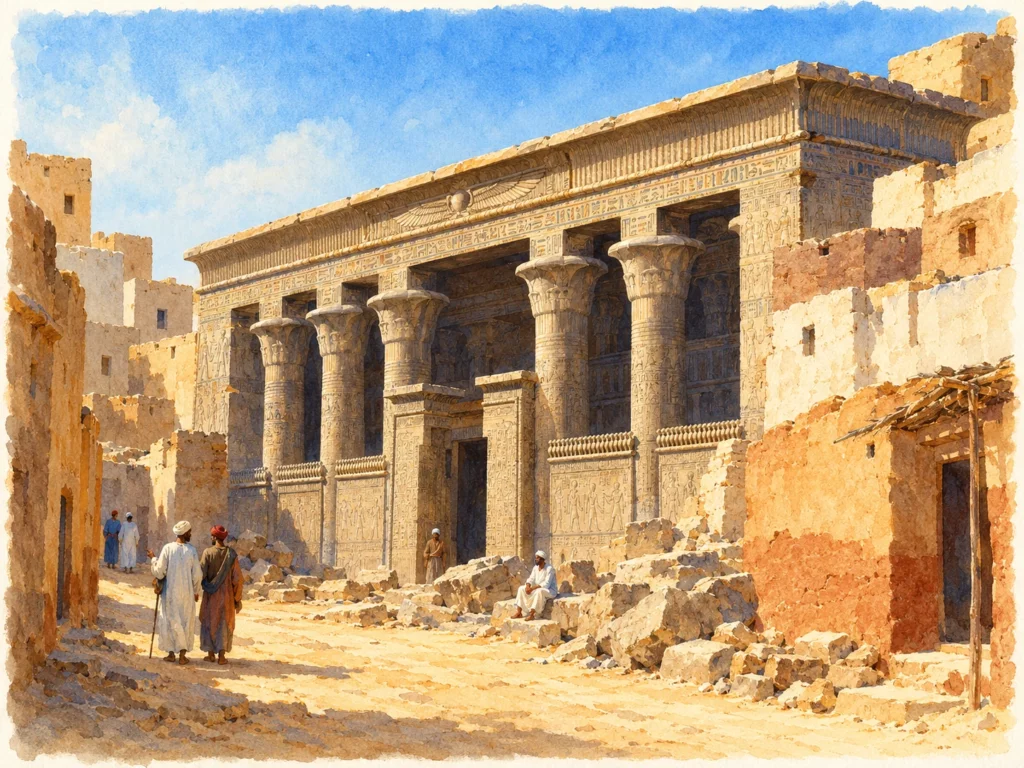
In the footsteps of Vivant Denon · 1799. A story adapted from the traveller’s account.
The portico is near the bazaar. Houses hide it, and rubble makes it impossible to read its proportions. Yet I only have to look at the columns to want to stay. It will take the hour of departure to get me out.
A cluttered square
At Esna, we are still in a real town, with its market and the remains of a quay on the bank of the Nile. The ancient monument does not present itself from a distance, isolated in the sand. It has to be looked for among the buildings surrounding it.
I go beneath the portico. Hieroglyphs cover the surfaces; above the columns, the capitals vary. My gaze goes back and forth from one to another. Foliage, stems and plant forms make up their ornaments. I think of the plants of the country rather than of the Greek orders through which I had learned to recognise architecture.
I would like to see the columns right down to their bases, follow the entrances and understand what survives behind. The accumulated ground and the houses limit the examination. A general drawing is already difficult to make in this state; a complete plan would be riskier still.
I take what I can: a view, the visible arrangements, a few details. When we have to set off again, I leave the temple with regret. We are going further south, into a country where resources are becoming scarce. The march still dictates the length of my visit.
Back to the capitals
The movements of the army bring me back to Esna several times. I use these stays to take up my drawings again. The first emotion now has precise points to settle on: a particular curve, an arrangement of leaves, the relationship between the capital and what it supports.
It is these differences that I want to keep. In the same hall, the columns do not need to repeat one another exactly to form a whole. The comparisons take time; a general view will not replace them.
General Belliard has the portico cleared of the buildings that covered it and has shops set up on each side. I see the inhabitants contribute to this transformation of their square. The monument becomes more visible, while trade stays close beside it.
I draw the plan before everything has been cleared. Some connections remain impossible to make out; I prefer to leave the doubt on the paper rather than draw doors whose position I have not seen.
Each time I came through, I took up something again. The capitals still hold me when the overall view at last begins to become clearer.