In brief
Edfu lies on the west bank of the Nile, halfway between Luxor and Aswan. Capital of the 2nd nome of Upper Egypt, the town was called Apollonopolis Magna in the Roman period, Horus being identified with Apollo. Its temple of Horus is considered the best-preserved monument in the Nile Valley. It is also one of the best dated: the foundation stone was laid on 23 August 237 BC, under Ptolemy III, and the building was completed in 57 BC, under Ptolemy XII. Between these two dates lie nearly two centuries of work.
What you discover
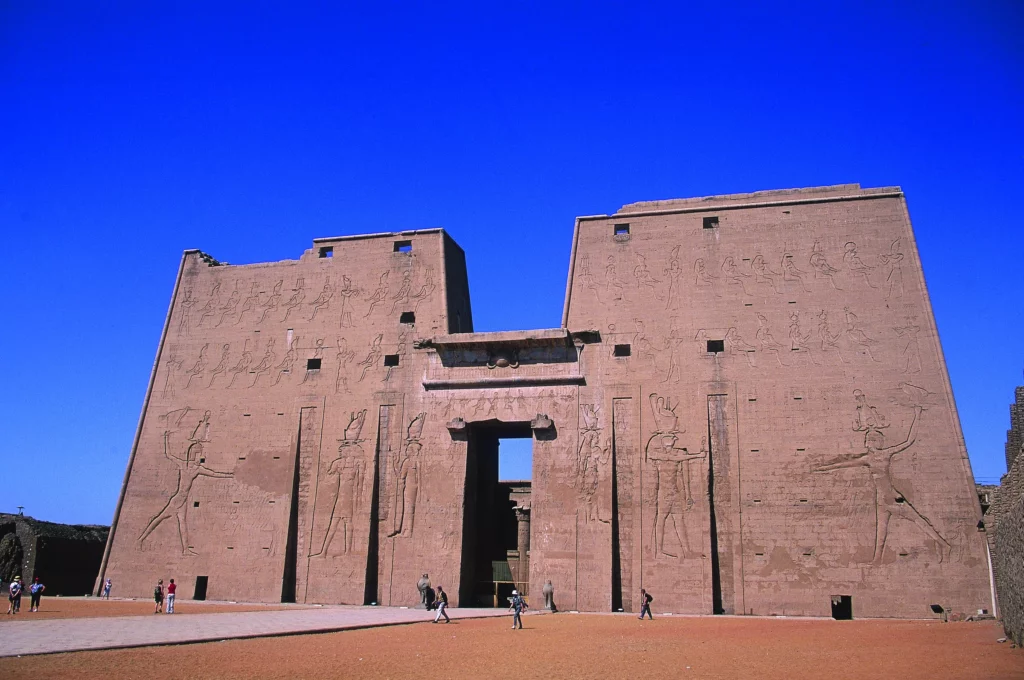
Two great granite falcons, images of Horus, stand in front of the pylon, whose faces show Ptolemy XII striking down his enemies. Behind it opens a vast court lined with columns with floral capitals, then a great hypostyle hall, a second smaller hall with twelve columns in three rows, two vestibules and finally the sanctuary. A corridor surrounding it gives access to ten ritual rooms. The whole measures 137 metres long by 47 wide. Outside, in front of the pylon, a badly damaged mammisi survives.
The temple is not perpendicular to the river, unlike most sanctuaries in the valley; the processional way that linked it to the Nile therefore did not extend its axis. Just to the west rises a mound, the tell, which covers more than three thousand years of urban history. Since 2001, an administrative building of the end of the 5th Dynasty, under Djedkare Isesi, has been excavated there, along with a governor’s residence of the Middle Kingdom. A vast court of silos of the Second Intermediate Period has also been uncovered there.
What to look at
At the back of the sanctuary stands a monolithic naos of dark granite, about four metres high. It bears the cartouche of Nectanebo II, of the 30th Dynasty: it therefore belonged to the earlier temple and was kept at the heart of the new building.
The walls, for their part, can be read like a calendar. The inscriptions give the day, month and year of the main stages of the work, and a long text on one of the outer walls describes the foundation of the temple and its plan. From it we learn that the naos was consecrated on 10 September 142 BC, in the presence of Ptolemy VIII and his wife, and that the pronaos was begun in 140 BC. The festivals are also depicted: the victory of Horus over Seth in the east corridor, the coronation of Horus on the north side of the outer corridor, and the Feast of the Beautiful Reunion on the inner face of the pylon, when Hathor came from Dendera to join her husband at the time of the flood.
Its history
At Edfu, Horus was worshipped in the form of the sun disc and the falcon, a warrior god defending the sun against its enemies. Son of Osiris, he was also the model of the king; by building here a temple of more than 6,400 m², the Ptolemaic sovereigns placed themselves within the pharaonic tradition.
At the time of the French expedition to Egypt, the temple was buried in sand up to the architraves and covered by the debris of houses. Auguste Mariette had it cleared around 1860. Its good preservation does not, however, mean an intact ancient state: the mammisi is in ruins, and the town that surrounded the sanctuary can now be read only through the excavations of the tell. The texts of the temple remain a source of the first order for the daily liturgies and the religious calendar of late Egypt.
Sources
Consulted on 30 September 2026: Pharaonic temples in Upper Egypt from the Ptolemaic and Roman periods, Tentative List, UNESCO; Temple of Edfu, Egyptian Ministry of Tourism and Antiquities; The Tell Edfu Project, American Research Center in Egypt.