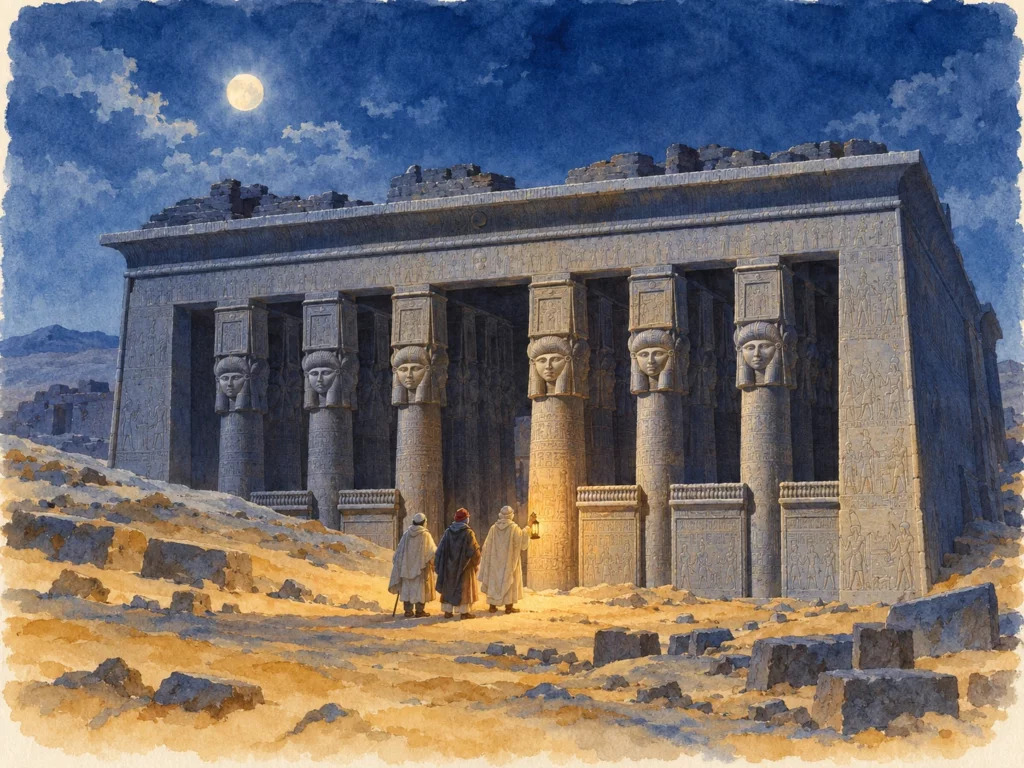
In the footsteps of Jean-François Champollion · 16–17 November 1828. A story adapted from his travel letters; it is not a quotation.
The boat has just arrived at Dendera. It is night, the moon lights up the fields and the temples are said to be only an hour’s walk away. We could wait until morning. Yet supper over, off we go, without a guide, singing operatic airs.
The straight line grows longer
We assume that the temples are straight ahead of us. This assumption makes us walk for an hour and a half without finding anything. Our great white hooded cloaks and our weapons do not make us particularly reassuring in the night-time countryside.
A man sees us and runs away. He is brought back; I make him show us the way. Our travellers’ impatience becomes for him an expedition he had not chosen. He puts us back on the right road, and the monuments finally appear.
The great gateway, then the portico of the temple, stop us in our tracks. Their effect in this light goes beyond anything I could fit into a measurement or a survey. We have found Dendera at last; we no longer want to go back to the boat.
A lantern for the great halls
We stay for two hours. Inside, our poor lantern accompanies our rush from one hall to the next. Outside, we try to read the inscriptions by the light of the moon. The wish to recognise the signs prolongs the visit still further.
It is three in the morning when we get back to our boat. Four hours later, we set off for the temples again. This time, the whole day of the 17th will be devoted to them.
The sun shows the details that the night barely allowed us to make out. The architecture keeps all its power. The sculptures, however, draw a much more severe judgement from me. I compare them with the older works I know; my admiration for the building does not extend equally to its decoration.
Cleopatra, then the emperors
The inscriptions give my eyes other work. On the outer rear wall, I recognise Cleopatra VII and her son Caesarion. Elsewhere come the names of the Roman emperors. The different parts of the temple begin to fall into place in time as I examine their inscriptions.
I also record the dedications: the great temple is dedicated to Hathor. This building must be distinguished from the temple of Isis that stands behind it. Reading makes it possible to clarify what a general view, however magnificent, would leave confused.
We arrived at night with only one wish, to see the temples at last. By day, I linger over their names. The lantern has given way to the sun; the walls now offer enough signs to fill this second visit amply.