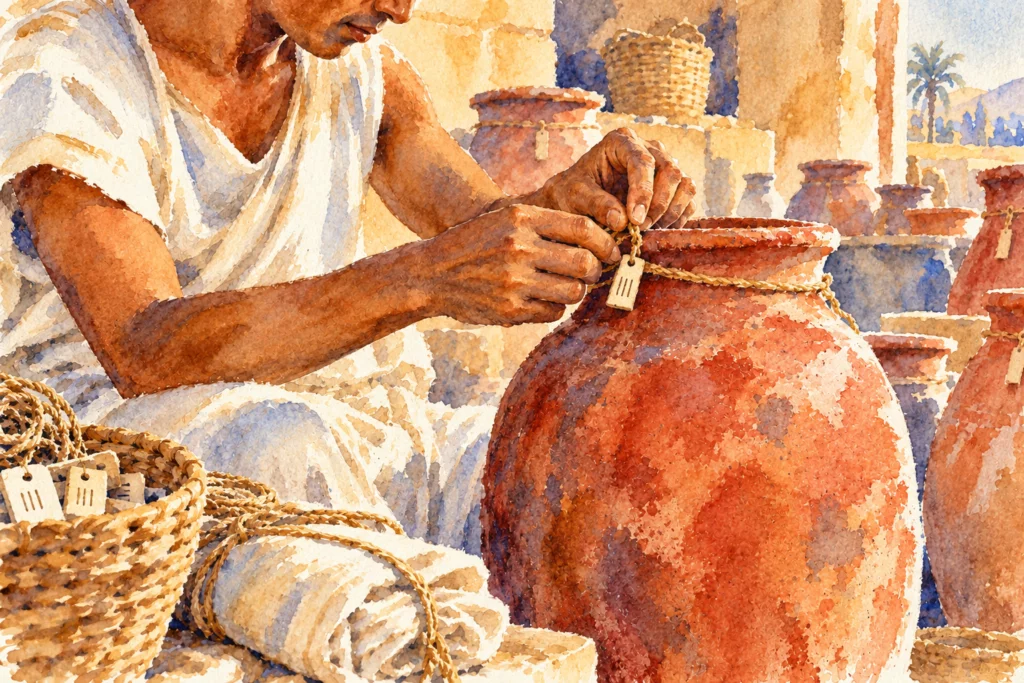
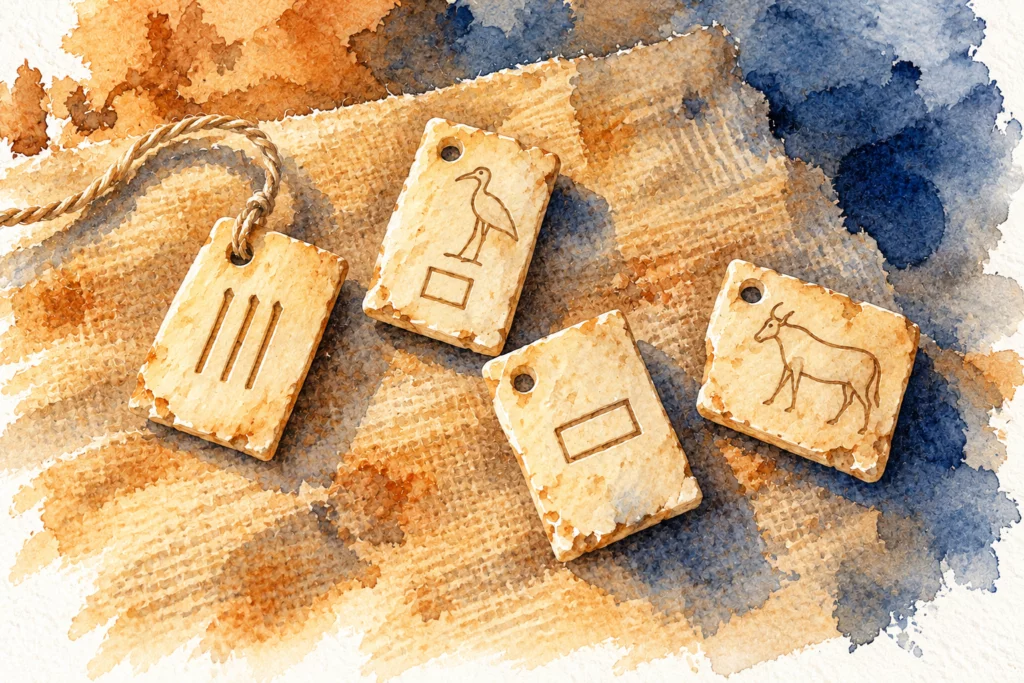
The earliest inscriptions from Abydos fit on small bone and ivory labels, pierced so that they could be tied to goods. They bear a few signs or numbers. Tomb U-j, which preserved them, dates from the end of the 4th millennium BC. The exact reading of the signs is debated, but their organisation brings us close to the first uses of writing.
Key dates
Egyptian writing appears at the end of the 4th millennium BC, around 3300–3200 BC. The British Museum gives the approximate benchmark of 3250 BC. These indications place a gradual emergence; the documents and their contexts keep their own date ranges.
Dates vary according to the methods and the documents. Tomb U-j is generally placed around 3320–3150 BC; the first royal names and the Narmer Palette belong to the decades and centuries that follow. The table keeps these benchmarks, together with the modern dates of the discoveries.
The pottery fragment from Abydos bearing, among other signs, the name of King Ka, presented by the British Museum under the number EA35508, is dated to around 3100 BC. It is the oldest Egyptian text preserved in that collection; this date does not mark the beginning of all Egyptian writing.
| Date (BC) | Milestone |
|---|---|
| c. 3320–3150 | Tomb U-j at Abydos: inscribed labels and jars marked in ink |
| c. 3200–3000 | ‘Dynasty 0’: first royal names in a serekh (Iry-Hor, Ka) |
| c. 3100–3000 | Narmer Palette, Hierakonpolis |
| AD 1897–1898 | Discovery of the palette by James Quibell and Frederick Green |
| AD 1988 | Excavation of tomb U-j by Günter Dreyer (DAI Cairo); publication in 1998 |
Abydos, tomb U-j: the earliest inscriptions
In 1988, Günter Dreyer and the team of the German Archaeological Institute in Cairo excavated cemetery U at Umm el-Qa’ab. Tomb U-j, with its twelve chambers, is the largest of its time. Its grave goods, including an ivory heqa sceptre and hundreds of wine jars from the southern Levant, point to a high-ranking ruler.
The inscriptions appear on several materials. Between 150 and 200 bone and ivory labels, depending on the count, each bear one to four signs; around forty carry only numbers. Jars are marked in ink, sometimes with a scorpion associated with a shape that has been compared to the serekh. Seal impressions complete the group.
Dreyer suggests calling the owner of the tomb ‘Scorpion I’, after some of the marks. The identification is not certain. The grave goods indicate a high-ranking ruler; his name and his exact place in history remain open to discussion.
Images that become sounds
Dreyer reads in certain combinations place names, notably Buto and Bubastis, which would indicate where the goods came from. The numbers could record quantities or dimensions, possibly those of textiles. These readings involve the rebus: the sound value of the name of a thing makes it possible to write another word.
Not all the specific proposals are agreed. John Baines, among others, recognises a phonetic dimension in certain signs while stressing that many readings are uncertain. The system nevertheless shows an organisation and conventions stable enough to suppose that it was learnt. Freely drawing an animal is not enough to produce this kind of inscription.
Documents cited: Before writing
Why writing appears
The origin and quantity of the goods gathered together are pieces of information needed to administer them. The labels provide these details where the object alone no longer allows them to be traced. The inscriptions are still very short; complete sentences are attested only towards the end of the 2nd Dynasty.
The royal name, too, takes up a growing place. It accompanies goods, monuments and prestige objects. We may see in it the wish to make the ruler identifiable and to make his presence last. The idea of the name as a component of the person, well documented in later texts, should not, however, be projected without caution onto these first inscriptions.
This writing belongs at first to a narrow circle, linked to the palace. The documents that have come down to us mainly make visible the needs and the representations of this elite.
From the serekh to the Narmer Palette
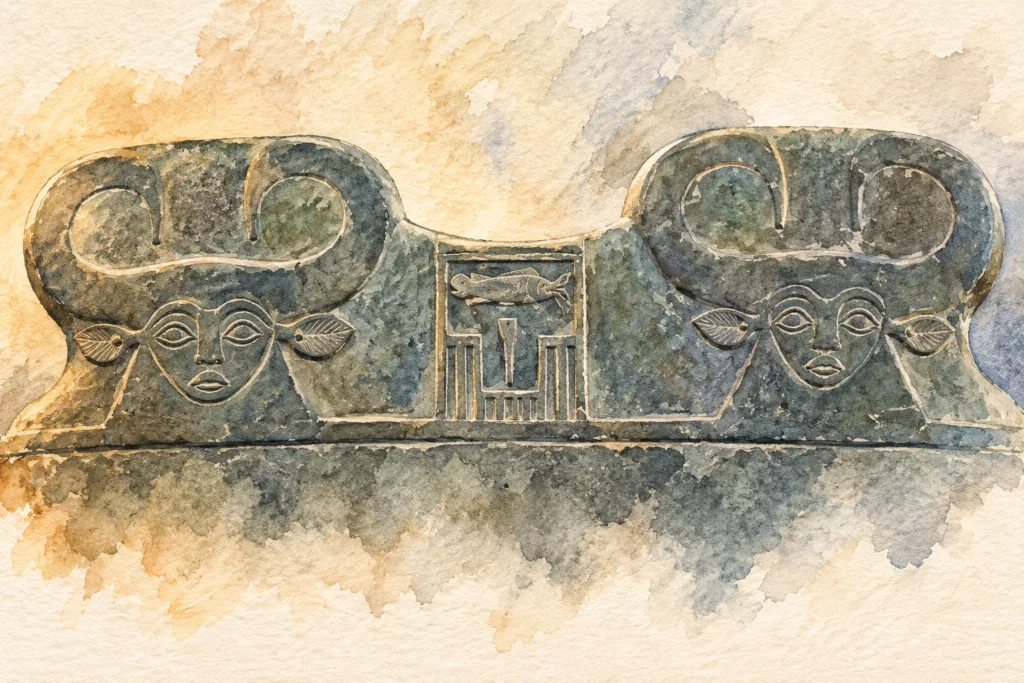
At the turn of the 4th and 3rd millennia BC, the king’s name takes its place in a serekh, a frame that evokes the façade of his palace and is surmounted by the falcon Horus. The names of Iry-Hor, Ka and Narmer are among the first known royal names, in inscriptions whose forms and readings must be examined case by case.
The catfish and the chisel are traditionally read n’r and mr in the name of Narmer. Their pictorial form here provides a sound value. One has to know this use to understand that they write a proper name.
The famous ceremonial palette in siltstone, 64 centimetres high, was discovered by Quibell and Green in 1897–1898 in the main deposit of the temple of Horus at Hierakonpolis. Kept in the Egyptian Museum in Cairo (JE 32169), it shows the king wearing the white crown, striking an enemy. On the other side, he wears the red crown and inspects decapitated enemies. Two animals with long intertwined necks frame the cosmetic hollow; at the bottom, a bull overturns an enclosure wall.
At the top of both sides, the serekh of Narmer is placed between two bovine heads. Groups of signs also accompany the figures. The image displays the power of the ruler; the inscriptions provide identifications. The palette has often been presented as the account of the unification of Egypt. Today, scholars prefer to distinguish the celebration of a royal victory from a reliable record of a single event.
Mesopotamia: influence or independent invention?
The tablets from Uruk appear at a similar period, around 3350–3200 BC. Contacts between Egypt and Mesopotamia are attested, notably by seals and certain motifs. The handle of the Gebel el-Arak knife, in the Louvre, is one of the objects discussed in this debate.
| Egypt (U-j) | Mesopotamia (Uruk IV) | |
|---|---|---|
| Material | bone, ivory, pottery, then papyrus | clay tablets |
| Signs | detailed images, drawn from the local repertoire | pictograms quickly reduced to strokes |
| Phonetic principle | present very early | rare, clearer in the following period (Uruk III) |
| First use | origin of goods, royal name | temple accounting |
The differences in materials, signs and workings lead scholars to favour an independent invention. A circulation of the idea of writing is also considered, without borrowing of the system itself. The chronological ranges do not allow the question of Egyptian or Mesopotamian priority to be settled once and for all.
Two figures
Günter Dreyer (1943–2019) devoted more than thirty years to the excavations at Umm el-Qa’ab and directed the DAI in Cairo from 1998 to 2008. His publication of tomb U-j in 1998 profoundly changed our knowledge of the earliest written evidence.
Narmer, placed around 3000 BC, is set by different authors at the end of ‘Dynasty 0’ or at the beginning of the 1st Dynasty. His name is attested as far as the southern Levant. His identification with Menes, founder of unified Egypt in the later tradition, also belongs to a history of identifications that must be kept separate from the contemporary objects.
To see today
The Narmer Palette is kept in the Egyptian Museum in Cairo and the Gebel el-Arak knife in the Louvre. At Abydos, the necropolis of Umm el-Qa’ab remains the place where excavations set these beginnings back in their material context.
Towards the hieroglyphic system
These inscriptions mainly make it possible to identify goods and people. More developed texts would require combining sounds, words and indications of meaning. The next article explains these uses, starting from signs that can be found in several words.
See: How hieroglyphs work
Sources
- Günter Dreyer, Ulrich Hartung and Frauke Pumpenmeier, Umm el-Qaab I. Das prädynastische Königsgrab U-j und seine frühen Schriftzeugnisse, Mainz, Philipp von Zabern, 1998.
- John Baines, ‘The earliest Egyptian writing: development, context, purpose’, in Stephen Houston (ed.), The First Writing, Cambridge University Press, 2004.
- Béatrix Midant-Reynes, Aux origines de l’Égypte. Du Néolithique à l’émergence de l’État, Paris, Fayard, 2003 (in French).
- James E. Quibell, Hierakonpolis I, London, 1900.
- Egyptian Museum, Cairo, entry for the Narmer Palette.
- British Museum, Hieroglyphs: unlocking ancient Egypt, large-print guide, 2022, pp. 106–107: ‘The invention of writing’, fragment EA35508.