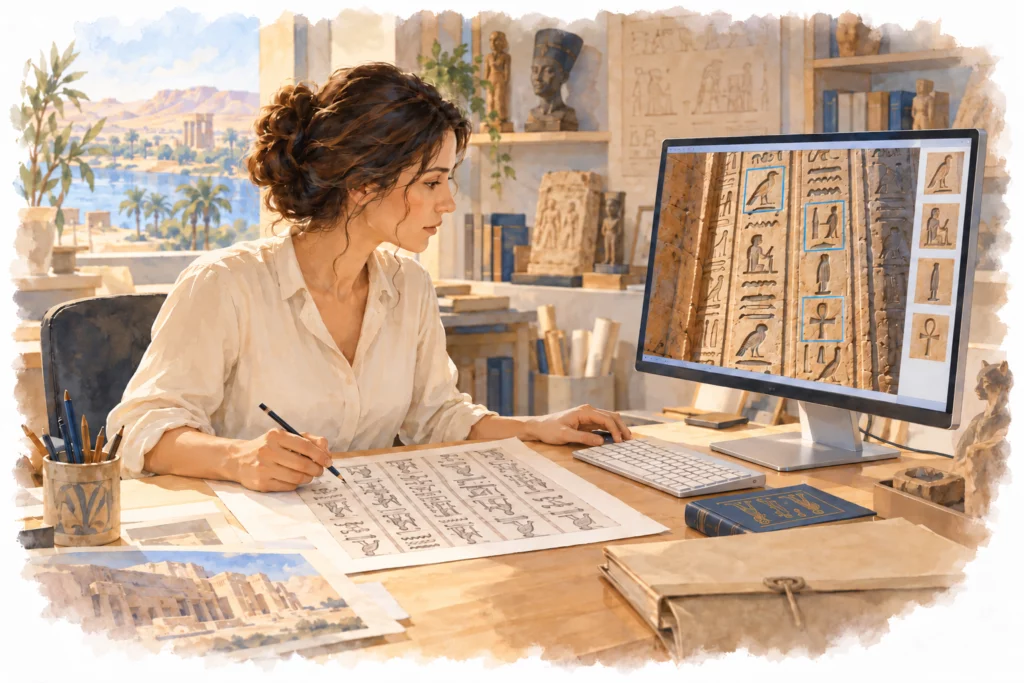
Programs for recognising and translating Egyptian texts use the readings, dictionaries and corpora prepared by researchers. Their results concern specific operations: recognising a shape, proposing a value, comparing witnesses. Some projects link these steps in a single interface. To judge what they contribute, we need to know which documents they were evaluated on and what the reader can still check or correct.
Hieroglyphs have been deciphered since 1822. Artificial intelligence plays a part in recognising and interpreting them on the basis of knowledge already acquired. Some tasks have produced measured results; others remain experiments or goals. To look at this progress without reducing it to a promise, let us take the time to distinguish the documents, the operations and the teams.
| Date | Milestone |
|---|---|
| 2013 | First work on the automatic recognition of hieroglyphs, on the Pyramid Texts of Unas (Morris Franken and Jan van Gemert) |
| 2020 | Fabricius, a Google Arts & Culture tool designed with Ubisoft and Macquarie University |
| 2021 | A team from the CNR and the University of Florence classifies hieroglyphs with neural networks, whatever the medium |
| 2025 | A system presented at SIGGRAPH links recognition, transliteration and translation |
A point of method
Deciphering a script whose key has been lost and learning to process texts that have already been read are different tasks. Champollion recovered how hieroglyphs work. Today’s programs learn in particular from the readings established since his discovery. Dictionaries, grammars and digital corpora give them the examples and references they need.
Sorting images and searching for similarities can prepare the examination of documents too numerous to be compared by hand. A first proposed reading can also guide the work. Its usefulness depends on being able to trace the signs concerned and the references that support it.
Documents cited: The Rosetta Stone and the race to decipherment · The digital age
What AI can do today
In 2013, Morris Franken and Jan van Gemert studied the automatic recognition of hieroglyphs on images of the Pyramid Texts of Unas. In 2021, Andrea Barucci and his colleagues at the CNR and the University of Florence published work on classifying signs with neural networks, using images from several media. This research gives results on clearly defined tasks, and its authors maintain the specialist’s role in reading.
Fabricius, launched by Google Arts & Culture in 2020 with Ubisoft and Macquarie University, also offers the public an introduction to the signs. In 2025, a system presented at SIGGRAPH sought to link recognition, transliteration and translation. Other teams examine gaps, variants and scribal hands. These projects do not all describe the same tool; their results have to be looked at separately.
Documents cited: The builders of Egyptology
From photograph to translation: several steps
A photograph contains shapes whose recognition may be uncertain. Then the order of the signs, the words and the construction of the sentence have to be worked out. An error at the start can alter the transliteration, then the translation. The reader must be able to go back through the steps to locate the difficulty and revise the proposal.
The 2021 study concerns the classification of isolated signs in two sets of images. The variety of media does not demonstrate a general reading of all inscriptions. OCR-PT-CT, presented as a preprint in 2025 by David Fuentes-Jimenez and his colleagues, including Carlos Gracia Zamacona, works for its part on facsimiles of Middle Kingdom funerary texts. It converts the recognised signs into Gardiner codes and is part of the work of comparing witnesses carried out with MORTEXVAR.
The Hieroglyphic Transformer by Mattia De Cao, Nicola De Cao, Angelo Colonna and Alessandro Lenci, published in 2024, learns translation from encoded texts taken from a corpus prepared from the Thesaurus Linguae Aegyptiae. It does not start from a photograph of just any monument. THOTH.AI, designed by So Miyagawa at Tsukuba, combines linguistic resources with a language model. Its designer reports better results with transliterations and printed Coptic than with photographs of ancient manuscripts.
The team presented at SIGGRAPH 2025 includes Ilya Makarov and Ekaterina Aleksandrova, with Maksim Golyadkin, Innokentiy Humonen, Ianis Plevokas and Ekaterina Bureeva. It seeks to link the operations in a single chain. In the interview published in October 2025, the researchers explain that extending the system to cursive scripts requires new training data. The coherence of an interface does not mean that all its steps are equally reliable.
Documents cited: The CNR publication · Scientific presentation of OCR-PT-CT · Publication of the Hieroglyphic Transformer · Presentation and limits of THOTH.AI · Interview with the SIGGRAPH team · Presentation and study of pyThoth, IJCAI 2026 · Presentation of the collaboration by Christ’s College, Cambridge · Publication of MEH · Publication of MuMMy · Study of THOTH AI, NLP4DH 2025 · Study of semantic alignment between stages of Egyptian
2025–2026: from demonstrations to a reading workshop
In pyThoth, presented at IJCAI 2026 by Golyadkin, Humonen and Makarov, the recognised signs and the annotations remain linked to the image. The researcher can correct a sign, then revise the transliteration and the translation. The interface thus makes it possible to examine the intermediate choices instead of receiving only a final sentence.
The study reported involves eight participants, six Egyptology students and two Egyptology doctoral students, working on four extracts from facsimiles of Middle Egyptian stelae. The total time was 51 minutes with the tool, against 61 by hand, a saving of about 16%. Keeping these dimensions of the experiment in mind makes it possible to judge its result without extending it to all documents.
The collaboration presented at CHI 2026 brings together Ekaterina Alexandrova and Alexandre A. Loktionov, among others, with the computer scientists. The Egyptologists take part in defining the tasks and evaluating them. Their expertise therefore comes into the design of the system as much as into checking its proposals.
Learning to read texts, beyond isolated signs
A clean sign in an edition does not present the same difficulties as its shape on worn stone. MEH, Multisource Egyptian Hieroglyphs, presented at ICCV 2025, brings together digital documents, scans and photographs of monuments. The annotations also cover the organisation of the text. Synthetic data generated from linguistic sequences are used to multiply the examples, with the need to check how far they represent real documents.
MuMMy, presented at ACM Multimedia 2025, links images, Gardiner codes, transliteration and English translation at two scales of text. It makes it possible to examine how an error carries over from one step to the next. For the researcher, being able to go back from the proposed translation to the visible sign is essential: the most fluent sentence may stem from a faulty recognition.
Giving models the knowledge of Egyptologists
The study of THOTH AI published by So Miyagawa in 2025 supplies the model with lexical and morphological resources before asking it for a translation. This approach, often called RAG, consists in searching a database for relevant information and then attaching it to the request. The case studied is the coronation decree of Thutmose I. The results encourage the use of targeted linguistic knowledge, without demonstrating a mastery of all Egyptian texts.
In March 2026, He Huang proposed a study, reported as accepted at LREC 2026, on aligning the meaning of words across four historical stages of Egyptian. The question differs from that of the isolated sign: the aim is to follow a language that changed over millennia. The results announced remain limited. Their value will have to be measured on comparisons whose philological relevance can be explained.
The real challenge: cursive scripts
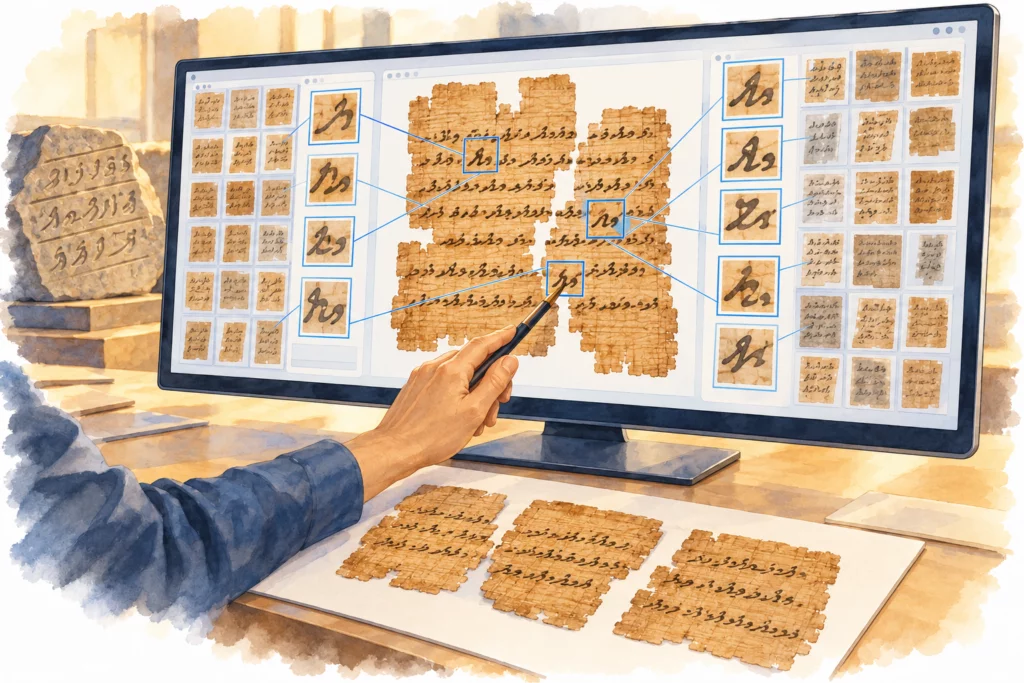
Hieratic and Demotic require the recognition of ligatures, variants and habits peculiar to a hand. The separation between two signs may be barely visible. Period, place and scribe change the forms further still. The difficulties are considerable, even for a trained reader; good results obtained on classical hieroglyphs cannot be transferred directly.
The papyri and ostraca still awaiting publication give this research a particular interest. Their study, however, requires precisely annotated examples representing several hands and states of preservation. Specialists’ corrections are needed to prepare these data and to check the readings obtained.
Documents cited: Everyday scripts · HieraticAI documentation · GlyPat project · Presentation of the AKU project · SCAM corpus and results of the experiments · Aims and method of GlyPat
Prototypes and resources for cursive scripts
HieraticAI, developed by Margot Belot in 2025, tests detection and classification on twenty lines of a facsimile of the Westcar Papyrus. An interface provides for validation by the Egyptologist. The modest size of the corpus is important for understanding what the experiment establishes and what remains to be tested on other hands.
At the Freie Universität Berlin, GlyPat, led by Hubert Mara with Margot Belot, Eren Kocadag and Philipp Schmidt among others, looks for Demotic formulas in a corpus of 272 annotated manuscripts. The comparison has to take ligatures and variants into account. This work in computational philology is not a neural translator. It can suggest connections, while the possibilities of dating or localising manuscripts still need testing.
AKU-PAL, from the AKU project in Mainz and Darmstadt, documents cursive forms, their variants and the contexts in which they are attested. This digital palaeography makes it possible to compare spellings and to prepare the annotations of future training corpora. It is a scholarly resource, without itself being an automatic translation system.
Coptic: extending the chain of Egyptian writing
The SCAM corpus, presented at ICDAR 2026 by Fabio Quattrini, Carmine Zaccagnino, Costanza Bianchi, Silvia Cascianelli and Rita Cucchiara, concerns handwritten Sahidic Coptic. It brings together 3,240 lines from twenty-seven leaves of a White Monastery manuscript dated 1002–1003. The images come from different digitisation conditions.
In these experiments, moving from one set of images to another raises difficulties, even though it is the same manuscript. Digitisation conditions therefore affect the results. The corpus makes it possible to study this variation on a well-identified medieval Coptic document.
For older cursive scripts, GlyPat envisages an interactive search in which variants remain accompanied by their images. In time, the connections could help to place manuscripts, provided it is shown what the similarities really say about their history. This is a goal, to be distinguished from a capability already achieved.
Restoring gaps and understanding texts better
When a passage is missing, another witness may preserve the formula. HieroLM, proposed in 2025 by Xuheng Cai and Erica Zhang, examines the prediction of missing signs from their context. A proposal then needs to be checked against the traces, the grammar and parallel passages. It must remain marked as a restoration.
Ithaca, for Greek inscriptions, and Aeneas, presented in 2025 for Latin inscriptions, explore other connections between text, context and visual data. The work in which Yannis Assael and Thea Sommerschield take part offers methodological leads. Adapting it to Egyptian would require corpora and evaluations specific to that language.
Connections between formulas can guide the study of their transmission, their variants or their circulation between scribal circles. The dates, provenances and uses of the texts then have to be compared. A calculated similarity does not on its own provide this historical explanation.
Documents cited: Publication of HieroLM
Reading without unrolling: the role of imaging
The Vesuvius Challenge continues the work of Brent Seales on the carbonised scrolls of Herculaneum. Tomography and virtual unrolling make it possible to examine the volumes; machine learning helps to detect the ink. Papyrologists then read the texts made visible.
This Italian example opens up prospects for fragile documents. It rests, however, on a measurable physical trace and on imaging suited to the material. A generated image that looks like an ancient text does not, on its own, restore the lost words of a scroll.
Documents cited: Vesuvius Challenge programme · Study of the coffin and hyperspectral imaging
Recovering traces before interpreting them
In Egypt, a 2024 study involving Costanza Cucci, Andrea Barucci and Fabrizio Argenti, among others, concerns a degraded inscription on a 25th Dynasty coffin. Hyperspectral imaging measures the response of the surface in the visible and near-infrared range. Processing distinguishes certain traces more clearly, then neural networks help to segment the signs.
This study improves the observation of traces preserved on the coffin before they are read. The measurements, the processed images and the segmentation decisions must be kept with the interpretations. Other researchers will then be able to examine the same clues and discuss the values attributed to the signs.
New datings, on what conditions?
In 2025 the Enoch project, led by Mladen Popović, Maruf A. Dhali and Lambert Schomaker at Groningen among others, combined radiocarbon dating with an analysis of the letter forms of the Dead Sea Scrolls. Trained on twenty-four manuscripts dated by carbon 14, the model proposes dates for 135 others, which are then compared with a palaeographic examination. Some results suggest earlier dates than had been thought.
This concerns that corpus. An application to Egyptology would require independently dated and representative references. Recognising a hand, dating the copy of a document and dating the composition of the text it preserves are distinct questions. A photograph does not give a program the measure of a monument’s age.
Documents cited: Study published in PLOS One · Basel programme and publications
Papyri from Egypt as a testing ground for dating
In Basel, Isabelle Marthot-Santaniello works with data analysis researchers on the Greek papyri of Egypt. Visual comparison, the matching of documents and the study of hands are part of this research, with the NeuroPapyri and Hell-Date resources. Papy-Date, a corpus of Greek papyri dated to the year, is among the contributions announced for the computational palaeography workshop at ICDAR 2026.
These documents belong to the history of Graeco-Roman Egypt. Their results cannot be extended to hieratic and Demotic without evaluation. They do show, on the other hand, how a historical question can guide the construction of a corpus and of a comparison tool.
Reconstructing monuments and matching fragments
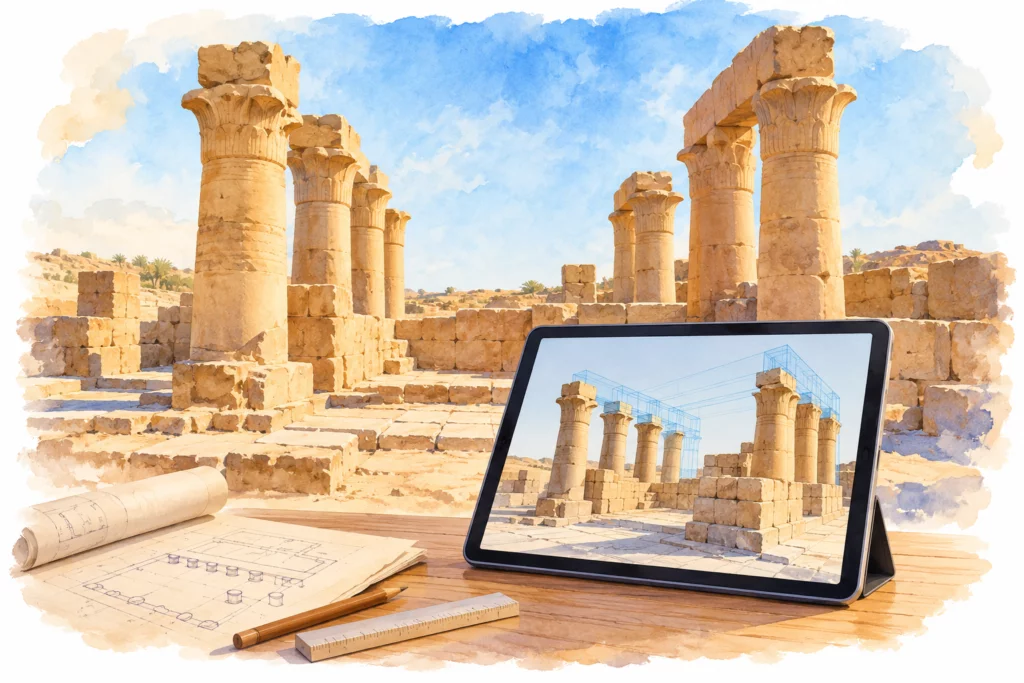
Before producing a reconstruction, you need plans, measurements, photographs and archives. Digital Giza, directed at Harvard by Peter Der Manuelian, gathers these documents and models of the Giza plateau. Digital modelling does not necessarily rely on AI. It first provides an organisation of what we know and of what remains hypothetical.
RePAIR, coordinated at Ca’ Foscari and associated with Marcello Pelillo, tested at Pompeii the search for joins between fragments of frescoes using 3D scanning and AI, followed by their placement by robots. Conservators and archaeologists step in to validate the assemblies. The PERCEIVE project explores, among other things, AI and immersive experiences for coloured heritage.
For colours, a reconstruction must indicate what comes from observed pigments, from comparisons and from hypotheses. Models can present several possible states of a decoration. Their visual realism does not allow us to decide which one corresponds to the ancient monument.
Documents cited: Presentation of Digital Giza · Scientific report on RePAIR · PERCEIVE programme · Review and prospects of ARCHER, 2026 · Results and prospects of RePAIR · Official announcement by the University of York
Recomposing a monument: learning from shapes and keeping the evidence
The review of ARCHER published in June 2026 presents experiments in architectural reconstruction in two and three dimensions, notably on Greek temples and on Romanesque and Mudéjar churches, using synthetic corpora. They explore the restoration of missing parts and the preparation of documented models. This field remains different from that of an Egyptian temple.
The final report on RePAIR, published by Ca’ Foscari in December 2025, describes a prototype using two robotic arms to place fragments of frescoes from Pompeii. It helps to clarify which actions can be assisted and which checks remain to be carried out. For Egyptian collections, comparing large fragmentary assemblages would be a lead to test on their own materials and decoration.
2026: a centre devoted to AI and Egyptian heritage
The British Egyptian Centre of AI and Virtual Heritage, BECAIVE, was inaugurated in Cairo on 17 August 2026. The University of York and the NRIAG run it jointly, under the direction of Mohamed Gamal Abdelmonem and Abbas Ali. The programme combines equipment, training and research, with the particular aim of bringing sites closer to objects kept in distant museums. Virtual tours of Hawara accompany its launch.
The centre brings together training and research resources around Egyptian heritage. The applications announced remain goals whose results will have to be examined. Its inauguration is an institutional milestone, distinct from the evaluation of the tools that will be developed there.
From excavation archives to archaeological landscapes
The IFAO and TEKLIA have worked on four of Bernard Bruyère’s notebooks, 891 pages of notes and drawings relating to the excavations at Deir el-Medina. Handwriting recognition and indexing make the archaeologist’s observations easier to access. Here, the machine is reading 20th-century French handwriting. The benefit may nonetheless concern ancient history, when these notes are set alongside the objects and their context of discovery.
ArchAIDE, coordinated by the University of Pisa, studies the description and comparison of potsherds with pottery catalogues. The categories present in the data limit what the tool can propose. A specialist has to go back to the objects.
On another scale, Yamagata University and IBM used assisted detection on images of the Nazca landscape, in Peru. Their 2024 publication reports a campaign that confirmed 303 new geoglyphs in six months. The example shows what computer-assisted detection followed by checking in the field can bring; it does not describe an Egyptian discovery.
Documents cited: TEKLIA–IFAO work · ArchAIDE project · Results of the Yamagata–IBM team
Tomorrow’s projects: linking texts, objects and places
PAMELA, a European programme coordinated by Charles University in Prague, is announced from 1 January 2026 to 31 December 2029. It combines Greek papyri, medieval manuscripts, assisted palaeography, non-invasive material analyses and digital reconstruction. Resources, shared methods and training are among its aims.
These aims make it possible to envisage the following uses. They are neither a timetable of discoveries nor the description of software that is already available.
Documents cited: Aims and timetable of PAMELA, European Commission
A reading file that others can take up
A file could bring together the photograph, the position of the signs, the readings considered and the parallels consulted. Corrections would be recorded with their reasons. Another reader would then have what they need to take up the translation and understand the earlier choices.
Fragments and collections brought back together
Comparing scattered collections could help to find related fragments or to link an object with its excavation archives. The proposed joins would have to be checked against the materials, dimensions, decoration and texts. The suggestions would help to guide the examination, without standing in for proof.
Historical hypotheses tested more thoroughly
Searching for variants between several witnesses could make it easier to study a formula, a hand or a story. The correspondences and divergences would remain available for consultation together with the images of the documents. Interpreting them would mean comparing contexts rather than automatically keeping the most frequent connection.
Accessible transmission, uncertainties included
The same files could be used for teaching. A student would compare several readings and their justifications; a visitor could follow the passage from a visible trace to a translated word. Reconstructions of monuments would indicate which elements are documented and which remain debated.
The limits
A well-phrased proposal can be wrong. Models learn from corpora in which some periods, genres and formulas are better represented than others. Their ease with a common case may hide their difficulties with a rare document.
To evaluate a tool, you need to know the training examples, the test documents and the task actually measured. Classifying a sign, translating a sentence and understanding its historical use do not call for the same checks. The checked images and transcriptions must remain available for consultation.
The specialist may also judge that a passage remains illegible or that several interpretations are still possible. Tools should make it possible to keep this uncertainty, without imposing an answer simply because their interface expects a result.
Documents cited: Reproducibility study, NLP4DH 2026
Measuring progress to make it last
In July 2026, Ammar Toutou, Abdelrahman Harb and Christine Basta examined a system for translating Egyptian into German. Of fifty translations in the test set, sixteen already appear word for word in the training data. The repetition of ancient formulas can thus encourage memorisation and inflate some results.
The authors propose a cleaned test set and new benchmarks for comparison. These evaluations concern the performance of the system, not a percentage of historically accurate translations. Removing examples already present in the training data gives a better measure of the work done on new documents.
From Thoth to AI
In the Phaedrus, Thamus reproaches writing for giving people an appearance of knowledge. The translations proposed by machines in turn raise the question of what we really understand of the text obtained. A readable sentence can satisfy us even before we have examined the signs that justify it.
The examples in this series range from the labels of Abydos to letters on ostraca, from temple inscriptions to archaeologists’ notes. Each document calls for a suitable method. Today’s tools can help to bring them together, to make traces more visible and to prepare their reading. To do so, they use knowledge built up by generations of researchers.
This work continues with new images, corrected transcriptions and debated interpretations. Keeping these steps allows others to take up the inquiry. The memory of Egypt also depends on this ability to go back to the documents, instead of letting a finished translation make us forget the questions that remain open.
Documents cited: The Word and the reed pen · Thirteen centuries of errors
Sources
- Morris Franken and Jan C. van Gemert, ‘Automatic Egyptian hieroglyph recognition by retrieving images as texts’, Proceedings of the 21st ACM International Conference on Multimedia, 2013.
- Andrea Barucci et al., ‘A Deep Learning Approach to Ancient Egyptian Hieroglyphs Classification’, IEEE Access 9, 2021.
- Google Arts & Culture, Fabricius, 2020.
- SIGGRAPH Blog, ‘AI and Ancient Egyptian Texts’, 2025.
- Plato, Phaedrus, 274c–275b.