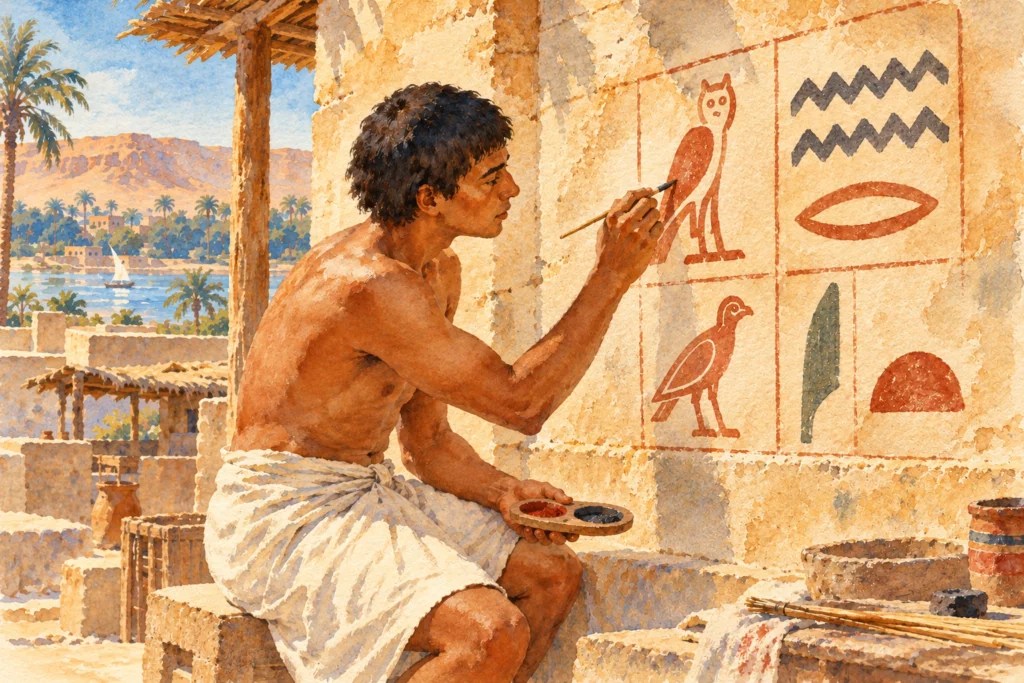
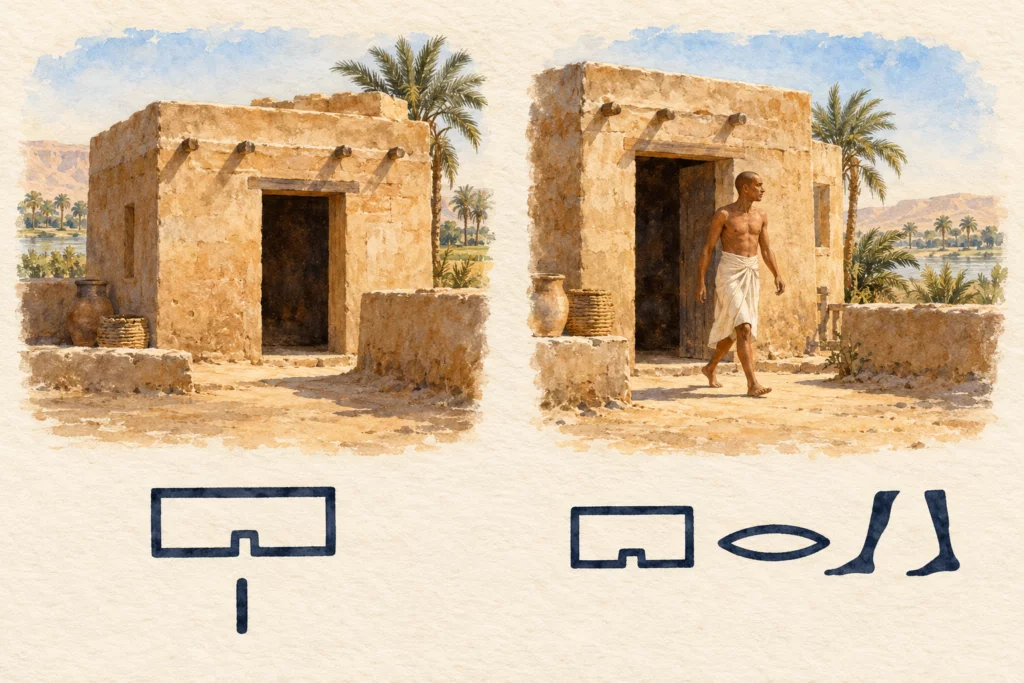
The plan of a house can write ‘house’, but it can also be part of a word meaning ‘go out’. The sign is recognisable in both cases. To read it, you have to understand what it is doing in the word, then look at the other signs that go with it. Hieroglyphs combine these different uses within a single script.
The explanations that follow deal mainly with the classical system, particularly that of Middle Egyptian. Its principles continue the first uses of writing, while the shapes of the signs, their spellings and the conventions of reading became more precise over the centuries.
The everyday repertoire of Middle Egyptian has about 700 to 800 signs. The table presents their main functions. Most common words use a far smaller number, and a sign can change function according to context.
| Category | Role | Pronounced? | Example |
|---|---|---|---|
| Phonogram | records one, two or three consonants | yes | the mouth = r |
| Phonetic complement | repeats a consonant to help reading | no (already read) | nfr + f + r |
| Ideogram | records a whole word | yes | the house plan + stroke = pr, ‘house’ |
| Determinative | places the word in a category of meaning | no | the walking legs for a verb of movement |
A script of consonants
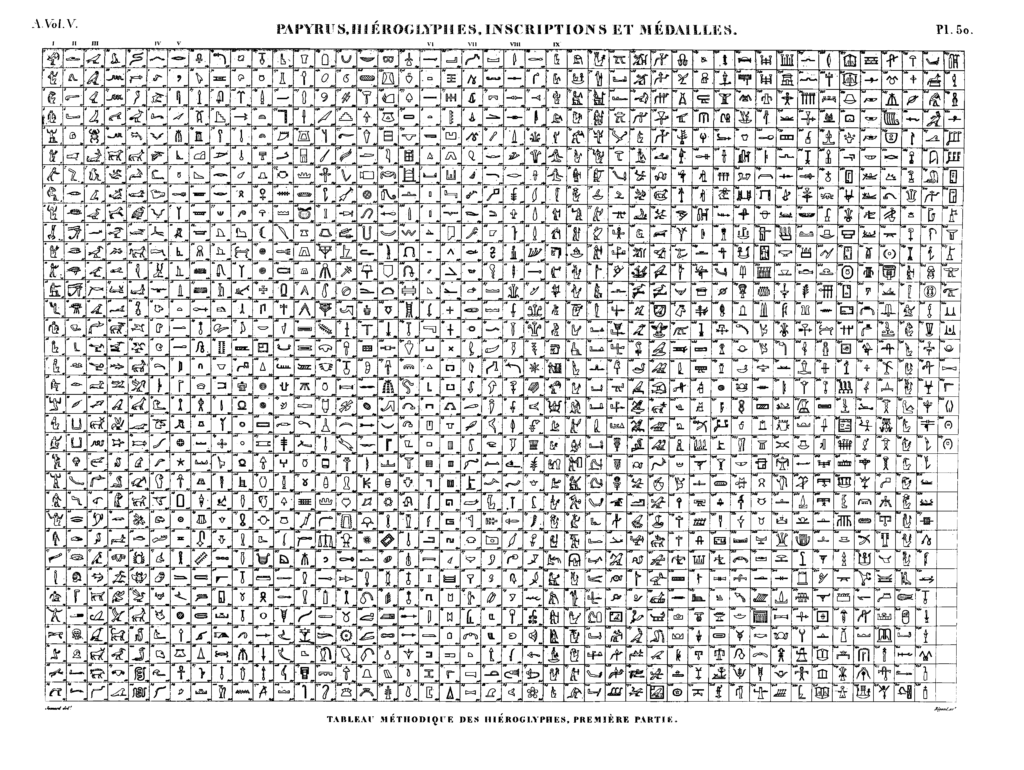
Egyptian writing essentially records consonants. The vowels needed to pronounce a word are generally not written. We thus read nfr, ‘beautiful, good’, without being able to recover its ancient pronunciation directly from the signs.
To work with these words and talk about them, Egyptologists use a convention. They often insert an e between the consonants and render certain consonants as vowels: nfr becomes ‘nefer’, ḥtp ‘hetep’, ʿnḫ ‘ankh’. It is worth knowing this before taking these sounds for those an Egyptian would have pronounced.
Coptic, Greek transcriptions and transcriptions of Egyptian names in cuneiform provide other clues. The Amarna documents have thus led scholars to link the name of Amun to a form ‘Amana’ in the New Kingdom. This late or outside evidence allows partial reconstructions; it does not give back all the vowels for every period.
Phonograms: signs for sounds
A phonogram records one or more consonants. The mouth can be read r, even in a word that has nothing to do with a mouth. Uniliteral signs carry one consonant; biliterals carry two; triliterals, three.
The uniliterals are a small set of about twenty-five signs. They are often presented as an alphabet, which makes a first approach easier. But the scribes used them together with biliterals, triliterals and the other signs: they did not reduce writing to this set. The codes given come from Gardiner’s 1927 list.
| Sign | Gardiner code | Transliteration | Approximate value |
|---|---|---|---|
| vulture | G1 | ꜣ | glottal stop (conventional ‘a’) |
| flowering reed | M17 | j | ‘i’, ‘y’ |
| two reeds, or two strokes | M17a, Z4 | y | ‘y’ |
| forearm | D36 | ʿ | guttural consonant (conventional ‘a’) |
| quail chick | G43 | w | ‘oo’, ‘w’ |
| leg | D58 | b | b |
| stool | Q3 | p | p |
| horned viper | I9 | f | f |
| owl | G17 | m | m |
| water | N35 | n | n |
| mouth | D21 | r | r |
| reed shelter | O4 | h | h |
| twisted flax wick | V28 | ḥ | emphatic h |
| hatched disc (placenta?) | Aa1 | ḫ | like ‘ch’ in Scottish ‘loch’ |
| animal belly and udder | F32 | ẖ | variant of the previous one |
| door bolt | O34 | z | z, later s |
| folded cloth | S29 | s | s |
| pool | N37 | š | sh |
| hill slope | N29 | q | deep k |
| basket with handle | V31 | k | k |
| jar stand | W11 | g | hard g |
| bread loaf | X1 | t | t |
| tethering rope | V13 | ṯ | tj, like ‘ch’ in ‘church’ |
| hand | D46 | d | d |
| cobra | I10 | ḏ | dj, like ‘j’ in ‘jam’ |
Among the common biliterals, the house plan records pr, the gaming board mn and the swallow wr. The heart and windpipe give nfr, the sign of life ʿnḫ and the offering mat with its loaf ḥtp: these are triliterals. Their appearance alone does not allow us to guess all their values.
Phonetic complements
The sign nfr is often followed by the viper f and the mouth r. These two signs repeat consonants that are already there to confirm the reading; they are not pronounced a second time. They are phonetic complements. Their presence helps in particular to choose between the possible values of the same sign.
The sign ʿnḫ can likewise take the complements n and ḫ. These spellings become recognisable with practice. Complements make it possible to choose between the possible values of a sign, and give the word a shape familiar to the reader.
Ideograms: one sign, one word
A sign can also represent a whole word. This use is called an ideogram or, more precisely in linguistics, a logogram. A small vertical stroke often accompanies the drawing to mark it: the house plan is then read pr, ‘house’, the mouth r, ‘mouth’, and the sun disc rʿ, ‘sun’, which is also the name of Ra.
With its stroke, the house plan can therefore refer to the building. In another group, it can record the consonants pr. The marks that go with it and its place in the word make it possible to tell these uses apart.
Determinatives: classifying meaning
At the end of a word, we often find a sign that is not pronounced. It shows the field to which what has just been written belongs: movement, human being, building, abstract idea. This determinative, also called a classifier in the work of Orly Goldwasser, helps us understand the word and spot where it ends.
The texts do not have our spaces between words. Determinatives help to find word boundaries and to distinguish terms written with the same consonants. The walking legs, for example, point to a movement; the papyrus roll can accompany writing or an abstract notion.
| Sign | Gardiner code | Category of meaning |
|---|---|---|
| seated man | A1 | man, person |
| seated woman | B1 | woman |
| seated god with curved beard | A40 | god, king |
| man with hand to mouth | A2 | eat, speak, think, feel |
| walking legs | D54 | movement |
| arm holding a stick | D40 | strength, effort |
| sealed papyrus roll | Y1 | abstract idea, writing |
| house plan | O1 | building |
| crossroads in a circle | O49 | town, place in Egypt |
| hilly ground | N25 | desert, foreign land |
| sun disc | N5 | light, time |
| branch | M3 | wood, wooden object |
Reading a word step by step
The house plan with its stroke gives pr, ‘house’. With the mouth and the walking legs, it is part of the spelling of prj, ‘go out’. The mouth confirms r; the legs indicate movement and are not pronounced.
| Word | Signs, in order | Function of each sign | Reading and meaning |
|---|---|---|---|
| house | house plan + stroke | ideogram + ideogram marker | pr, ‘house’ |
| go out | house plan + mouth + walking legs | phonogram pr + complement r + determinative of movement | prj, ‘go out’ |
| beautiful, good | heart and windpipe + viper + mouth | triliteral nfr + complements f and r | nfr, ‘beautiful, good’ |
| pharaoh | house plan + column | biliteral pr + biliteral ʿꜣ | pr-ʿꜣ, ‘the Great House’ |
Pr-ʿꜣ, ‘the Great House’, gave us the word ‘pharaoh’. The expression first referred to the royal palace, then, in the New Kingdom, to the ruler. We still know this shift from a building to the person who holds power there when we say ‘Downing Street’. The history of the word is therefore not limited to that of its signs.
Reading direction, quadrats and cartouches
To know where to begin, look at the living beings. Their faces or heads turn towards the beginning of the text. You move towards them, from right to left or from left to right. In columns, reading goes from top to bottom.
The signs are grouped in imaginary squares, the quadrats. A wide sign can sit above two small ones; two narrow signs can stand side by side. The composition must remain legible while filling the surface harmoniously. Reading a monumental text means following this arrangement rather than looking for a simple line of letters.

Some rules also change the visible order. Out of respect, the name of a god or of the king can be written before elements that come before it in the reading: this is honorific transposition. The name of Tutankhamun, ‘living image of Amun’, thus begins in writing with Amun.
The loop of rope called a cartouche surrounds certain royal names. It appeared at the end of the 3rd Dynasty and became general under Sneferu, and it makes these names easy to spot in an inscription. The soldiers of the French expedition to Egypt gave it its French name, likening it to their cartridges (cartouches). This frame would become one of the footholds of decipherment.
Numbers
Numbers are built by repeating signs for units, tens, hundreds and the following powers of ten. The system is additive and has no zero.
| Value | Sign | Gardiner code |
|---|---|---|
| 1 | vertical stroke | Z1 |
| 10 | cattle hobble | V20 |
| 100 | coil of rope | V1 |
| 1,000 | lotus plant | M12 |
| 10,000 | raised finger | D50 |
| 100,000 | tadpole | I8 |
| 1,000,000 | the god Heh kneeling, arms raised | C11 |
Two lotuses, two hobbles and six strokes thus give 2,026. The earliest documents from Abydos already bear numerical inscriptions. On the Narmer macehead, kept in the Ashmolean Museum in Oxford, the quantities are enormous: 120,000 prisoners, 400,000 oxen and 1,422,000 goats. Being able to read these numbers is not enough to treat them as an exact historical count.
Documents cited: The birth of writing
Towards everyday scripts
On papyrus and pottery sherds, scribes also used cursive forms, suited to a quicker hand. They were drawn with a rush brush, and later with a reed pen. The accounts, letters and exercises that survive will let us find them in ‘Everyday scripts’.
See: Everyday scripts
Sources
- Alan H. Gardiner, Egyptian Grammar, Oxford, Griffith Institute, 1927 (3rd edn 1957).
- Pierre Grandet and Bernard Mathieu, Cours d’égyptien hiéroglyphique, Paris, Khéops, 1990 (new revised edition) (in French).
- Michel Malaise and Jean Winand, Grammaire raisonnée de l’égyptien classique, Liège, Aegyptiaca Leodiensia 6, 1999 (in French).
- James P. Allen, Middle Egyptian. An Introduction to the Language and Culture of Hieroglyphs, Cambridge University Press, 3rd edn 2014.
- Orly Goldwasser, From Icon to Metaphor. Studies in the Semiotics of the Hieroglyphs, Fribourg and Göttingen, OBO 142, 1995.
- University College London, ‘The development of writing’, Digital Egypt for Universities: development and standardisation of the first uses.
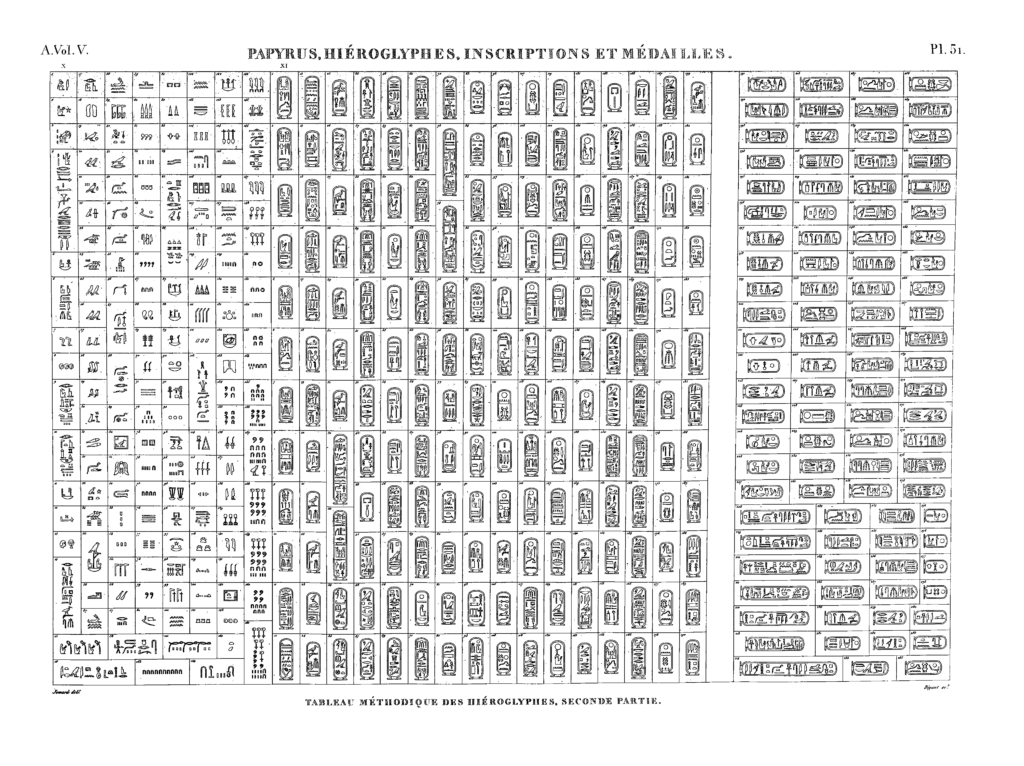
- Edme-François Jomard, Tableau méthodique des hiéroglyphes, first and second parts, Description de l’Égypte, Antiquités, volume V, pls 50–51, early 19th century. A historical classification of forms, distinct from the functional categories presented here.