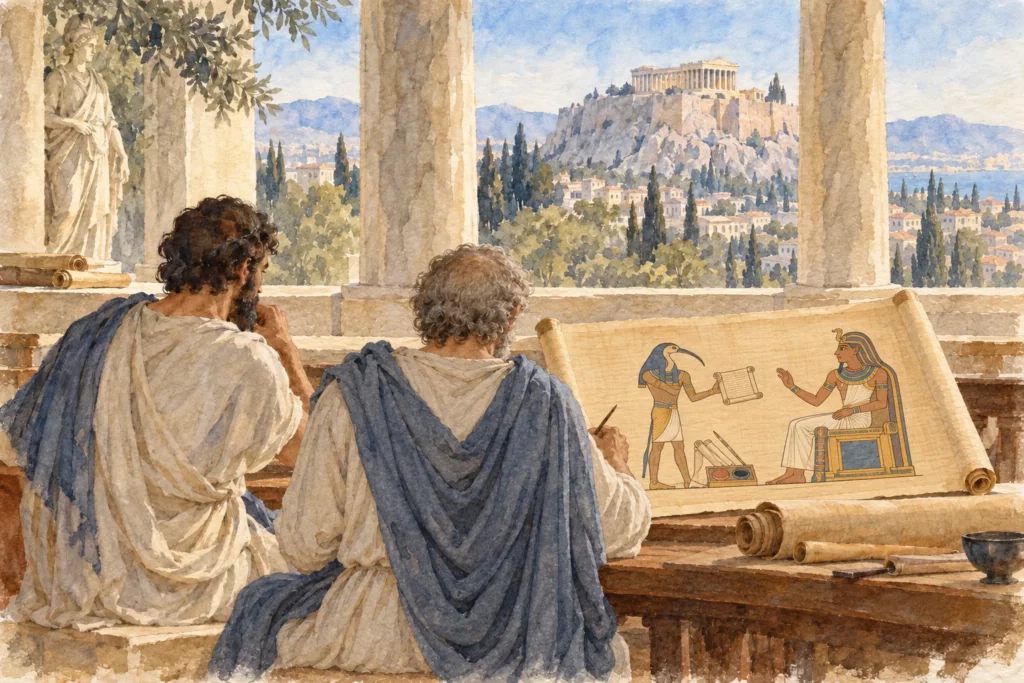
In the Egyptian accounts of creation, words bring beings into existence. Ptah thinks the world, then names it. Once written down, these words can be kept and spoken again. Hieroglyphs belong to this world, where a written name commits far more than the memory of the person who bears it. It is this relationship with writing that we shall find with Ptah, Thoth and Seshat.
The accounts that tell us of it were written down long after the first inscriptions. The Pyramid Texts go back to the end of the Old Kingdom, around 2350 BC; the Shabaka Stone, to the end of the 8th century BC. In them we look for the way the Egyptians understood their writing, without asking them to describe its invention as it actually happened.
In the beginning, the word: Ptah
At Memphis, Ptah conceives beings and things in his heart before speaking their names. This is how they come into existence in the Memphite Theology. Atum and the other gods are the teeth and lips of his creating mouth. Thought and speech take part in the same act; writing will make it possible to keep the names thus given.
The Memphite Theology is preserved on the Shabaka Stone, a dark slab in the British Museum (EA 498). Shabaka had it carved around 710 BC, in the 25th Dynasty. He explains that he saved an ancient text that worms had damaged. The stone was later reused as a nether millstone: the grinding wore away a large part of the central inscription. What we have is what escaped that use.
The language of the text long led scholars to date it to the Old Kingdom. Friedrich Junge’s study, published in 1973, called this attribution into question: an archaising language can also be used to give a late composition the authority of the past. A Ramesside composition, or one contemporary with Shabaka, is widely considered. The dating is still debated; the date of the slab does not settle that of the text it preserves.
The role given to the name partly explains the care taken over writing. An inscription makes it possible to repeat a word and keep it effective beyond the moment when it was spoken.
Hu, Sia and Heka: the word that acts
The Pyramid Texts and the Coffin Texts associate with the creator Sia, the perception that makes conception possible, and Hu, the word that commands. Heka, effective power, is often joined to them. These texts, too, deal with the link between thought, words and action on the world.
Heka is often translated as ‘magic’. The term needs explaining, because to us it easily suggests the occult or secret practices. In Egyptian texts, Heka belongs to the workings of creation and to the effectiveness of the divine word. Using the Egyptian word leaves room for this idea, which our habits of vocabulary risk taking away from it.
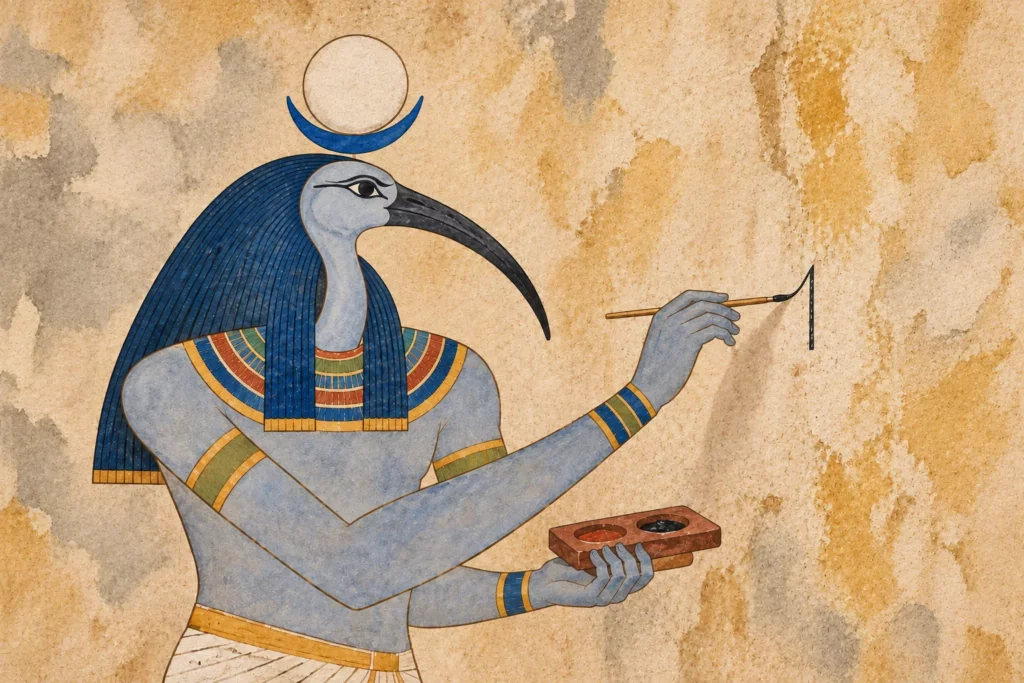
Thoth, lord of the divine words
The Egyptians called hieroglyphs medu-netjer, ‘divine words’, and gave Thoth the title of neb medu-netjer, their lord. The god appears in the form of the ibis or the baboon. He is the lord of Hermopolis (ancient Khemenu) and, as a lunar god, he measures time.
Thoth records the judgement of the dead, keeps the annals and drafts the decrees of the Ennead. Human scribes seek his protection. The statue of Nebmerutef in the Louvre (E 11154) shows one of them busy writing at the feet of a baboon of the god. The relationship between the scribe’s work and his protector is written into the arrangement of the figures.
The story of a god offering his invention to humankind is not the same as this patronage. Egyptian sources make Thoth the lord of writing. The episode of the invention presented to a king is known above all from Plato, in a Greek story that we shall come back to further on.
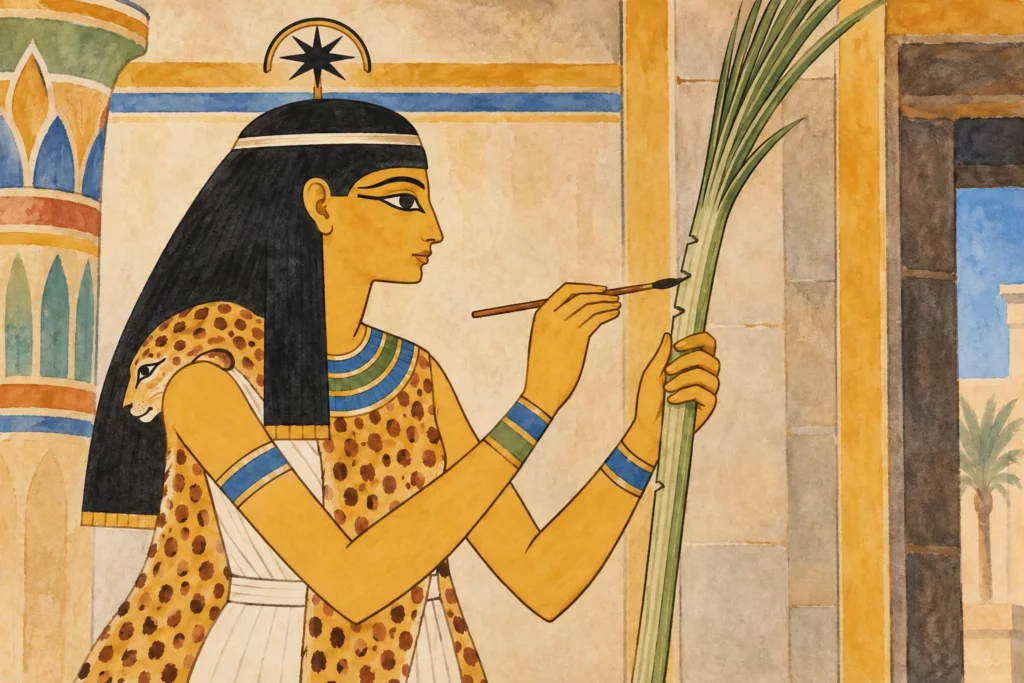
Seshat, lady of writings
Seshat is ‘she who presides over the house of books’. She wears a leopard skin and a seven-pointed emblem beneath a bow. The palm rib she holds is used to record the years of the reign.
A granite door jamb of Khasekhemwy, found at Hierakonpolis and kept in the Egyptian Museum in Cairo (JE 33896), attests Seshat as early as the 2nd Dynasty. She accompanies the king during the ‘stretching of the cord’, the rite that prepares the foundation of a temple. Measuring the ground, drawing the plan and recording the years are among her functions. In this way she contributes to the order of Maat.
Living signs
In the pyramid of Unas and those of his successors, some hieroglyphs depicting dangerous animals were mutilated. Snakes are cut in two, animals deprived of their legs. These precautions were meant to stop the figures from harming the dead king. The engraver therefore had to take into account what a sign could do, as much as what it allowed one to read.
The name, ren, must be preserved and spoken to keep its bearer present. Hammering it out helps to erase that presence. The names of Hatshepsut and Akhenaten, chiselled out after their reigns, bear witness to this. Their destruction sometimes leaves enough traces for us still to recognise the person who was meant to disappear.
The sign for the scribe depicts his equipment: palette, water and brush case. In early times, the rush was prepared to serve as a brush. The calamus, a reed cut to a point, appears only later, in the Ptolemaic period. The title of the article recalls this long history; to understand a particular depiction, you have to look at which tool is held in the hand.
The Greek view: Theuth and Thamus
In the Phaedrus (274c–275b), around 370 BC, Plato tells how Theuth presents his inventions to King Thamus, who is likened to Amun. The god offers writing as a remedy for memory. The king fears, on the contrary, that people will rely on external marks, stop remembering and mistake the appearance of knowledge for knowledge itself.
The scene is Greek, despite its Egyptian setting. The disagreement between Theuth and Thamus nevertheless raises a question that will come back at the end of this series: does keeping words help us understand what they say? A text that is available may still demand a great deal of work from the person who reads it. The translations proposed by machines will bring us back to this difficulty.
From myth to excavation
To find the material beginnings of writing, we have to go back well before these accounts. Naqada pottery already bears boats, animals and repeated emblems. The article ‘Before writing’ examines these images and the precautions needed when comparing them with the first signs.
Sources
- Serge Sauneron and Jean Yoyotte, ‘La naissance du monde selon l’Égypte ancienne’, Sources orientales 1, Paris, Seuil, 1959 (in French).
- Susanne Bickel, La cosmogonie égyptienne avant le Nouvel Empire, OBO 134, Fribourg, 1994 (in French).
- Friedrich Junge, ‘Zur Fehldatierung des sog. Denkmals memphitischer Theologie oder Der Beitrag der ägyptischen Theologie zur Geistesgeschichte der Spätzeit’, Mitteilungen des Deutschen Archäologischen Instituts, Abteilung Kairo 29, 1973, pp. 195–204.
- Reginald Engelbach, ‘A Foundation Scene of the Second Dynasty’, Journal of Egyptian Archaeology 20, 1934, pp. 183–184.
- Claire Lalouette, Textes sacrés et textes profanes de l’ancienne Égypte, Paris, Gallimard, 1984–1987 (in French).
- Plato, Phèdre, trans. Luc Brisson, Paris, GF-Flammarion, 1989 (in French).