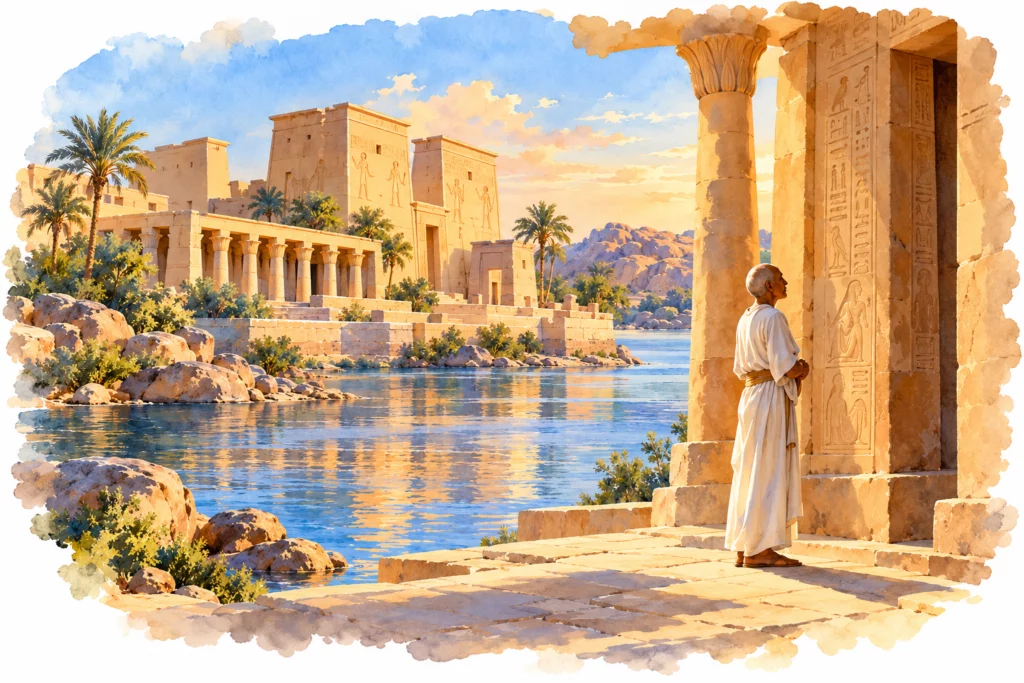
At Philae, an inscription next to a figure of Mandulis is dated 24 August 394. No later dated hieroglyphic text is known. This last piece of evidence does not mean that all readers vanished on that day: the abandonment of the script went hand in hand, over several centuries, with changes in its uses and in the institutions that passed it on.
| Date | Event |
|---|---|
| 332 BC | Alexander in Egypt; Greek becomes the language of power |
| 30 BC | Egypt becomes a Roman province |
| 391–392 | Edicts of Theodosius banning pagan cults |
| 24 August 394 | Last dated hieroglyphic inscription, Philae |
| 12 December 452 | Last dated Demotic graffito, Philae |
| c. 535–537 | Closure of the temple of Isis at Philae on Justinian’s orders |
| 641–642 | Arab conquest of Egypt |
| c. 706 | Arabic becomes the language of the administration |
A slow fading
The disappearance of hieroglyphs was centuries in the making. Under the Ptolemies, Greek became the language of power, while Demotic continued to be used for contracts and local life. Monumental writing remained linked above all to the temples. A career in the administration now required a knowledge of Greek.
Under Rome, the resources and privileges of the temples were gradually reduced. The great decoration projects, such as those at Esna, came to a halt around the middle of the 3rd century. Training and maintaining a literate staff became more difficult.
The spread of Christianity also changed religious practice. The edicts of Theodosius, in 391–392, banned sacrifices in particular and tightened the restrictions on pagan cults. The Serapeum of Alexandria was destroyed in 391. How these measures were applied, and what changed, varied from place to place: these dates do not describe a simultaneous closure of every Egyptian sanctuary.
Documents cited: Ptolemaic hieroglyphs
Philae, the last sanctuary
Philae held a special place on the Nubian frontier. The temple of Isis was visited by neighbouring peoples, notably the Blemmyes and the Noubades, with whom Rome had to come to terms. The cult survived there longer than in many other sanctuaries.
On the gate of Hadrian, two columns of hieroglyphs accompany the invocation of Mandulis in the name of Nesmeterakhem, also transcribed Esmet-Akhom. The nearby Demotic text gives the birthday of Osiris in year 110 of the era of Diocletian, that is, 24 August 394. The last known dated Demotic evidence also belongs to Philae: a graffito on the second pylon bears the date 12 December 452.
Procopius reports that Justinian had the temple closed, its priests imprisoned and its statues taken to Constantinople, around 535–537. This decision was long presented as the end of Egyptian religion. The research of Jitse Dijkstra places the episode within an earlier decline of the cult and its staff. The closure completed a transformation that was already under way.
The temple was then turned into a Christian place of worship. Between 1972 and 1980, UNESCO’s international campaign made it possible to dismantle it and rebuild it on the neighbouring island of Agilkia, safe from the waters. The inscriptions that can be seen there have thus survived several changes of use and the moving of the monuments.

Documents cited: Everyday scripts
Coptic, the last form of Egyptian
Hieroglyphs ceased to be used, but the Egyptian language continued. Coptic records it with the twenty-four Greek letters, supplemented by six or seven signs derived from Demotic, depending on the dialect. Vowels become visible, which would give modern readers essential clues.
So-called ‘Old Coptic’ attempts appear in the 2nd and 3rd centuries in magical and astrological texts. Coptic then developed in Christian communities and monasteries. It carried Bible translations, sermons, lives of saints and letters. Shenoute, abbot of the White Monastery near Sohag, who died around 465, is one of its great authors. The Nag Hammadi codices, discovered in 1945, preserve Gnostic texts copied in Coptic in the 4th century.
After the Arab conquest of 641–642, Greek and Coptic remained in use in the administration for a time. Arabic became the language of the offices around 706. The decline of spoken Coptic was much slower and its last stages remain hard to date; its survival until the 17th century in some villages of Upper Egypt is often suggested.
Coptic is still a liturgical language of the Coptic Orthodox Church today. This last form of Egyptian preserves words and clues to pronunciation that were essential for decipherment. Champollion would draw on his knowledge of Coptic to recover the language behind the hieroglyphs.
Towards the centuries of errors
When the reading of hieroglyphs was no longer passed on, their forms went on prompting interpretations. The animals and objects depicted invited people to look for symbols, at the risk of overlooking the sounds they recorded. ‘Thirteen centuries of errors’ examines this history and the insights that would prepare the way for decipherment.
See: Thirteen centuries of errors
Sources
- Jitse H. F. Dijkstra, Philae and the End of Ancient Egyptian Religion. A Regional Study of Religious Transformation (298–642 CE), Leuven, Peeters, OLA 173, 2008.
- Roger S. Bagnall, Egypt in Late Antiquity, Princeton University Press, 1993.
- Eugene Cruz-Uribe, ‘The death of demotic at Philae, a study in pilgrimage and politics’, in Studies in Honor of László Török, Budapest, 2010.
- Christian Cannuyer, Les Coptes, Turnhout, Brepols, ‘Fils d’Abraham’ series, 1990 (in French).