The accounts, letters and exercises that survive look little like temple inscriptions. They are written on papyrus, limestone flakes or potsherds. The hand shortens the forms and joins some signs. Hieratic, then Demotic, thus give access to documents whose preparation did not require the work of a carved wall.
Hieroglyphs, hieratic and Demotic coexisted for long periods. The table gives their main fields of use; the chronological limits remain benchmarks, since practices changed from place to place and from one milieu to another.
| Script | Period | Region | Main uses | Media |
|---|---|---|---|---|
| Hieroglyphs | c. 3300–3200 BC – AD 394 | all of Egypt | monuments, sacred texts, prestige objects | stone, wood, painted walls |
| Hieratic | c. 3000 BC – 3rd century AD | all of Egypt | administration, letters, literature, then religious texts | papyrus, ostraca, tablets |
| Abnormal hieratic | c. 722–535 BC | Upper Egypt, especially Thebes | contracts, legal deeds | papyrus |
| Demotic | c. 650 BC – AD 452 | all of Egypt | administration, law, letters, literature | papyrus, ostraca, stone |
Hieratic, the scribes’ cursive
Hieratic uses the same principles as hieroglyphs, with forms simplified so that they can be drawn quickly. Some ink marks on jars bear witness to it from the very beginning. Signs can be joined and become hard to separate. The reader has to recognise the habits of a hand as well as the words written.
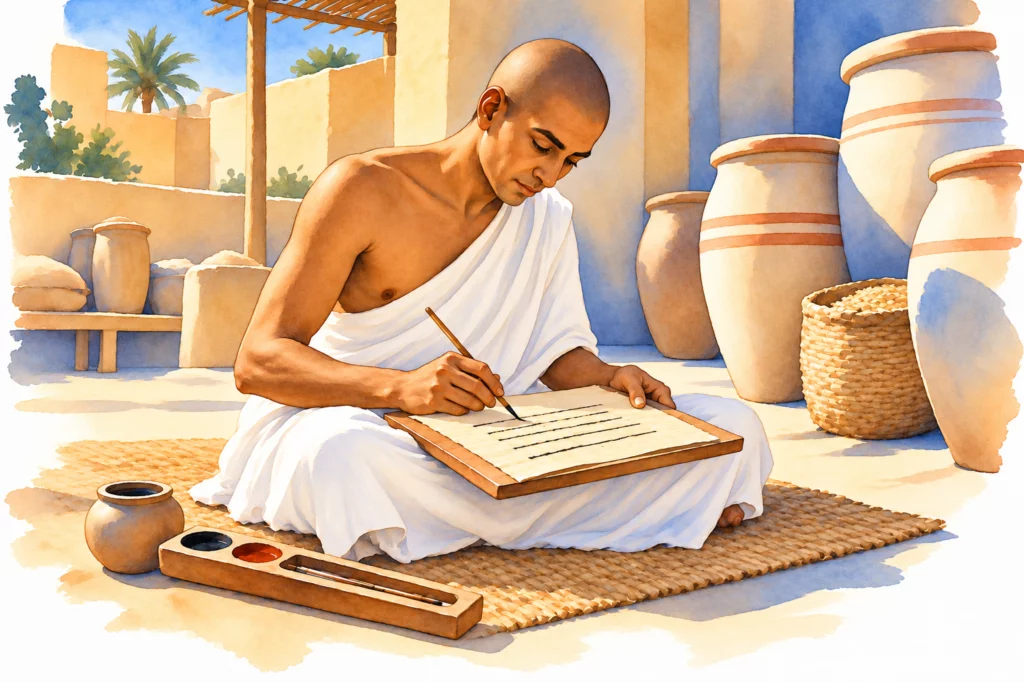
The scribe first used a rush whose end was prepared as a brush; the reed cut to a point appeared later, in the Greek period. On his palette, carbon black was used for the running text and red ochre for titles, the beginnings of sections or corrections. The text is read from right to left. The columns of early documents gradually gave way to horizontal lines, which became the rule in the Middle Kingdom.
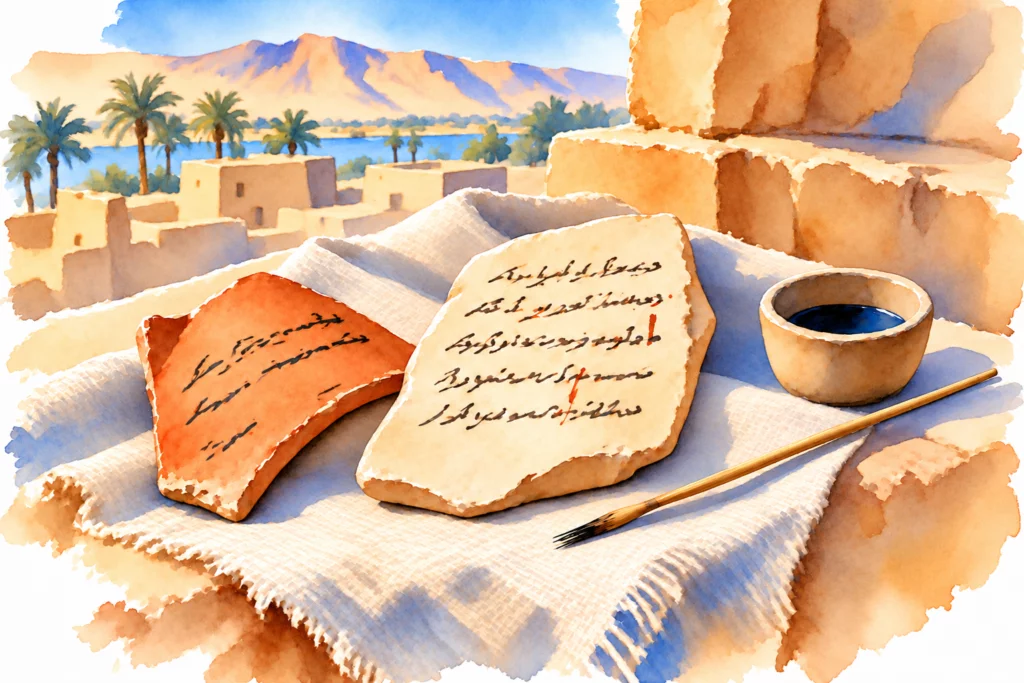
The medium depended on the document and the means available. Papyrus was precious. For an exercise, a note or a draft, a potsherd, a limestone flake or a wooden tablet coated with plaster could be enough. These ostraca have preserved for us writings to which their very modesty now lends a particular interest.
The papyri discovered in 2013 at Wadi el-Jarf by the Franco-Egyptian mission led by Pierre Tallet date from the end of the reign of Cheops, around 2550 BC. They are the oldest inscribed papyri known. In them, the inspector Merer records the days spent carrying limestone from Tura to the building site of the Great Pyramid. The journal lets us follow part of the organisation of work that the finished monument no longer shows.
Hieratic gives access to very different fields: the archives of the mortuary temple of Neferirkare at Abusir, stories such as Sinuhe, the teachings of the Prisse Papyrus, medical and mathematical texts. At Deir el-Medina, ostraca carry accounts, letters and exercises. After the rise of Demotic, its uses became more concentrated in religious texts. The Greek name of ‘priestly’ script, used by Clement of Alexandria around AD 200, matches what he could observe at the time, without summing up the three preceding millennia.
Documents cited: How hieroglyphs work
Abnormal hieratic, the cursive of Thebes
Under the 25th and 26th Dynasties, contracts from Upper Egypt, especially from Thebes, took a particularly abbreviated form. The first Egyptologists called it ‘abnormal hieratic’, so much did its ligatures and the variations between hands baffle their reading. The name also tells of a modern difficulty in front of these documents.
This cursive coexisted with the Demotic that came from the north before being replaced by it. A Theban document kept in Cairo is dated 544 BC; a witness’s signature on a papyrus in the Louvre still attests its use in 535. These last examples allow us to follow a transition, rather than to fix a day when all scribes would have changed their way of writing.
Demotic, the script of a kingdom
Around 650 BC, under Psamtik I, the Saite administration used in Lower Egypt a cursive that would spread throughout the country. Demotic became a common script, used for nearly a thousand years. Its name also refers to the stage of the language it records, closer to spoken usage than the classical Egyptian of learned inscriptions.
Herodotus contrasts ‘popular’ script, dēmotika, with sacred script. The Egyptians spoke of ‘document writing’, sš šʿt. Marriage, sale and lease contracts, letters, administrative texts and literature all found a place in it. The tales of Setne Khamwas and the Instruction of Ankhsheshonqy remind us that these highly abbreviated signs also carried stories.
The Rosetta Stone gives us a famous example: Demotic fills the middle register of the Memphis decree of 196 BC. Under Roman rule, its uses retreated before Greek and narrowed down around the temples. The last known dated Demotic graffito, at Philae, bears the date 12 December 452.
Coptic, whose first developments go back to the first centuries AD, also records the Egyptian language, with an alphabet that is mainly Greek, supplemented by signs of Demotic origin. At first it coexisted with the older scripts.
One language, several hands
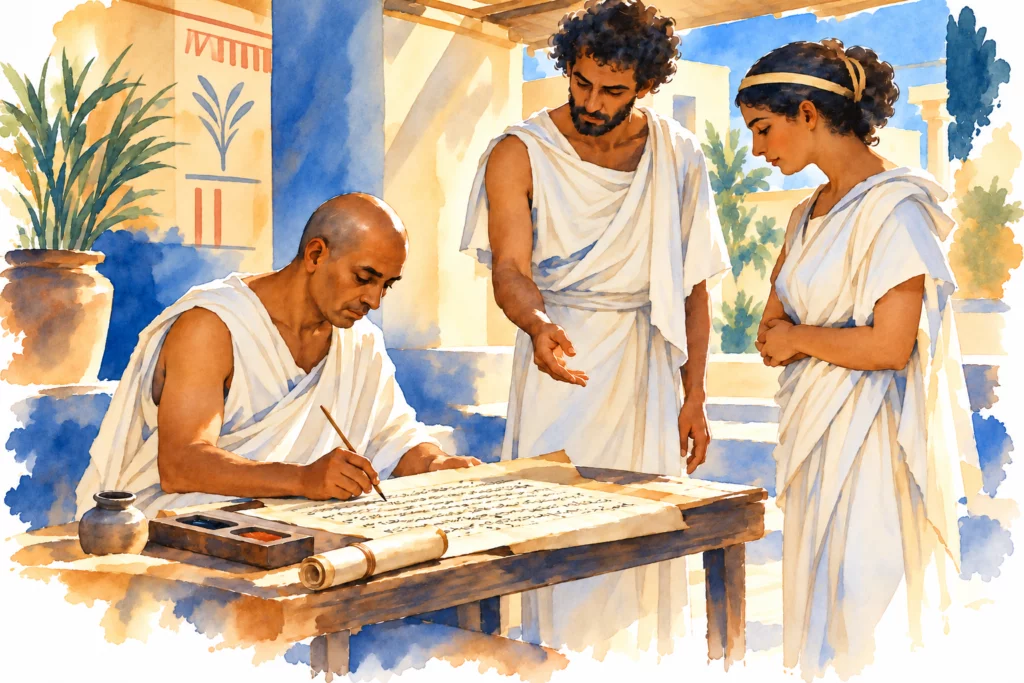
In the Ptolemaic period, a priest could use hieroglyphs for an inscription, copy a ritual in hieratic and draw up a contract in Demotic. The scripts coexisted, with different uses. Their dates of appearance should not suggest that each one immediately replaced the one before.
Demotic now has a major tool, the Chicago Demotic Dictionary. Yet the cursives still resist readers, and even more so automatic recognition programs: hands vary, signs touch, and the media are often damaged. Researchers have to return to each document with its own particularities.
Documents cited: Artificial intelligence
Towards the world of the scribes
The scribe’s quick hand was acquired through copying, corrections and familiarity with texts. The exercises on ostraca let us recover part of this training. They lead us to the next article, devoted to scribes and the House of Life.
See: The scribe and the House of Life
Sources
- Georg Möller, Hieratische Paläographie, 3 vols, Leipzig, 1909–1912.
- Pierre Tallet, Les papyrus de la mer Rouge I. Le ‘journal de Merer’, Cairo, IFAO, MIFAO 136, 2017 (in French).
- Michel Chauveau, L’Égypte au temps de Cléopâtre, Paris, Hachette, 1997 (in French).
- Ali Hamdy Abu Hamed, comparative study of abnormal hieratic and early Demotic, BIFAO 125, 2025, pp. 207–234.
- Janet H. Johnson (ed.), The Demotic Dictionary of the Oriental Institute of the University of Chicago, Chicago, 2001–.
- British Museum, Hieroglyphs: unlocking ancient Egypt, large-print guide, 2022, pp. 10–11 and 100–101 on the origins of Coptic; pp. 106–107 on the beginnings of Egyptian writing.