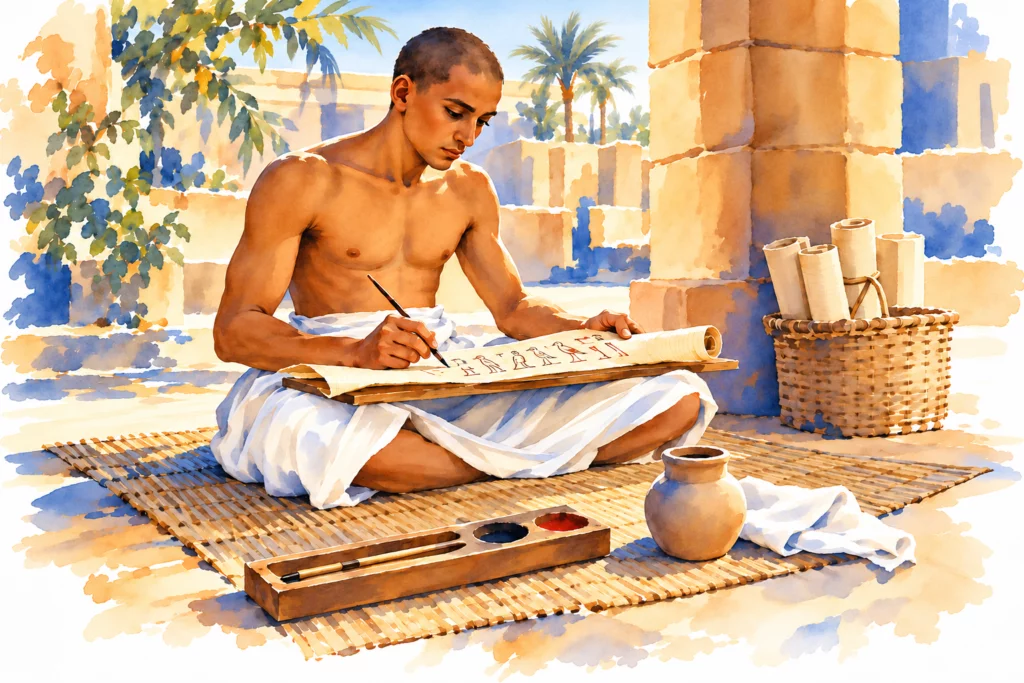
The papyrus unrolled across the knees and the palette make the figure of the scribe recognisable. This image may be that of a high official, and the title covers very different posts. Knowing how to write gave access to jobs in the administration and the temples, in a society where this skill remained uncommon.
The scribe, a man of the state
The wooden palette has two wells for black and red inks and a slot for the rushes. A little pigment and water complete the equipment. It is distinctive enough to provide the sign Y3, used for the scribe and for the act of writing.
The Seated Scribe in the Louvre was discovered at Saqqara by Auguste Mariette in 1850. It is dated to the 4th or 5th Dynasty. High officials chose this posture for their portraits: the roll and the working pose signal their competence and their place close to power. So the figure does not simply suggest a humble clerk.
Scribal titles concern the fields, the treasury, the army and the temples. They can refer to a local agent as well as to a senior official, up to the royal scribes and the overseers of scribes. Posts and knowledge were often handed down within families.
Thoth protects this work; some statues pair a scribe with the god’s baboon. Imhotep, Djoser’s architect, became in the New Kingdom a model of wisdom for the literate, before his deification in the Late Period. These figures tell us what the scribes recognised as an authority within their own tradition.
Documents cited: The Word and the reed pen
Learning to write
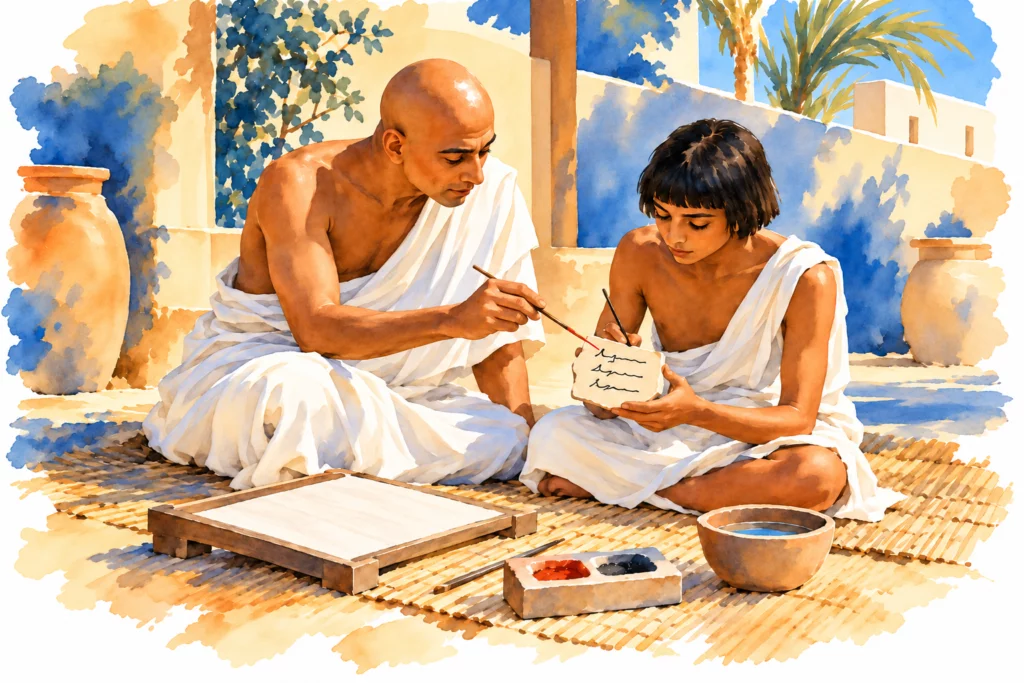
A scribe father could train his son and pass his post on to him. From the Middle Kingdom onwards, texts also mention a ‘house of instruction’, ʿt sbꜣ, attached to the palace, a temple or an administration. No school building has been identified with certainty. The exercises mainly tell us about the work between a master and his pupils.
Pupils first learnt the useful script, hieratic. Model texts were copied and recited in sections; corrections appear in red on tablets or ostraca. The discipline described is harsh. The saying that a boy’s ear is on his back states plainly how much room was given to punishment.
| Text | Date of composition | Content | Use in teaching |
|---|---|---|---|
| Kemyt, ‘the Compendium’ | Middle Kingdom (12th Dynasty) | letter formulas, vocabulary, praise of the scribe’s profession | first textbook, written in columns in an archaising hand; many copies at Deir el-Medina (19th–20th Dynasties) |
| Teaching of Khety or Satire of the Trades | Middle Kingdom | a father takes his son to school and describes to him the misery of every other trade | a text to motivate pupils, much copied in the New Kingdom |
| Miscellanies | New Kingdom (Ramesside period) | collections of model letters, lists, exhortations to become a scribe | training of the administration’s scribes |
The Kemyt brings together letter formulas, vocabulary and praise of the profession. Georges Posener reconstructed it from copies on ostraca. The Teaching of Khety, or Satire of the Trades, presents a father who takes his son to school and describes to him the hardships of other professions. The Ramesside miscellanies offer model letters, lists and exhortations to become a scribe. These exercises trained pupils in the language while reinforcing the flattering image of the profession.
The House of Life, a workshop of sacred knowledge
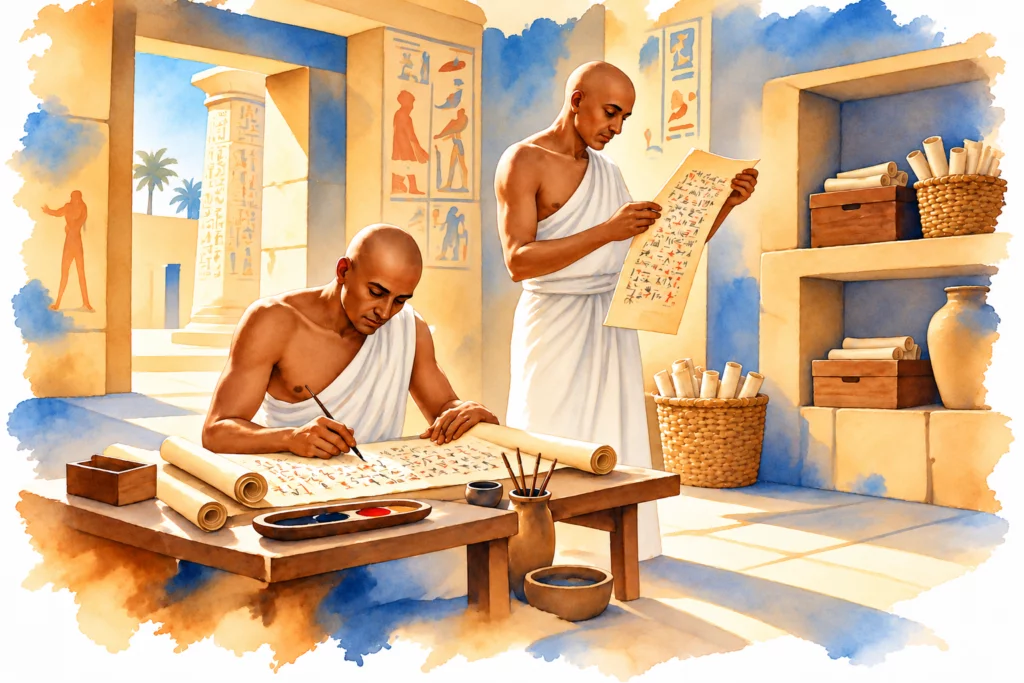
The House of Life, pr-ʿnḫ, brought together, near the great temples, scholars who composed, copied and kept the texts. Rituals, hymns, funerary writings, medicine, astronomy and dream interpretation belonged to this learned work. It combined the functions of a library and a workshop; reducing it to a school for beginners would miss most of its activity.
On a stela at Abydos, Ramses IV states that he studied its writings in order to know the gods. The study published by Alan Gardiner in 1938 remains a landmark for understanding the institution, whose evidence has to be placed back in its own periods.
On his statue in the Vatican, the physician Udjahorresnet tells of a restoration of the House of Life at Sais. After serving the last Saite kings, then Cambyses and Darius I, he is said to have been sent back to Egypt by Darius, around 519 BC, to re-establish it. He describes the admission of pupils from good families and the means put at their disposal. His account shows the political value placed on passing on this knowledge, even under Persian rule.
Who could read?
The estimate put forward in 1983 by John Baines and Christopher Eyre is often quoted: about one per cent of the Old Kingdom population could read and write. The figure is not a census. It rests on the traces available and is still debated; it does not apply indiscriminately to all periods or all regions.
Skills ranged from recognising a name or a formula to reading a contract or a ritual through. They did not all require the same training. A reader of everyday documents did not necessarily master the learned inscriptions of the temples.
Deir el-Medina is a remarkable case. The thousands of ostraca from the village of the craftsmen of the royal tombs carry letters, exercises, accounts and literary texts. They bear witness to a familiarity with writing among a notable share of the workmen and draughtsmen. Letters were exchanged between women; we do not always know whether they wrote them themselves or dictated them. Women explicitly bearing the title of scribe are rare in the sources.
The lector priest recited the rituals, decrees were proclaimed and letters could be read aloud to their recipients. A person who could not read could therefore learn the content of a document through someone’s voice. This oral use played a part in the transmission of texts, alongside the differences in skill that the sources allow us to glimpse.
Towards the priests’ hieroglyphs
Under the Ptolemies, temple scholars developed increasingly learned hieroglyphic compositions, while the administration used Greek and Demotic. Reading them requires knowledge of the texts and of the particular uses of the signs. The next article returns to this work.
Sources
- John Baines and Christopher Eyre, ‘Four notes on literacy’, Göttinger Miszellen 61, 1983, pp. 65–96.
- Alan H. Gardiner, ‘The House of Life’, Journal of Egyptian Archaeology 24, 1938, pp. 157–179.
- Georges Posener, Catalogue des ostraca hiératiques littéraires de Deir el-Médineh, Cairo, IFAO, 1938–1980 (in French).
- Pascal Vernus, Sagesses de l’Égypte pharaonique, Paris, Imprimerie nationale, 2001 (in French).
- Georges Posener, La première domination perse en Égypte, Cairo, IFAO, 1936 (in French).
- UCL Digital Egypt for Universities, entry Kemyt.