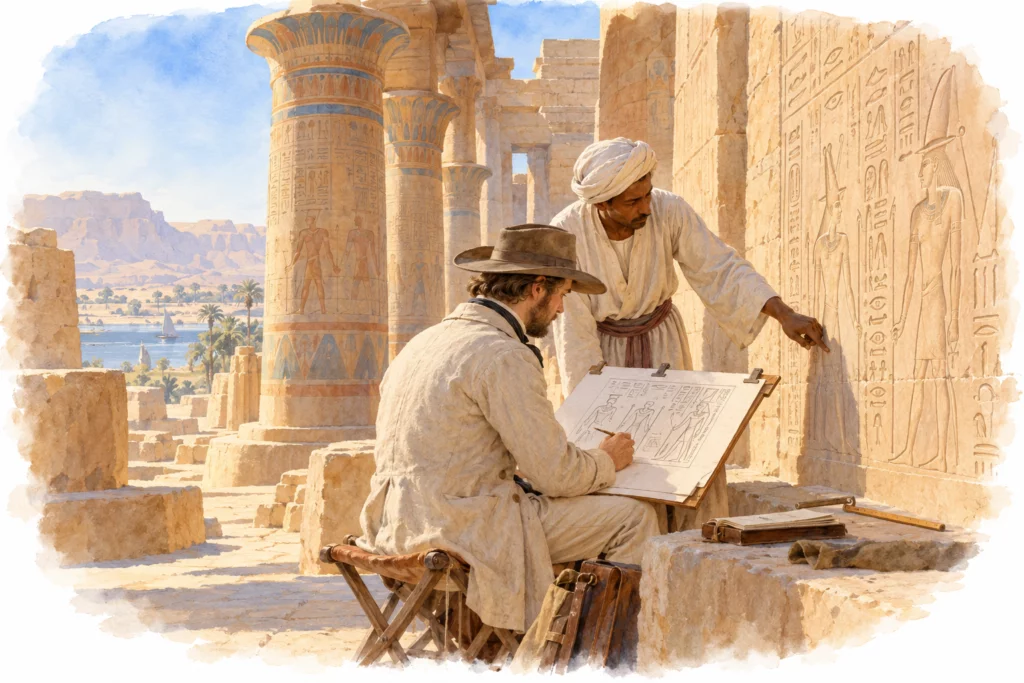
After Champollion’s death in 1832, the readings still had to be checked and completed. Texts multiplied with recording work and excavations. Grammars, dictionaries and editions would gradually make it possible to study them with shared references. This work went on for decades, in several countries.
| Date | Milestone |
|---|---|
| 1837 | Letter from Karl Richard Lepsius to Rosellini on the hieroglyphic alphabet |
| 1842–1845 | Lepsius’s Prussian expedition to Egypt and Sudan |
| 1855 | Grammaire démotique by Heinrich Brugsch |
| 1858 | Auguste Mariette founds the Egyptian Antiquities Service |
| 1866 | Discovery of the Canopus decree at Tanis |
| 1880 | Foundation of the Mission archéologique française du Caire, the future IFAO |
| 1926–1931 | Wörterbuch der ägyptischen Sprache by Adolf Erman and Hermann Grapow |
| 1927 | Egyptian Grammar by Alan Gardiner |
Confirming Champollion
In 1837, Karl Richard Lepsius published a letter to Ippolito Rosellini that clarified Champollion’s system. Many signs carry two or three consonants. By distinguishing these uses, he made the explanation of spellings more coherent and answered certain objections.
Lepsius led the Prussian expedition to Egypt and Sudan from 1842 to 1845. The twelve volumes of the Denkmäler aus Aegypten und Aethiopien appeared between 1849 and 1859. They document monuments, some of which have since suffered or disappeared. These records still allow us to consult inscriptions and details that can no longer be found on site.
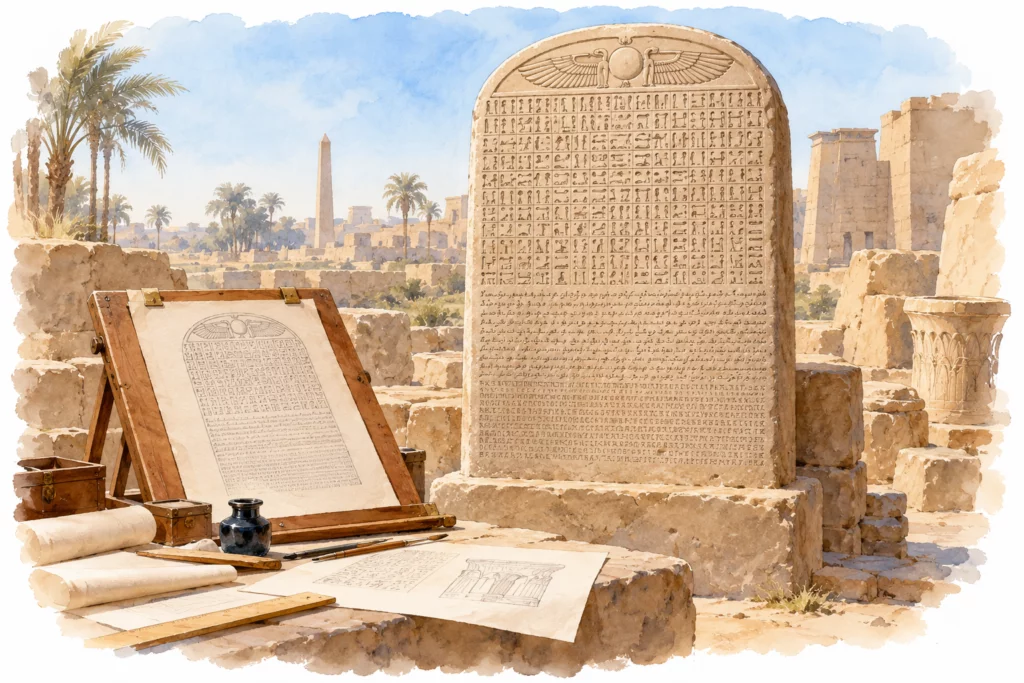
At Tanis, in 1866, the discovery of the Canopus decree provided a new comparison. The decree of Ptolemy III, dated 238 BC, is inscribed in hieroglyphs, Demotic and Greek. Better preserved than that of Rosetta, its hieroglyphic version could be read with the method of decipherment. The check concerned another text, without depending on the same damaged passages.
In France, Emmanuel de Rougé, curator at the Louvre and then professor at the Collège de France, worked on continuous translations and trained researchers. Egyptology was thus built up through reading, teaching and the discussion of documents.
Documents cited: How hieroglyphs work
Reading Demotic: Brugsch
The highly cursive forms of Demotic call for special study. Heinrich Brugsch published a Grammaire démotique in French in 1855, then his hieroglyphic-Demotic dictionary between 1867 and 1882. Contracts, letters and other documents of the Late Period and the Graeco-Roman period gradually became accessible.
The contracts and letters made readable by this research widened the sources available. They tell us about transactions, obligations and relationships between people of whom the royal monuments say little.
Documents cited: Everyday scripts
Excavating, preserving, publishing: Mariette, Maspero and the IFAO
Auguste Mariette uncovered the Serapeum at Saqqara, then founded the Antiquities Service in 1858. The Bulaq museum gave a home to the collections that foreshadowed the Egyptian Museum in Cairo. Organising conservation on site became a major issue, even though the history of these institutions remains bound up with the political relations of their time.
Gaston Maspero succeeded him. The exploration of the pyramids of Saqqara in 1881 made the Pyramid Texts accessible. He published them; Kurt Sethe would produce a reference edition between 1908 and 1922. The carved sentences could now be compared from one monument to another.
The Mission archéologique française set up in Cairo in 1880 became the Institut français d’archéologie orientale (IFAO, French Institute of Oriental Archaeology) in 1898. Housed in the Mounira palace since 1907, the IFAO publishes the BIFAO and scholarly series, records temples and carries out excavations. At Deir el-Medina, Bernard Bruyère’s campaigns, from 1922 to 1951, uncovered in particular the documents of the craftsmen’s village. Excavating produces new texts; publishing them allows others to read them.
Documents cited: Ptolemaic hieroglyphs · The scribe and the House of Life
Gathering the language: the Berlin dictionary
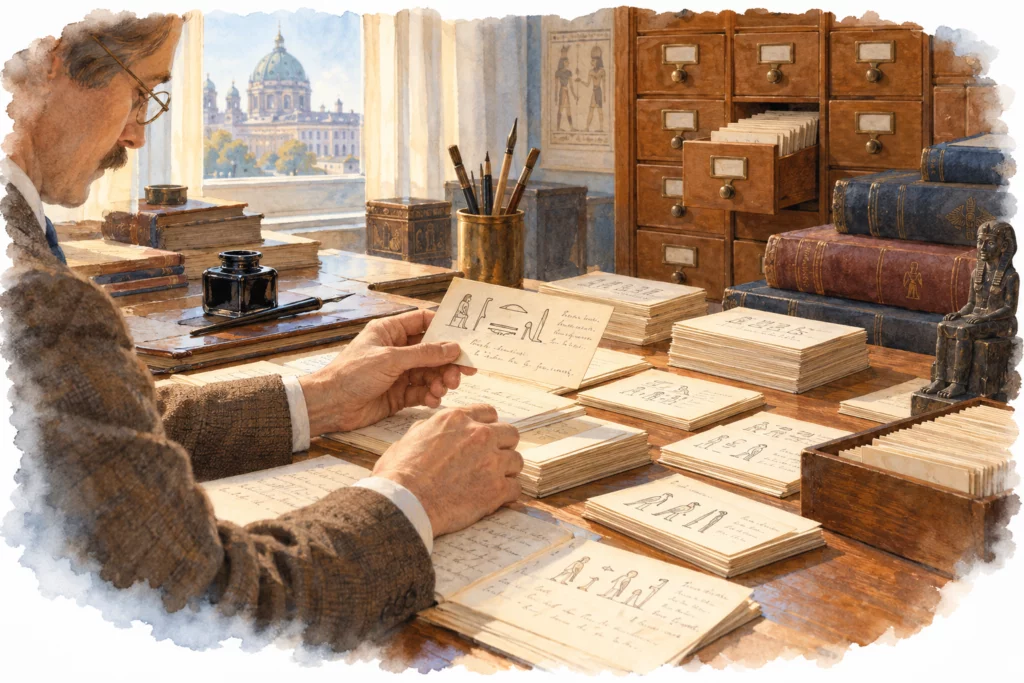
In 1897, Adolf Erman launched a project to record the words in Egyptian texts. For decades, researchers from several countries filled in some one and a half million slips. Each attestation gives the word a context, a spelling and a place in a document.
The Wörterbuch der ägyptischen Sprache appeared under the names of Erman and Grapow, in five main volumes, from 1926 to 1931. The attestations gathered on the slips make it possible to examine the uses of a word across several texts. The dictionary remains a foundation of lexical research, extended today by digital resources.
Teaching the language: Gardiner and Lefebvre
Alan Gardiner’s Egyptian Grammar, published in 1927, provides a textbook and a list of signs classified into twenty-six categories. Codes such as G1 for the vulture come from this classification. They allow researchers to refer to a sign without depending on the way each of them draws it.
Gustave Lefebvre’s Grammaire de l’égyptien classique, published by the IFAO in 1940, in turn became a reference textbook in French. Later generations relied on these works and discussed some of their analyses in the light of other texts.
The great tools at a glance
The works gathered in the table serve different purposes. Records give access to the monuments; editions organise the witnesses; grammars and dictionaries help to build a reading. Using them always means going back to the document under study.
| Tool | Author | Date | What it provides |
|---|---|---|---|
| Précis du système hiéroglyphique | Champollion | 1824 | the key to the system |
| Letter to Rosellini | Lepsius | 1837 | biliterals and triliterals, a coherent system |
| Denkmäler aus Aegypten und Aethiopien | Lepsius | 1849–1859 | records of the monuments |
| Grammaire démotique | Brugsch | 1855 | reading Demotic |
| Die altaegyptischen Pyramidentexte | Sethe | 1908–1922 | edition of the Pyramid Texts |
| Wörterbuch der ägyptischen Sprache | Erman and Grapow | 1926–1931 | the complete vocabulary |
| Egyptian Grammar | Gardiner | 1927 | reference grammar and sign list |
| Grammaire de l’égyptien classique | Lefebvre | 1940 | reference textbook in French |
Towards the digital age
From the 1980s onwards, signs, texts and the old slips began to be entered into computers. The change concerned how they were entered, consulted and compared. The next stage shows how these resources became accessible on screen.
Documents cited: The digital age
Sources
- Jean Vercoutter, À la recherche de l’Égypte oubliée, Paris, Gallimard, ‘Découvertes’ series, 1986 (in French).
- Morris L. Bierbrier, Who Was Who in Egyptology, 5th edn, London, Egypt Exploration Society, 2019.
- Jason Thompson, Wonderful Things. A History of Egyptology, 3 vols, Cairo, American University in Cairo Press, 2015–2018.
- Adolf Erman and Hermann Grapow, Wörterbuch der ägyptischen Sprache, Leipzig then Berlin, 1926–1963.
- IFAO, official website, presentation and history of the institute.